
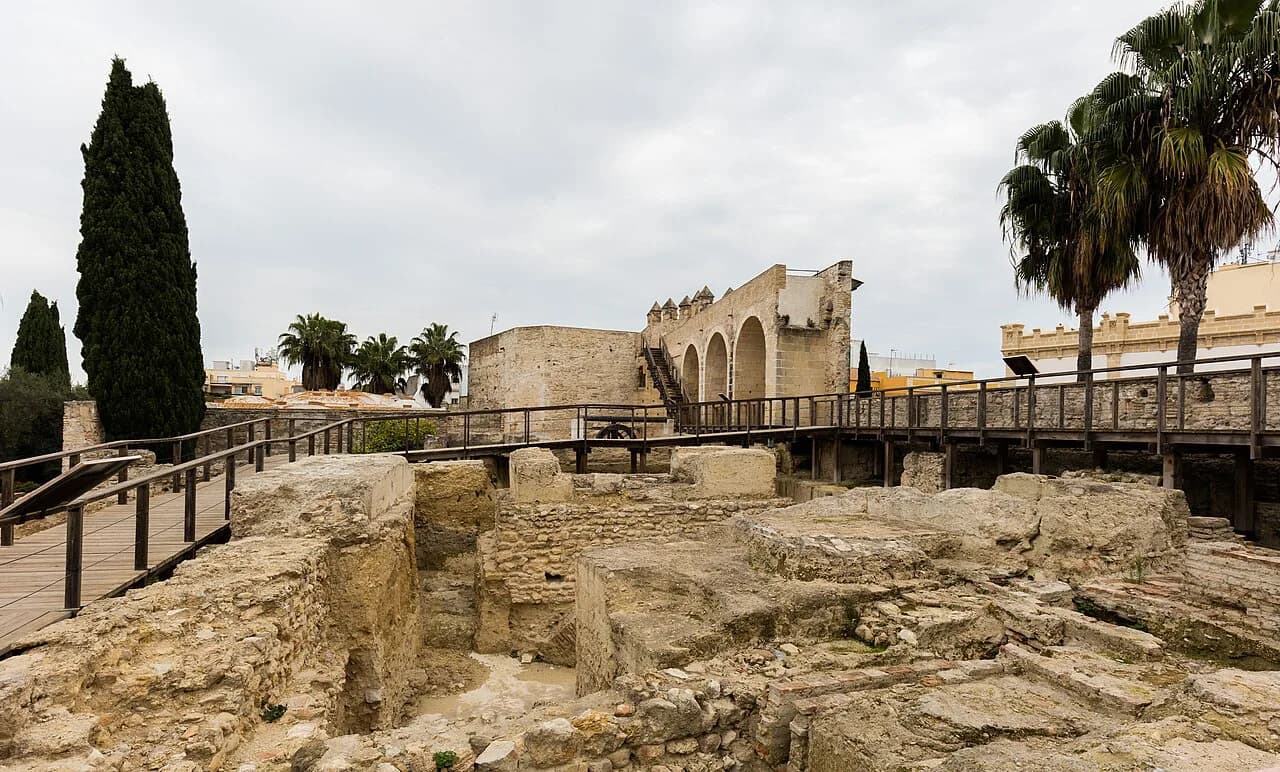
Alcázar de Jerez: what to see inside the fortress

The Alcázar de Jerez is a 12th-century Almohad fortress and governors' residence on Alameda Vieja, and it visits as one compact monument rather than a scattered set of sights. Allow roughly an hour and a half for the full circuit, more if you linger in the gardens or the towers. This guide follows the order of the complex, from the defences and the Moorish core to the Christian and baroque layers on top.
What makes the site unusual is how openly it wears its history: an Almohad fortress, a Christian seat of power and a baroque palace sit inside the same walls. Reading it in sequence, rather than as a jumble of rooms, is the difference between a quick photo stop and a satisfying visit.
Where the Alcázar is and how to reach it
The entrance is on Alameda Vieja, on the western edge of the old town, where the fortress walls meet a broad tree-lined square. The municipal tourist office sits at Plaza del Arenal in the Edificio Los Arcos, a short walk east and a useful orientation point before or after the visit.
On foot, most of the historic centre is within fifteen to twenty minutes of the gate, so the Alcázar slots easily into a morning or late afternoon. Jerez is an inland Andalusian city, and the exposed Alameda Vieja outside and the open courtyards inside make midday summer heat a real consideration.
The Alcázar answers visitor enquiries on 956 149 955 and 956 149 956 or at info.visitas.alcazar@aytojerez.es, the contacts published for the monument; the municipal tourist office at Edificio Los Arcos, Plaza del Arenal, also handles tourist information on 956 14 98 63.

How much time to allow
Budget about ninety minutes to two hours. The official route lists sixteen stops, and although several are courtyards and short passages, the towers, the palace rooms and the two permanent exhibitions reward a slower pace.
If your time in Jerez is tight, the essential sequence is the Patio de Armas, the mosque, the Arab baths, a tower for the view and the Villavicencio palace. The gardens, the olive mill and the archaeological zone are the parts to trim first, not the core.

The Almohad core: courtyard, mosque and baths
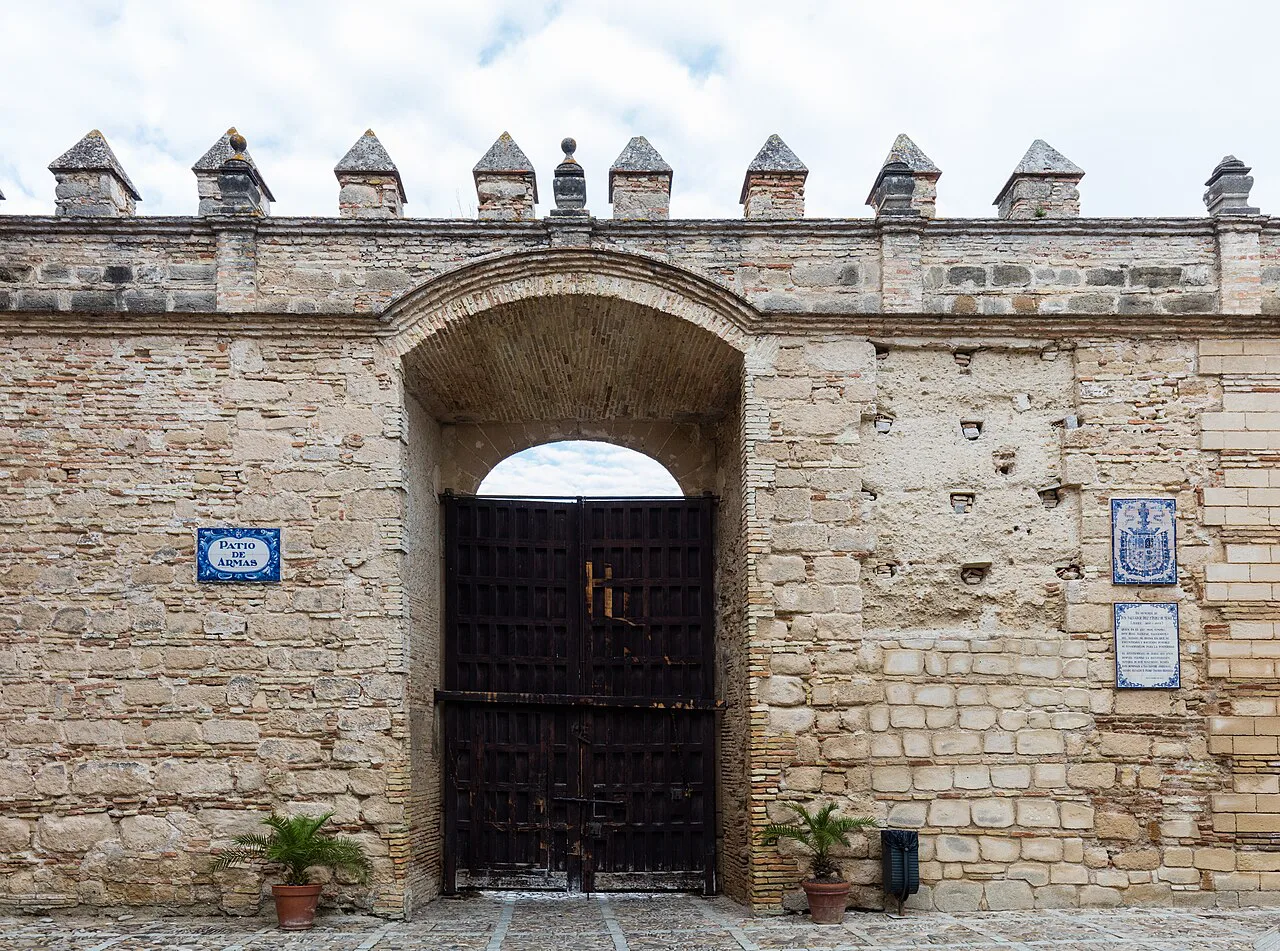
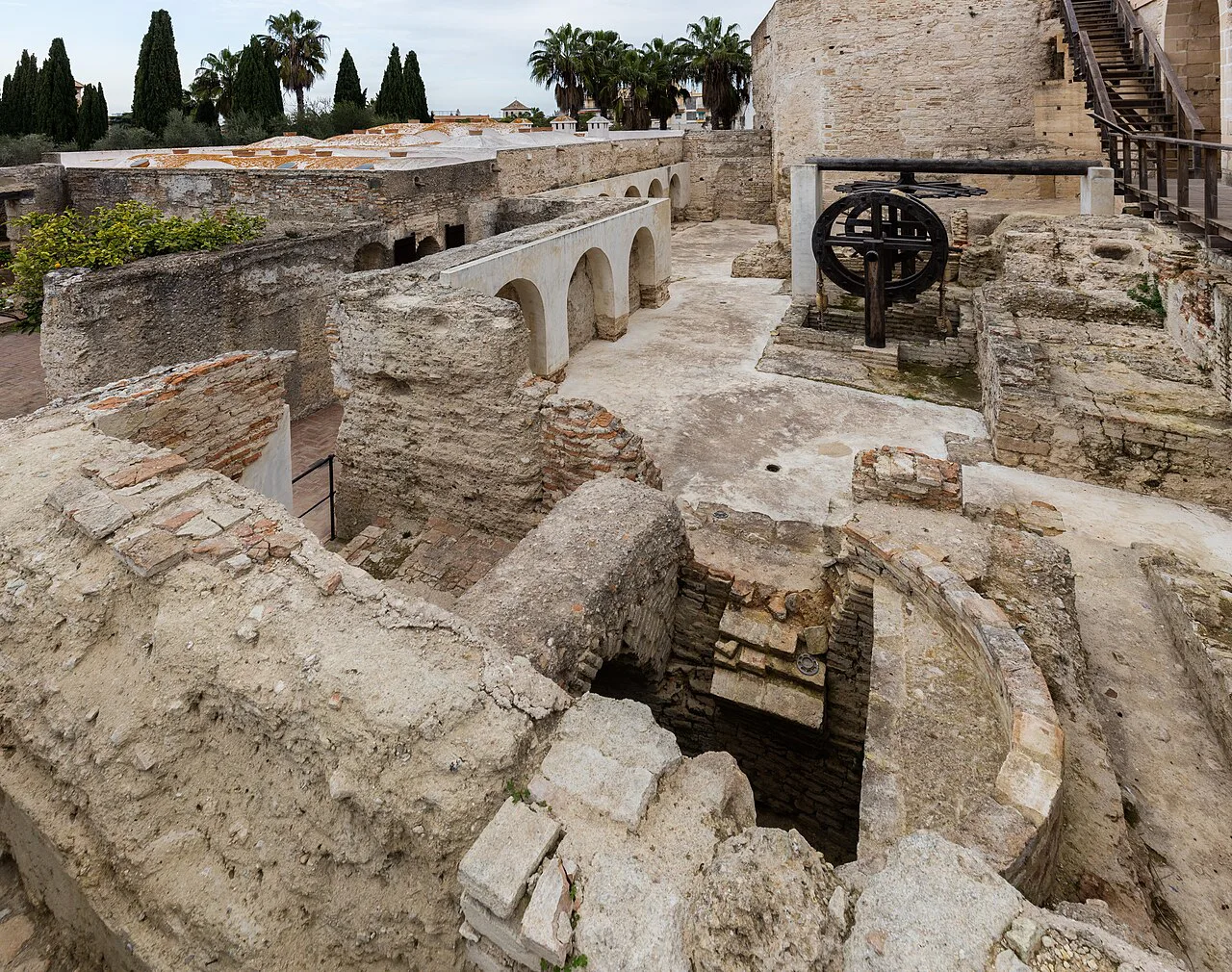
You enter through the Patio de Armas, the open parade ground that sets the military tone of the whole complex. From there the route moves to the mosque, a small prayer space that survives inside a later Christian shell, and then to the Arab baths, whose vaulted rooms and star-shaped openings are among the most photogenic parts of the visit.
The Almohads built the fortress in the 12th century as both stronghold and residence for their governors, which explains the irregular plan and the defensive towers rather than a single tidy palace block. After the Christian conquest the site became the seat of political power, and the architecture shifts accordingly as you walk on.
Gates, towers and the defences
The numbered route threads the defences in a logical order: the Puerta de la Ciudad and Puerta del Campo mark the old ways in and out, while the Torre Octogonal and the Torre del Homenaje, the keep, are the strongest statements of power in the complex. Climb where the route allows, because the towers are the point from which the layout of the walls suddenly makes sense.
The views from the top take in the whole city, which is the clearest reminder that this was for centuries the nerve centre of Jerez. Keep an eye on the time here: the towers are the easiest place to lose half an hour without noticing.
The Christian and baroque layers
Higher up the scale of comfort, the Pabellón Real, the Patio de San Fernando and the Palacio de Villavicencio show what the fortress became once it was no longer purely military. The Villavicencio palace is the baroque intrusion that surprises most visitors, and it carries the exhibitions described below.
The Escultura de Alfonso X el Sabio, on the route between the gates and the baths, marks the Christian reordering of the site and is a natural pause point between the Moorish and later sections.
The working parts: olive mill, huerto and archaeology
The molino de aceite, the huerto and aljibe, and the zona arqueológica are easy to overlook because they read as service areas, but they explain how the complex fed and watered itself. The olive mill in particular gives the fortress a working, everyday dimension that the ceremonial rooms lack.
The water cistern and garden are also the most pleasant stretch on a hot day, since they combine shade with something to actually look at.
Two permanent exhibitions most visitors miss
The Antigua Farmacia Municipal, the old municipal pharmacy, is displayed on the third floor of the palace, and the Carteles de Fiestas de Jerez, a collection of festival posters, forms the second permanent display. Both are part of the permanent exhibition inside the complex rather than separate visits.
The palace rooms are also used for conferences, exhibitions and one-off events, so a hall occasionally closes to visitors at short notice.
Tickets, opening hours and open days
Ticket prices, opening hours and any reduced or free slots are set by the monument; check current times and terms before you travel. The published contacts above are the route to confirm them.
The annual programme lists open days for Día del Turismo in September and for Día del Enoturismo in November, along with master tastings in September during the Fiestas de la Vendimia. Vinoble, the biennial salon for noble wines, is usually held in June every two years; its most recent edition ran at the Alcázar from 29 to 31 May 2022, so treat that as history rather than a promise for your dates.
Virtual reality preview and tickets
The municipal tourism listing offers a virtual-reality view alongside ticket sales and a map, which is a useful preview if you are weighing up the visit or planning a route through the rooms. Treat the virtual tour as a planning aid rather than a substitute for the towers and the baths.
What is nearby in the old town
Step out and you are on the edge of the historic centre, with the Alameda Vieja itself as an open-air promenade. The Jerez Cathedral and the Iglesia de San Miguel, Jerez de la Frontera both stand in the old town and pair naturally with the fortress if you want a monument-heavy half day.
If the archaeological zone inside the Alcázar whets your appetite, the Museo Arqueológico de Jerez takes the story further and is the obvious follow-on for anyone interested in the layers beneath the city.
The full set of Jerez Attractions: 4 Visitor Guides covers the rest of the centre, so you can slot the Alcázar into a wider circuit without doubling back across town.
Should the Alcázar be your first stop in Jerez?
Yes, if you want one monument that explains the city's layered history in a single circuit. The Alcázar de Jerez packs Almohad defences, a mosque, Arab baths, a baroque palace and two permanent exhibitions into a manageable walk, and the towers give you the whole city as a map.
Go early or late in the day in summer, allow ninety minutes to two hours, and combine it with the cathedral or San Miguel for a full old-town half day. The fortress is restored and open to visitors; check current opening times and ticket terms before you travel.