
Iglesia de San Miguel, Jerez de la Frontera

Allow around 45 minutes for the Iglesia de San Miguel, and rather more if you take a guided visit that includes the tower. The church stands in the San Miguel neighbourhood just outside the old walls, close to the Puerta Real, and the two things to linger over are the tower-façade at the west end and the Renaissance sacristy. This page covers where it is, how to walk there from the centre, what to look for, and how the guided visits work.
What the Iglesia de San Miguel is
San Miguel is a parish church, not a cathedral, founded in the fourteenth century when Alfonso XI raised an existing hermitage to parish rank to serve the population living outside Jerez's walls. Building on the present church began in 1430 according to the historian Grandallana, and the fundamental elements were finished by 1569. Construction continued through the seventeenth and eighteenth centuries, which is why late Gothic, Renaissance and Baroque work sit side by side.
That long build is why the interior reads as a catalogue of styles rather than a single scheme. Masters including Diego de Riaño and Hernán Ruiz II worked here, and the parish drew its wealth from the neighbourhood's leading families. The result is a building of cathedral-like proportions in a district that was, for centuries, home to the upper end of local society.

Where it is and how to walk there
The church sits in the Barrio de San Miguel, outside the historic core near the Puerta Real, so you approach it by leaving the old town rather than staying within it. From the cathedral and the central plazas, head for the Puerta Real and keep going into the San Miguel district; the tower-façade is the landmark you are aiming for.
Because the church is extramuros, it does not sit on the natural loop between the Alcázar and the cathedral, and it is easy to leave off a short break. Treat it as a separate short walk rather than something you pass by chance. If you are building a day around the centre first, the Alcázar de Jerez and the cathedral make a logical morning before you head out through the Puerta Real.

The exterior: doorways, chevet and tower-façade
Start outside. The Gothic side doorways and the Sagrario doorway carry much of the church's monumental character, and the volumes of the projecting chevet and the rear of the sacristy and Sagrario domes add to the effect. Walk a slow circuit before going in, because the west front is easy to read too quickly and the side entrances are where the medieval masonry shows most clearly.
The tower-façade at the west end is the building's signature. Work began with its foundations in 1675 and it was finished in 1702, designed by the local architect Diego Moreno Meléndez in a Sevillian Baroque manner akin to Leonardo de Figueroa, with whom he collaborated. It rises in four stone stages topped by a polygonal spire clad in glazed tiles, so look up rather than straight at the door.
At the entrance, the carved programme by Francisco de Gálvez, who took on the tower's sculpture from 1677, gives you the Evangelists on the door jambs and San Pedro dressed as Pope in the tympanum. Above, pairs of Tuscan columns frame niches holding four Latin Fathers of the Church. Reading the programme takes a couple of minutes and makes the rest of the façade legible.
Inside: three naves and the crossing
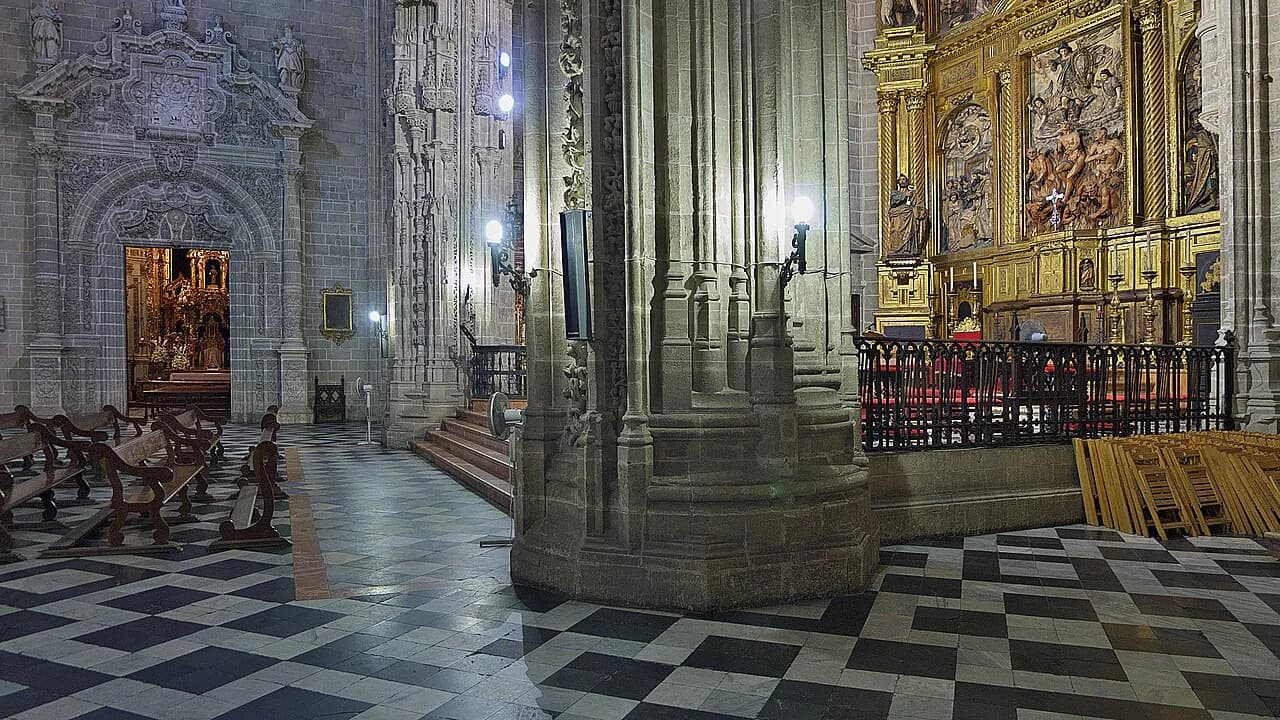
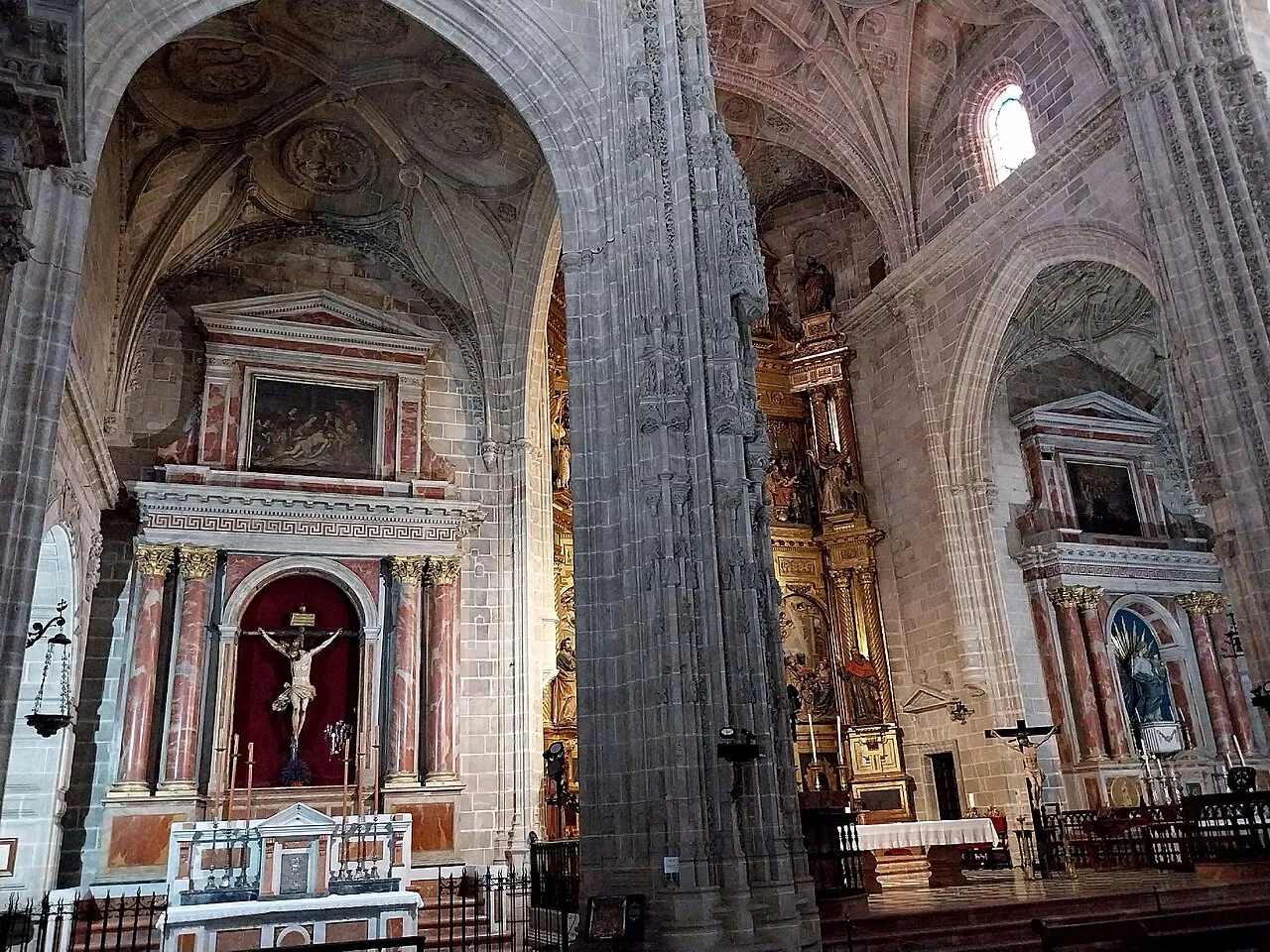
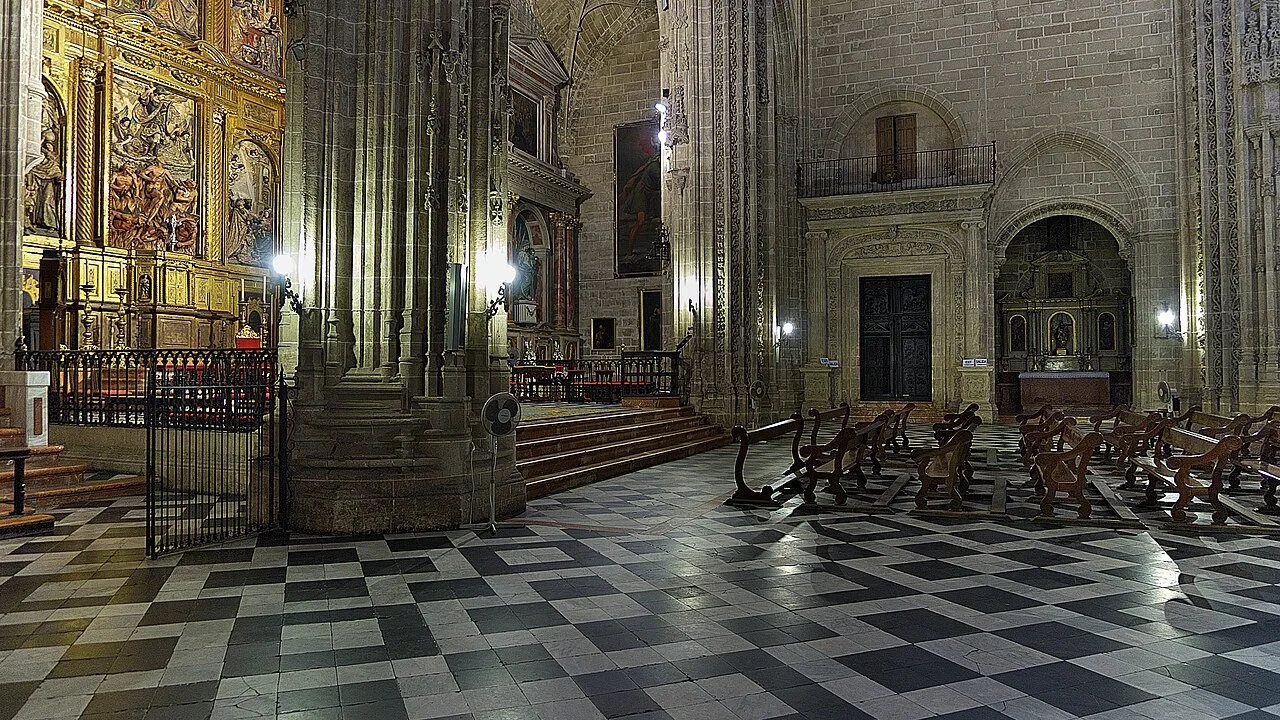
The plan is rectangular with three naves, the central one taller than those flanking it, separated by florid Gothic pilasters with canopied capitals that vary from one bay to the next. They grow simpler towards the west end and richer near the chevet, which is covered by a fine ribbed vault. The crossing does not project in plan but does rise above the roofline, which is why the church reads as taller than its footprint suggests.
Look for the change in handling as you move east: the capitals closest to the chevet are the most elaborate, and the vaulting over the sanctuary is the high point of the Gothic work. The architecture is the attraction here more than any single altarpiece, so give the nave and aisles a slow pass rather than heading straight for the sacristy.
The sacristy: the reason to come
The sacristy is the finest interior space in the church. Built on an earlier structure by Martín de Gaínza, it was completed by Hernán Ruiz II between 1564 and 1568 on a square plan, crowned by a Renaissance dome with coffered decoration and slate plates. It is closely related to the main sacristy of Seville Cathedral and is one of the most accomplished Renaissance interiors in Andalusia.
If you only have ten minutes in the building, spend them here and at the tower-façade outside. Access to the upper levels and the tower is controlled, and on the combined guided visit it is handled in passes of fifteen people, which tells you the numbers upstairs are limited.
How long a visit needs
Budget 30 to 45 minutes for the church and its exterior at an unhurried pace; the compact version is 15 minutes on the nave, the sacristy and the west front. Add the walk out from the centre and back, which is the real cost in a short break rather than the visit itself.
The combined guided visit of the cathedral and San Miguel is listed at an estimated duration of one hour forty minutes, which is the realistic figure if you want the tower and commentary. That format suits travellers who would rather have the sculpture and dates explained than read them off a wall.
Guided visits pairing the church with the cathedral
Jerez has run a guided visit, Entre retablo y caliza, that links the Catedral de Jerez with the Iglesia de San Miguel, with prior booking required and limited places. In 2025, during the Fiestas de la Vendimia, it was listed at 15 euros per person, ran in Spanish and English on set days and times, and was booked with the organiser Optima Cultura. Those dates and times belong to 2025, so ask the tourist office about the current programme before planning around it.
Ordinary visiting hours, and any admission charge for going in on your own, are things to confirm with the Jerez tourist office or the parish before you set out, particularly if you are making a special trip out to the neighbourhood. The same applies to mass times, which change and are best taken from the parish itself.
Nearby in the San Miguel neighbourhood
The church is the anchor of its own district rather than a stop on a central circuit, so pair it with something on the walk back towards the old town. The Alcázar de Jerez, the cathedral and the archaeology collection in the centre give you a natural sequence if you are spreading the church and the old town across a morning and an afternoon.
If your interests run to the Roman and medieval layers beneath the city, the Museo Arqueológico de Jerez makes a sensible counterweight to San Miguel's Gothic and Renaissance fabric. Otherwise, keep the visit simple: the church, the walk along the outside of the walls and the Puerta Real, then back into the centre.
Is San Miguel worth the walk out of the centre?
Yes, if you want one building that shows Jerez's late Gothic and Renaissance ambitions in a single visit, and the sacristy alone justifies the detour. Skip it if your short break is already full and you would rather spend the time inside the old town; the church rewards attention to stonework rather than a quick look.
Frequently Asked Questions
Do I need to book to see the Iglesia de San Miguel?
The combined guided visit of the cathedral and San Miguel has required prior booking with limited places, and tower access is managed in passes of fifteen people. For going in on your own, ask the parish or the tourist office about current access before making a special trip.
How old is the church?
A hermitage on the site was raised to parish status in the fourteenth century under Alfonso XI, and construction of the present church began in 1430 according to the historian Grandallana, with the main elements complete by 1569. The tower-façade was built between 1675 and 1702.
What should I look at first?
Walk the exterior first, starting with the Gothic side doorways and the west tower-façade with its carved entrance and tiled spire. Inside, head for the Renaissance sacristy by Hernán Ruiz II, then work back through the three naves.