Things to Do in Girona: Old Town, Walls and Cathedral
Plan a Girona break around the cathedral steps, Arab Baths, Roman walls and the Call, with the layout explained and ticket prices in euros.
On this page
Girona's old town is a single walkable package: river bridges, a cathedral hill and a medieval walled circuit within roughly a couple of kilometres of each other. One full day covers the essentials comfortably, and a second day lets you add a Costa Brava run, so the city suits a short break that does not need a car.
What follows groups the sights by neighbourhood so you can walk a loop instead of chasing a list: the Onyar bridges and painted riverside houses first, then the squares of the commercial centre, then the cathedral hill, the Arab Baths, the Call and the walls. Ticket prices in euros appear where the sights charge, and the steep staircases are flagged honestly.
What to see in Girona: the short answer
Prioritise four things: the Cathedral of Girona with its baroque façade and broad Gothic nave, the Arab Baths, the Call (the old Jewish quarter) and the medieval walls. The riverside houses on the Onyar and the squares around the Rambla fill the gaps between them.
Two of those carry a ticket. The cathedral costs 7 € and the ticket also covers the Basílica de Sant Feliu, while the Arab Baths cost 3 €; the walls and the Call are free to walk. That means a full day of sightseeing in the historic centre can stay under 10 € per person in admissions.
The layout matters more than the list. Girona was founded by the Romans as Gerunda and its historic core still reads as layers: the riverfront, the flat commercial streets and the fortified hill, which locals call the Força Vella. Walking it in that order avoids climbing the same slope twice.
How the old town is laid out, from the Onyar bridges to the cathedral hill
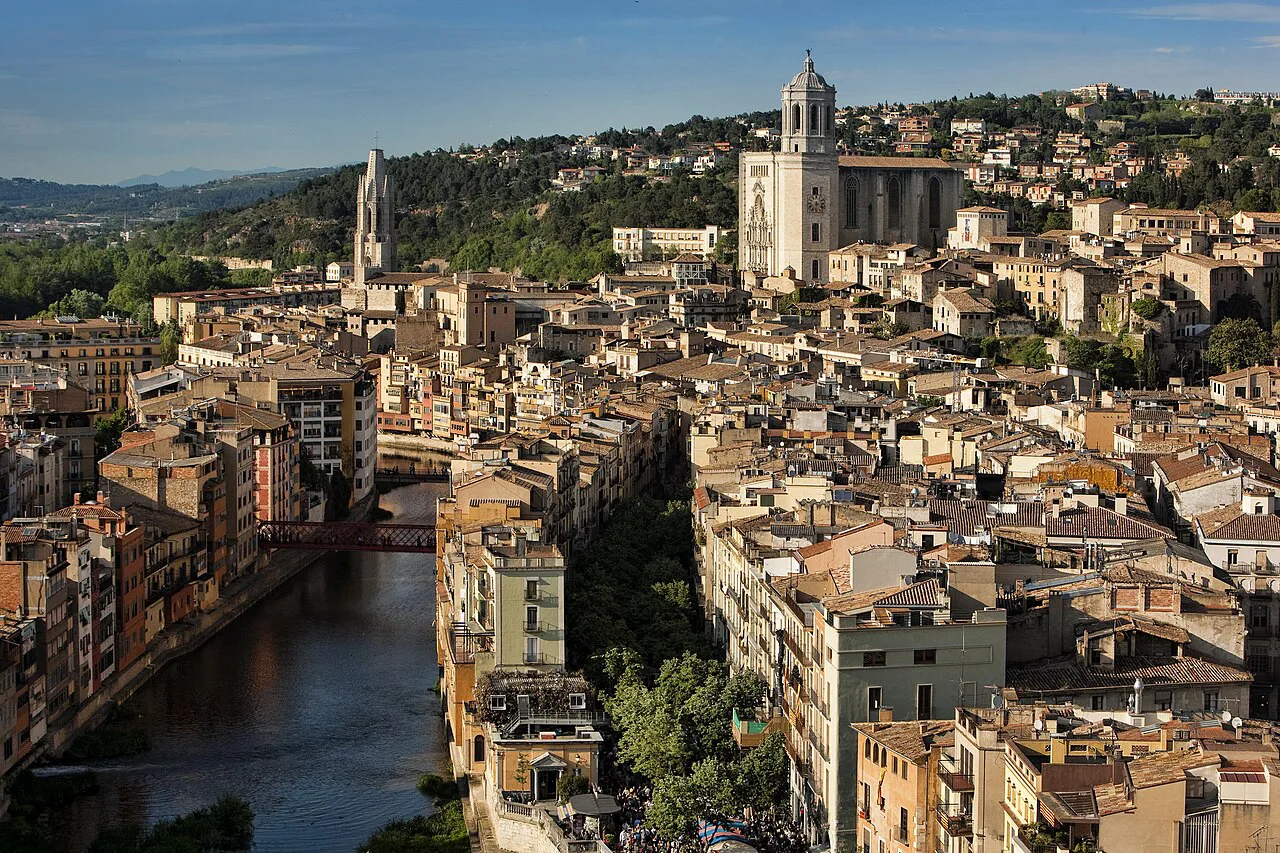
The Riu Onyar splits Girona into two halves. The modern city, the train station and most through traffic sit on the western bank; the historic centre, the Barri Vell, occupies the eastern side, rising from the river to the cathedral. Almost every visit starts by crossing a bridge.
From the water, three zones stack up. The riverside strip and the Rambla are level and easy; the Call and the streets around Plaça del Vi form the middle band; the cathedral, the walls and the Passeig Arqueològic sit on top. Plan your heaviest climbing for the morning and keep the flat streets for the afternoon.
Distances are short, but the paving is cobbled and the gradients are real. Good shoes matter more than a map here, and anyone with knees or pushchairs should note that several routes up to the cathedral are staircases rather than ramps.
Crossing the Onyar: the Pont de Pedra and the painted houses on the river
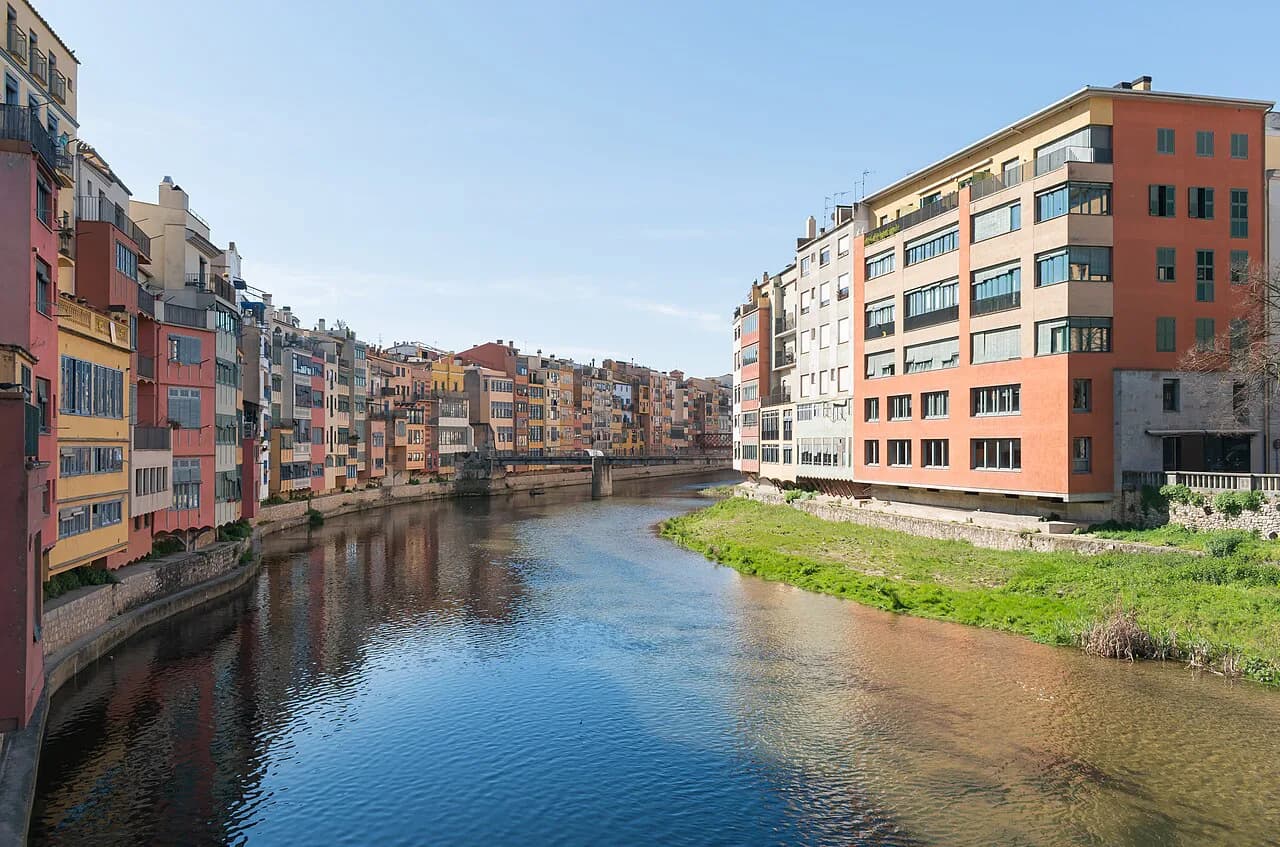
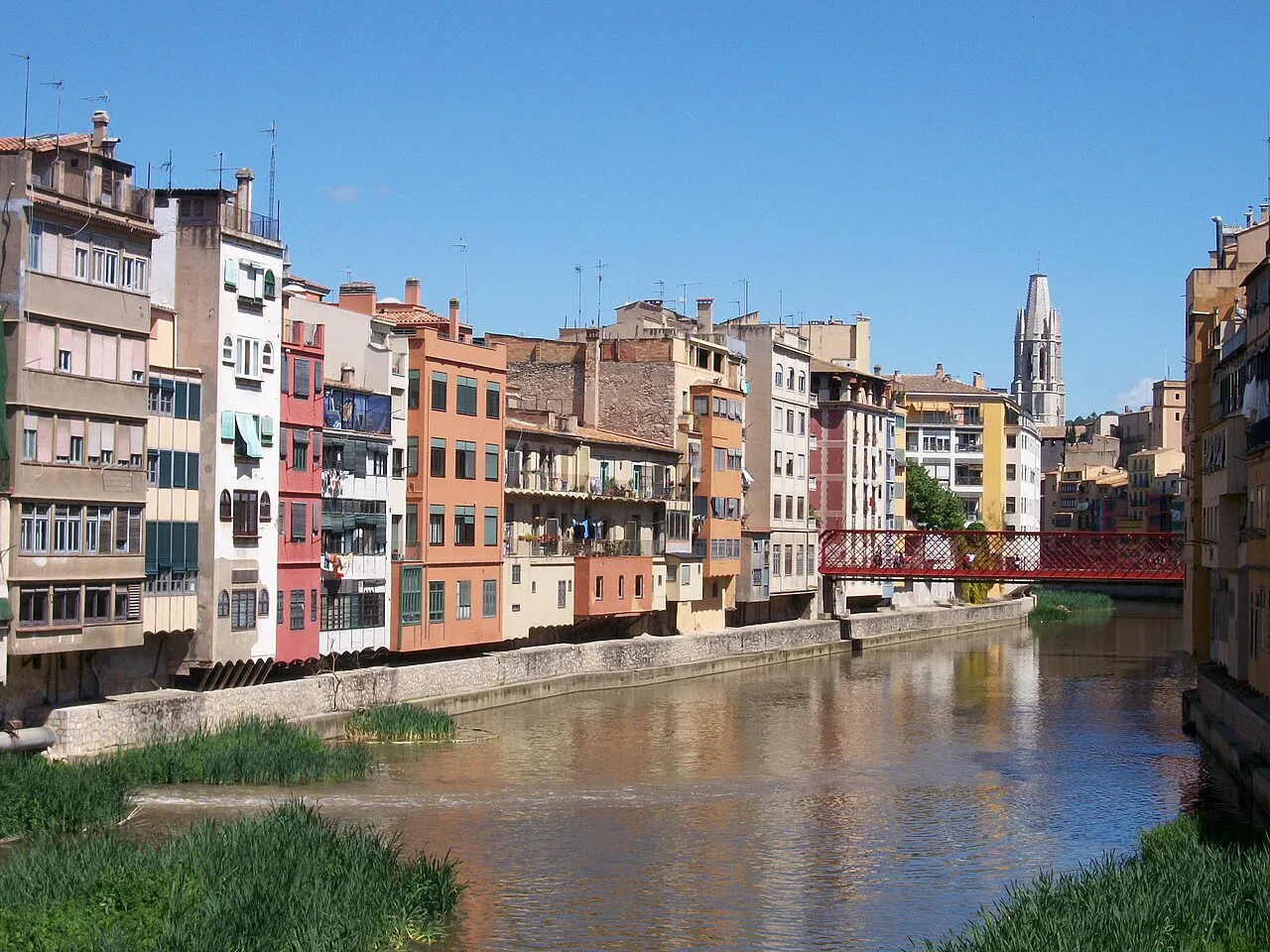
Arriving by train from Barcelona, the Pont de Pedra is likely to be your first view: a nineteenth-century stone bridge and the only one in the immediate area built of that material. From it you get the postcard shot of the coloured façades reflected in the Onyar.
The painted houses along the river, often called the Casitas del Río Onyar, are the most photographed sight in Girona after the cathedral. They line both banks and are best seen from the bridges rather than from street level. The riverside walk on the historic-centre bank links the crossings and makes a gentle start to the day.
Further along, the Pont de les Peixateries Velles, a red iron bridge, gives a slightly different angle back towards the cathedral hill. It is a crossing rather than a monument, so treat it as a five-minute pause between the riverfront and the old lanes.
The Rambla de la Llibertat, Plaça del Vi and Plaça de la Independència
Inland from the river, the Rambla de la Llibertat is Girona's main promenade, a long, arcaded street of shops and cafés that runs parallel to the Onyar. It is the natural corridor between the bridges and the old town, and the place to pause without committing to a full sit-down meal.
Plaça del Vi, the old civic square, sits just off the Rambla and marks the start of the climb towards the cathedral. Plaça de la Independència, a porticoed neo-classical square with a monument to the city's defenders at its centre, is where the arcades fill with tables spilling out from under the arches.
The Pujada de Sant Domènec is the street that ties this band together, running up from the level streets towards the religious buildings. Take it slowly: it is the first proper climb of the day, and it delivers you directly to the Sant Feliu and cathedral area.
The Cathedral of Girona: the wide Gothic nave, the baroque façade and the staircase
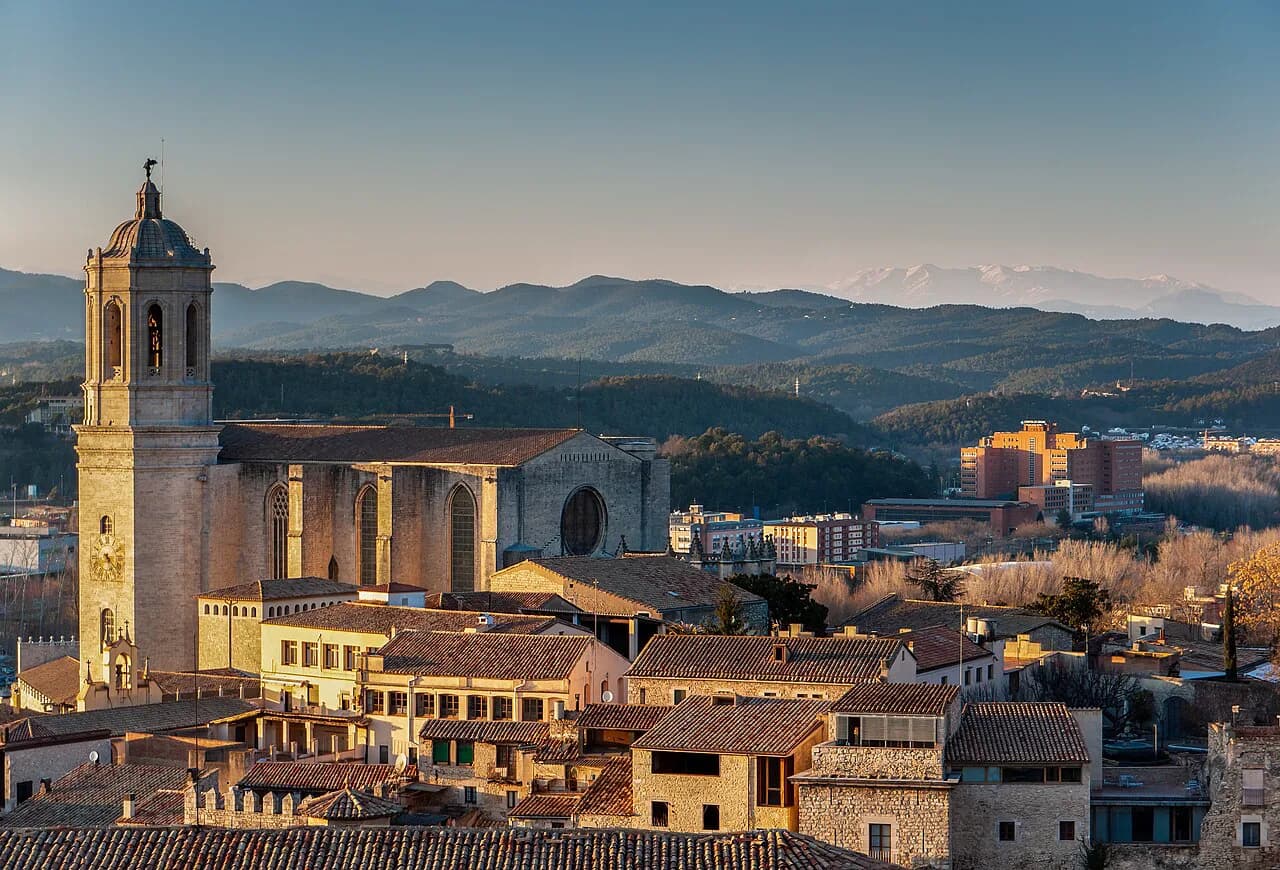
The cathedral's Gothic nave is the widest of its kind in the world, and that single fact explains the interior: a single span with no columns breaking it up. The baroque façade and the broad staircase below it are the other defining elements, and the steps are familiar from Game of Thrones.
Admission costs 7 €, and the same ticket covers the Basílica de Sant Feliu nearby. The staircase has a long central flight and side landings, so an unhurried climb with a pause at the top is the sensible approach in summer.
The cathedral sits at the highest point of the historic core, which means everything afterwards is downhill or flat. Pair the visit with the lanes immediately below rather than backtracking later. The Museu d'Art de Girona, in the former episcopal palace beside the cathedral, is the obvious add-on if you want more time indoors.
Basílica de Sant Feliu and Plaça de Sant Feliu
Sant Feliu is Girona's other great church, its bell tower dominating the skyline over a square that dates from around 1200 but was not completed until the early 1600s. The tower served as both a defence tower and a bell tower, which explains its fortress-like lower stages.
Entry is included in the cathedral ticket, so the pair works as one visit rather than two separate payments. If you are short of time, do the cathedral first and treat Sant Feliu as the walk-out, since it sits on the route between the cathedral hill and the river.
The Arab Baths: the octagonal pool and the changing-room columns
The Banys Àrabs are a twelfth-century bathhouse drawing on Roman and Moorish models, and they are small: a handful of rooms around a central pool. The most impressive space comes first, with a small octagonal pool surrounded by columns, thought to have been the changing room rather than the bathing hall itself.
The Arab Baths charge 3 €, which makes them an easy yes, but budget less than half an hour. The atmosphere rewards a quiet moment, so an early or late slot in the day beats the middle of the afternoon.
The baths sit between the cathedral hill and the monastery of Sant Pere de Galligants, so the three combine into one loop without retracing steps. Come out of the baths and follow the lanes north rather than dropping straight back to the Rambla.
The Call, Girona's Jewish quarter, and the Museum of Jewish History
The Call is one of the best-preserved Jewish quarters in Europe, a knot of narrow stone lanes climbing towards the cathedral. Its streets are free to walk at any time, and the atmosphere comes from the steep, tight alleys rather than from any single monument.
The Museu d'Història dels Jueus fills in the background on the community that lived here, and it is the natural indoor stop if the weather turns. Along with the Museu d'Art de Girona, it makes up the core of the city's collection-led sightseeing.
Navigation is the challenge: lanes fork and dead-end, so treat the Call as a place to wander rather than to route precisely. Aim for the Centre Bonastruc ça Porta area at the top and let the streets do the rest.
Walking the medieval walls: the Muralles and Passeig Arqueològic stretch
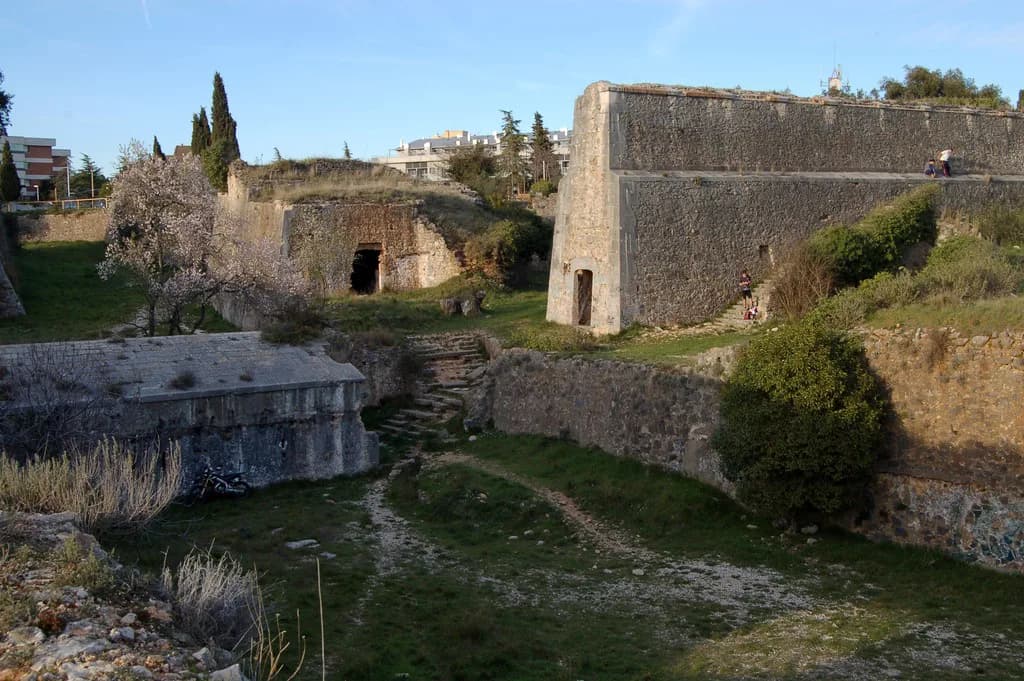
The wall walk runs for roughly 2 km, and the best section is the stretch between the Muralles and the Passeig Arqueològic, where the circuit skirts the old town with far-reaching views. The restored walkway includes several watchtowers you can climb.
This is the honest constraint of a Girona day: the walls involve steep steps up onto the walkway and more inside each tower, so they are poor value if you are tired or pressed for time. Do them fresh in the morning, or skip them and keep the cathedral hill as your only climb.
Access is free and the walkway is open to anyone, which makes it the best-value viewpoint in the city. Sunset is the classic slot, but the light on the old town is arguably better in the morning, when fewer people are on the steps.
Sant Pere de Galligants and the archaeology park
The Monastery of Sant Pere de Galligants sits just beyond the old town on the north side, a Romanesque complex that now houses the city's archaeology collections. Around it, the Parc Arqueològic and the rising ground give one of the better views back towards the monastery and the old town.
This is the quietest corner of the essential Girona circuit and a sensible place to end a walking day. It also sits close to the northern edge of the old town, so you can re-enter the centre without repeating the cathedral climb.
Plaça dels Raïms and the lanes of the old town on foot
Plaça dels Raïms is billed as the smallest square in Europe, a pocket-sized opening in the lanes near the cathedral. It takes a minute to see, and it is the kind of detail that rewards wandering rather than itinerary-building.
The streets around it hold the rest of the small sights: the Portal de Sobreportes, one of the old town gates, and the scattered remnants that make the Barri Vell feel layered rather than uniform. A Girona walking tour makes sense if you want the street pattern explained rather than simply walked.
Shopping in Girona concentrates along the Rambla and the commercial streets west of the river, so combine retail time with a bridge crossing rather than mixing it into the old-town lanes.
What costs money and what is free: cathedral and Arab Baths tickets
In the historic centre, the paid sights are few. The cathedral charges an entry fee that also covers Sant Feliu, the Arab Baths have a modest ticket, while the walls, the Call and the riverside are free. Set aside a small budget for the ticketed core and check current prices before you go.
Beyond that pair, the museums and the cathedral treasury charge separately, so check the cathedral's own ticket page before you travel rather than budgeting from memory.
The practical consequence is that Girona is a cheap city to sightsee in. Budget your money for meals and coffee rather than admissions, and treat the paid interiors as optional extras if the weather or your energy dips.
A short break shape: one day, or two with a Costa Brava run
One full day is enough for the essential loop: cross at the Pont de Pedra, walk the Rambla and Plaça del Vi, climb to the cathedral and Sant Feliu, drop to the Arab Baths and the Call, and finish on the walls or at Sant Pere de Galligants. That is a full day of walking, not a rushed one.
Two days buy you breathing room. Use the second for a run out to the Costa Brava, or for the museums and the Devesa park, and keep the first day's climbing to a minimum. A car is the practical choice if the second day heads for the coast.
If you are building a longer Catalonia route, the same logic applies to other Spanish cities: compare the shape of Girona's old town with what you would find doing things to do in A Coruña or things to do in Alcúdia on a short break of their own.
Getting there and getting around: trains from Barcelona and walking times
Girona is an easy rail hop from Barcelona, and the high-speed AVANT service is the quickest option at around 40 minutes. Regional trains take longer but cost less, and current departure times belong in the operator's timetable rather than in a guide.
Once in the city, everything in this guide is walkable. The station is on the western bank, the old town begins across the Pont de Pedra, and the far end of the wall circuit is roughly 2 km from the cathedral. Allow ten to fifteen minutes between the station and the cathedral steps.
Local buses cover the wider city, but for the historic centre they are unnecessary. If you are arriving by air, Girona has its own airport with bus connections into the centre, and Barcelona's airport is an alternative with a rail link onwards.
Where Girona sits for a Costa Brava trip: Cadaqués and Besalú as add-ons
Girona works as a base for the Costa Brava because the coast is close and the roads are good, with Cadaqués the classic eastern add-on and Besalú the medieval inland one. Both are day-trip shapes rather than half-days, and a car makes them straightforward.
Use Girona's compact centre as the anchor and treat the surrounding towns as extensions rather than alternatives. The city's own sights are concentrated enough that you can be on the road by mid-morning having already seen the cathedral.
Which Girona day suits your break?
If you have one day, do the cathedral, Sant Feliu, the Arab Baths and the Call, and add the walls only if your legs are fresh. The ticket outlay is small, the walking is the real cost, and the old town rewards a slow loop over a checklist.
With two days, give the first to the historic core and the second to the coast or an inland town. Either way, the city is compact enough that you will see more by walking one sensible route than by trying to cover every named sight.
Explore more Girona guides
Frequently Asked Questions
Is Girona worth visiting?
Yes, if you want a compact historic city with a major cathedral, a well-preserved Jewish quarter and a walkable medieval wall circuit. The ticketed sights are few and cheap, so most of the day costs you walking time rather than admissions.
What are the unusual things to do in Girona?
Look for the tiny Plaça dels Raïms, the old town gates such as the Portal de Sobreportes, and the tower climbs along the wall walk. The Arab Baths' octagonal pool room is the most atmospheric interior most visitors miss.
Which Game of Thrones locations are in Girona?
The cathedral staircase is the best-known filming location, and the old-town lanes around the Call provided other backdrops. Treat them as part of a normal cathedral and old-town visit rather than a separate trail.
Sources
Notes for your next Spanish town break
Optional updates to our guides.
You might also like
Continue reading
More guides you'll find useful