
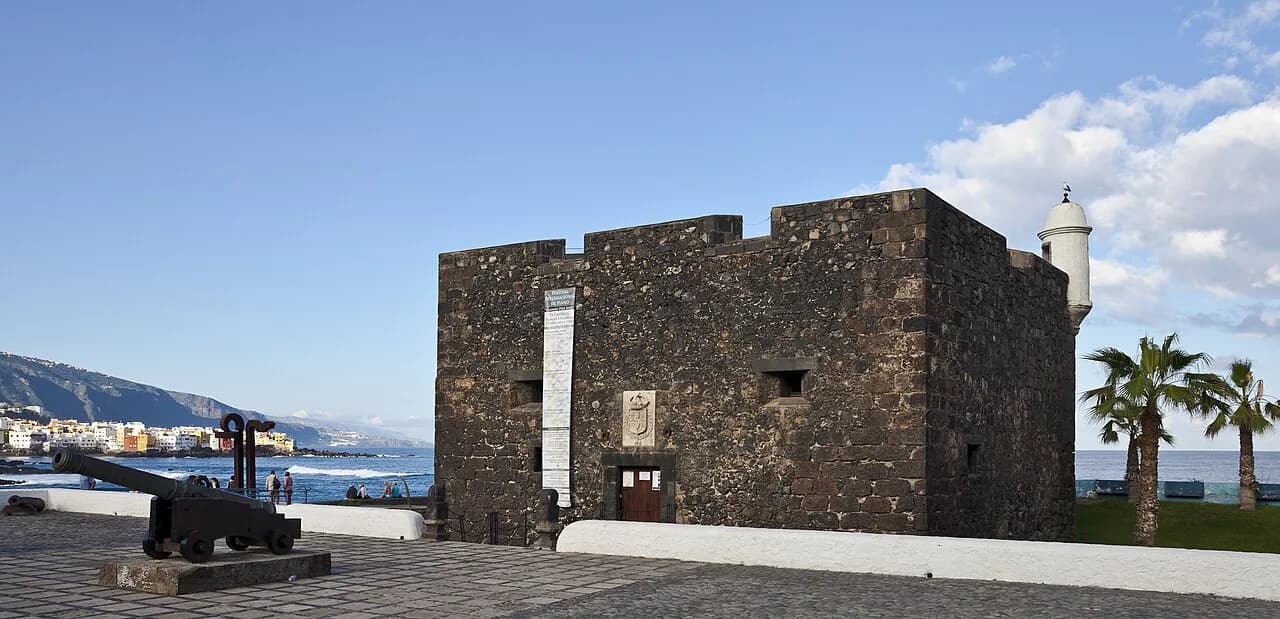
Castillo de San Felipe: the small fortress by Playa Jardín

Castillo de San Felipe is a small coastal fortress beside Playa Jardín on the western edge of Puerto de la Cruz, and it needs well under an hour of your day. It is worth seeing as a piece of the town's defences and for the sweep of bay around it, not as a museum you travel across the island for. This guide covers where the castle stands, how to reach it from the centre, what it looks like up close, and which protected sites sit within a short walk.
What Castillo de San Felipe is
The fortress is listed as a Bien de Interés Cultural in the monument category, declared on 12 July 1993 and entered in the national register under reference RI-51-0008254-00000. That protection puts it among the nineteen protected cultural assets recorded in Puerto de la Cruz and among the nine castles registered in the province of Santa Cruz de Tenerife. Read it as a monument first and a visitor attraction second: the structure itself, its setting and its legal status carry more weight than any exhibition.
One local description records construction running from 1599 to 1604, after which the fort served as a defensive post against raiders in the bay. By the 19th century it had fallen into disrepair and was renovated, then gutted in 1878 and handed to the town as a hospital and lazaretto. It was declared unfit for military use and closed in 1924. Treat these dates as the fort's traditional history rather than a fully documented official record.

Where it stands
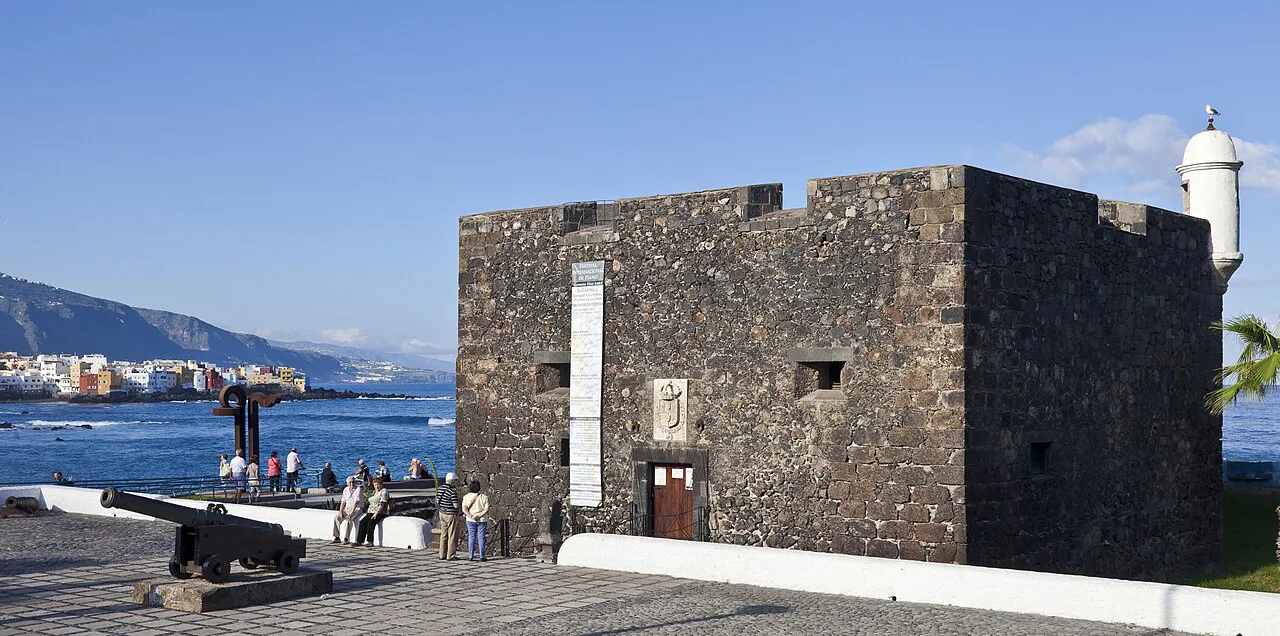
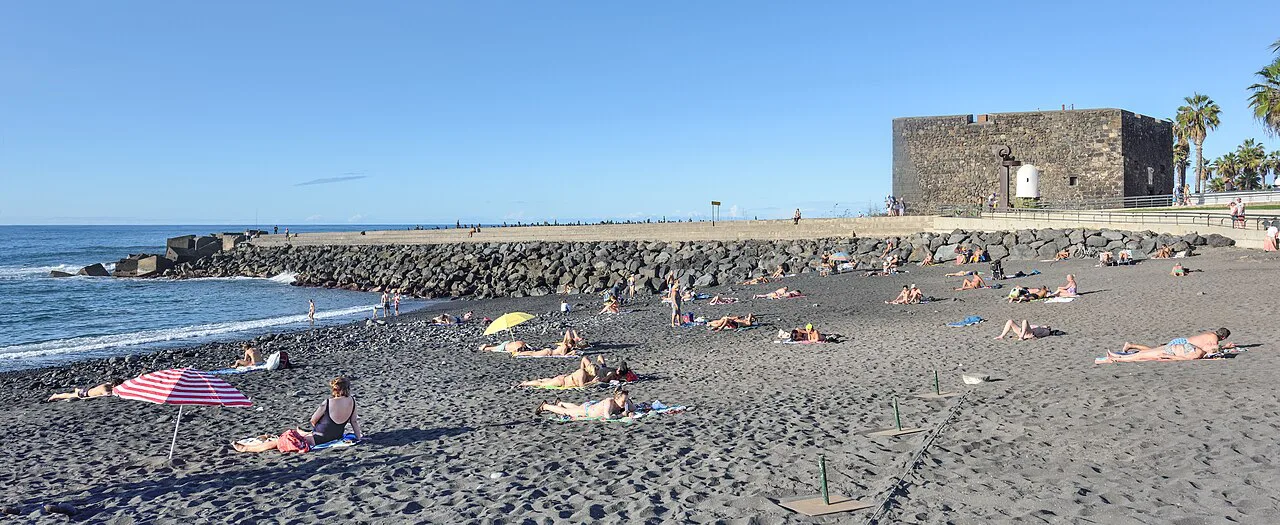
The castle sits at Calle Luis Lavaggi, 10, on the coast at the western end of Puerto de la Cruz, with Playa Jardín directly in front of it. Its position is recorded at roughly 28.4144, -16.5586, which is the quickest way to confirm on a map that you are heading for the right end of town. If you are walking the seafront promenade, the fortress is the point where the beach and the bay open out.
Other protected buildings cluster in the same neighbourhood, including the Casa de la Calle de la Marina at the corner with Calle las Lonjas, the Hornos de Cal and the building at Calle Blanco number 19. It is also part of the wider Conjunto Histórico del Puerto de la Cruz, so the walk to the castle passes through listed streets rather than anonymous resort sprawl. The castle's own listing places it among these assets in the town's heritage inventory.
How to get there from the centre
From the centre of Puerto de la Cruz, aim for the coast and follow the seafront west towards Playa Jardín; the fortress is the low bastioned structure at the far end of the beach. The walk from the old town is straightforward and mostly level along the promenade, which makes it an easy addition to a morning in the centre. Anyone arriving by car should navigate to Calle Luis Lavaggi rather than to the beach name alone, since the beach runs for some distance.
The castle is used today as an exhibition space and for events organised by the town, and opening varies accordingly. There is no reliable fixed timetable to plan around, so check with the town's own information or by telephone on the published number before making the walk the purpose of a trip. If the interior is shut when you arrive, the exterior walls, the beach and the promenade still justify the walk.
Opening times and entry
No entry charge or booking rule is published for this fortress, and no fixed visitor timetable is set out. Do not plan around a stated price or a guaranteed opening slot: confirm both with the town's culture department or the telephone number listed for the castle before you set out. That is the only reliable way to know whether the interior is open on the day you visit.
What to look for on a visit
The fort is small, and its interest lies in the walls, the compact footprint and the way the defences were shaped to cover the bay. Circle the outside first to read the plan and to take in the sea view from the promenade side; that pairing is the core of the visit. Because it functioned as a hospital and lazaretto after 1878, any interior you do see reflects later uses as much as its military life.
Views around the castle take in Playa Jardín, the promenade and the coastline towards the western end of town. Bring no expectations of furnished rooms or a large display: the site operates as an exhibition and events space when it is open. Photography of the walls against the sea is the strongest reason to linger.
How long to allow
Allow under an hour for the castle and its immediate surroundings, and treat it as one element of a longer seafront walk. The surrounding promenade and beach do most of the work of a half-day out; the fortress supplies the historical anchor. If the interior is closed, the exterior circuit alone still gives you the shape of the defences.
What else is within a short walk
Playa Jardín stretches in front of the castle, and the Conjunto Histórico del Puerto de la Cruz lies back towards the town centre along the same coastal route. The Torreón del Ventoso, a protected tower, is listed among the heritage assets in the same municipality, so a walk inland can take in more than one piece of the old defensive scheme. Plan the castle as the western turn-around point of a promenade walk rather than a separate excursion.
Inland, the Jardín de Aclimatación de La Orotava is the town's other long-established visitor garden and makes a natural pairing with a seafront morning. Back towards the centre, the arcaded streets around the Plaza del Charco give you the town's civic heart after the coastal defences. Both sit comfortably in the same day as the fortress if you start early.
The other Castillo de San Felipe
Search results for this name are dominated by two far larger forts in the Americas: Castillo San Felipe del Morro in San Juan, Puerto Rico, and Castillo San Felipe de Barajas in Cartagena, Colombia. Neither is this building. The Tenerife fortress is a modest coastal work on the bay at Puerto de la Cruz, and the confusion is worth clearing before you book anything.

Nearby in the north of Tenerife
For a longer half-day, the Rambla de Castro protected landscape and the Monumento Natural Montaña de los Frailes lie in the same part of the island's north coast and are recorded as protected natural spaces near the town. They suit travellers who want coastal scenery after the fort rather than another built monument. Check access and conditions locally before setting out, as these are natural sites rather than ticketed attractions.
Is the fortress worth the walk?
Yes, if you are already spending time in Puerto de la Cruz and are heading for Playa Jardín or the promenade. The castle is small, its opening pattern is irregular, and the surrounding coast does most of the work. It is not worth a dedicated journey from elsewhere on the island unless you are combining it with the town centre and the botanical garden.
Build the visit around the walk: start in the old town, follow the seafront west to the fortress, and return along the beach. Confirm the interior opening before you go, then let the walls, the bay and the listed streets fill the half-day.