
Aljafería Palace, Zaragoza: a Visitor's Guide to the Taifa Palace

The Aljafería is the one building in Zaragoza that compresses the city's history into a single walled enclosure: an eleventh-century taifa palace, a Mudéjar residence of the kings of Aragon, a palace of the Catholic Monarchs and a Felipe II fortress, now home to the Cortes de Aragón. Give it about ninety minutes, and plan around a guided slot because the interiors are toured with a set schedule. This guide covers the layout, the rooms worth seeking out, the practical arrangements and what sits within easy reach afterwards.
What the Aljafería actually is
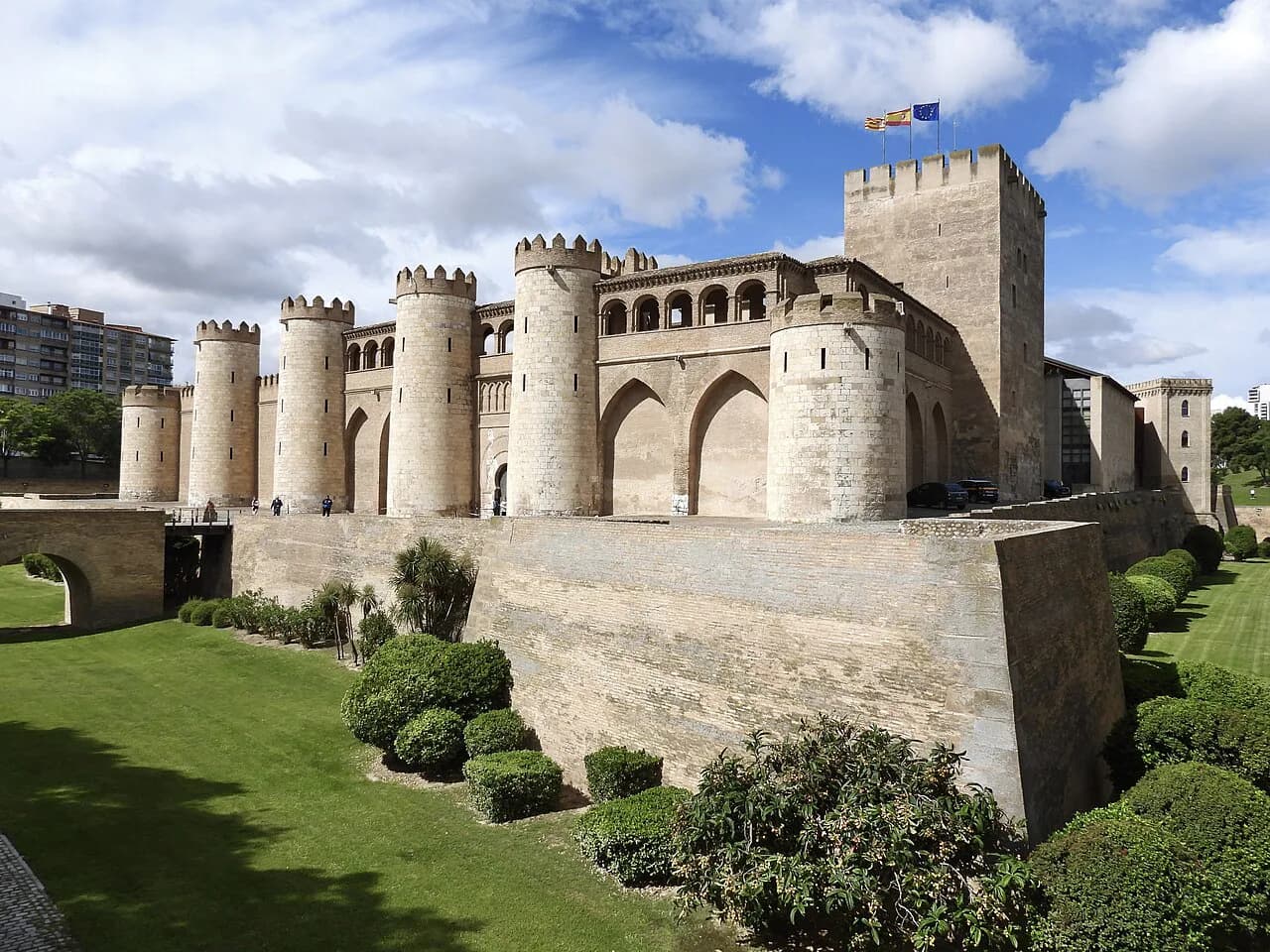
The palace began as a pleasure retreat built in the eleventh century under al-Muqtadir, king of the taifa of Saraqusta, and its name echoes the Arabic for a palace of joy. Its oldest surviving element is the Torre del Trovador, a defensive tower from that taifa phase. With the Christian conquest of Zaragoza under Alfonso I el Batallador, the complex became a residence of the kings of Aragon, and each later century added a layer rather than replacing the last, so a single visit turns up Islamic stucco, Mudéjar ceilings, Gothic-Mudéjar carpentry and heavy artillery defences in sequence.
Separate the layers before you go in. Pedro IV el Ceremonioso (1336–1387) was responsible for the Mudéjar palace, including the Iglesia de San Martín, while the Catholic Monarchs added their own palace block on the north side around 1492. Felipe II later turned the whole site into a fortification with a moat and angled bastions.
Since 1987 the complex has housed the Cortes de Aragón, which is why some parts are working parliamentary space rather than pure museum. It also fits the guided-visit system: the published slots structure the route, so check the schedule before you set out.

Where the Aljafería is and how to get there
The palace stands on Calle de los Diputados, west of the old town, in a part of Zaragoza that feels like a working city rather than a tourist quarter. It is not on the Pilar–La Seo circuit, so it works best as a separate stop at the start or end of a day rather than something you pass through.
On foot, the approach is straightforward from the city centre, and the crenellated outline and moat are visible before you reach the entrance. The recorded telephone number for the palace is +34 976 289 683 if you need to confirm access arrangements.

Opening hours and the closures that matter
Published hours split the day into morning and afternoon sessions, and the exceptions are what catch people out. In the schedule set out by InSpain.org, from April to October mornings run 10:00–14:00 except on Thursdays and Fridays, and afternoons run 16:30–20:00 with Thursday afternoons excluded. From November to March the pattern is broadly the same, the afternoon runs to 18:30, and Sunday afternoons are closed. January, July and August are listed as open every day, and 25 December and 1 January as unvisitable.
For a short break this decides your day order. If you are in Zaragoza from Friday to Sunday, a Thursday or Friday morning will not get you in, and a Sunday afternoon is out between November and March. Put the palace on a morning that the schedule leaves clear and keep the afternoon for the old town.
Tickets, free entry and guided tours
The published tariff is modest: a general adult ticket at 5 €, a reduced rate of 1 € for pensioners, students and Carné Joven holders, and 4 € for groups of more than twenty, with free entry listed for Sundays and children under twelve. These figures come from a third-party listing rather than a live booking page, so confirm them when you reserve.
Guided visits are the practical way to see the interiors, and they run at set times rather than continuously. The slots published in that schedule are 10:30, 11:30 and 12:30 in the morning, plus 16:30, 17:30 and 18:30 in the summer afternoons, narrowing to 16:30 and 17:30 in the winter months. Turn up for a slot, not a general admission time, or you may end up waiting.
Individual visitors join the guided slots; groups of twenty or more are asked to book ahead by telephone on 976 28 96 85, which is the number to use if you are organising a party rather than turning up on your own.
The Patio de Santa Isabel
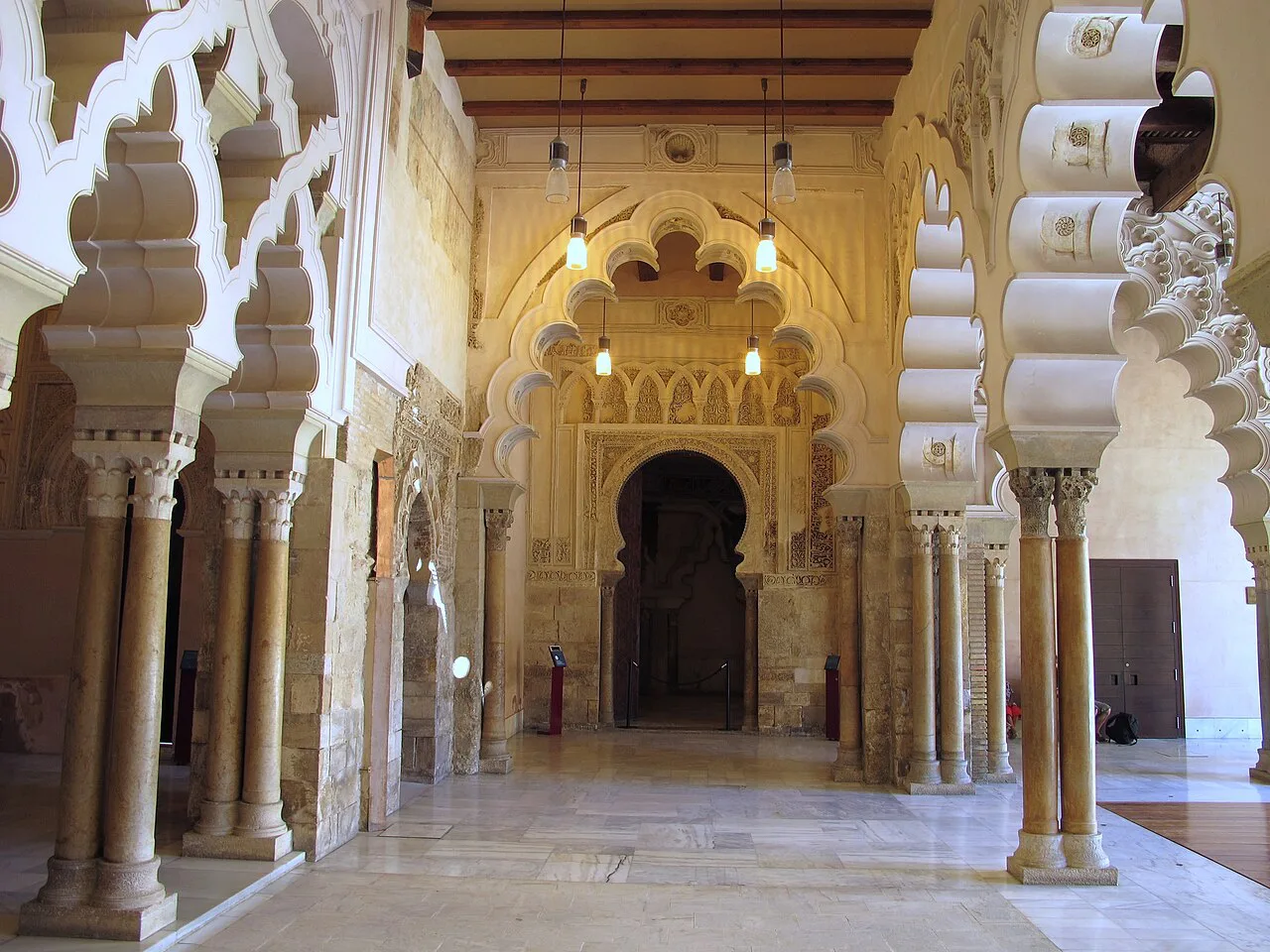
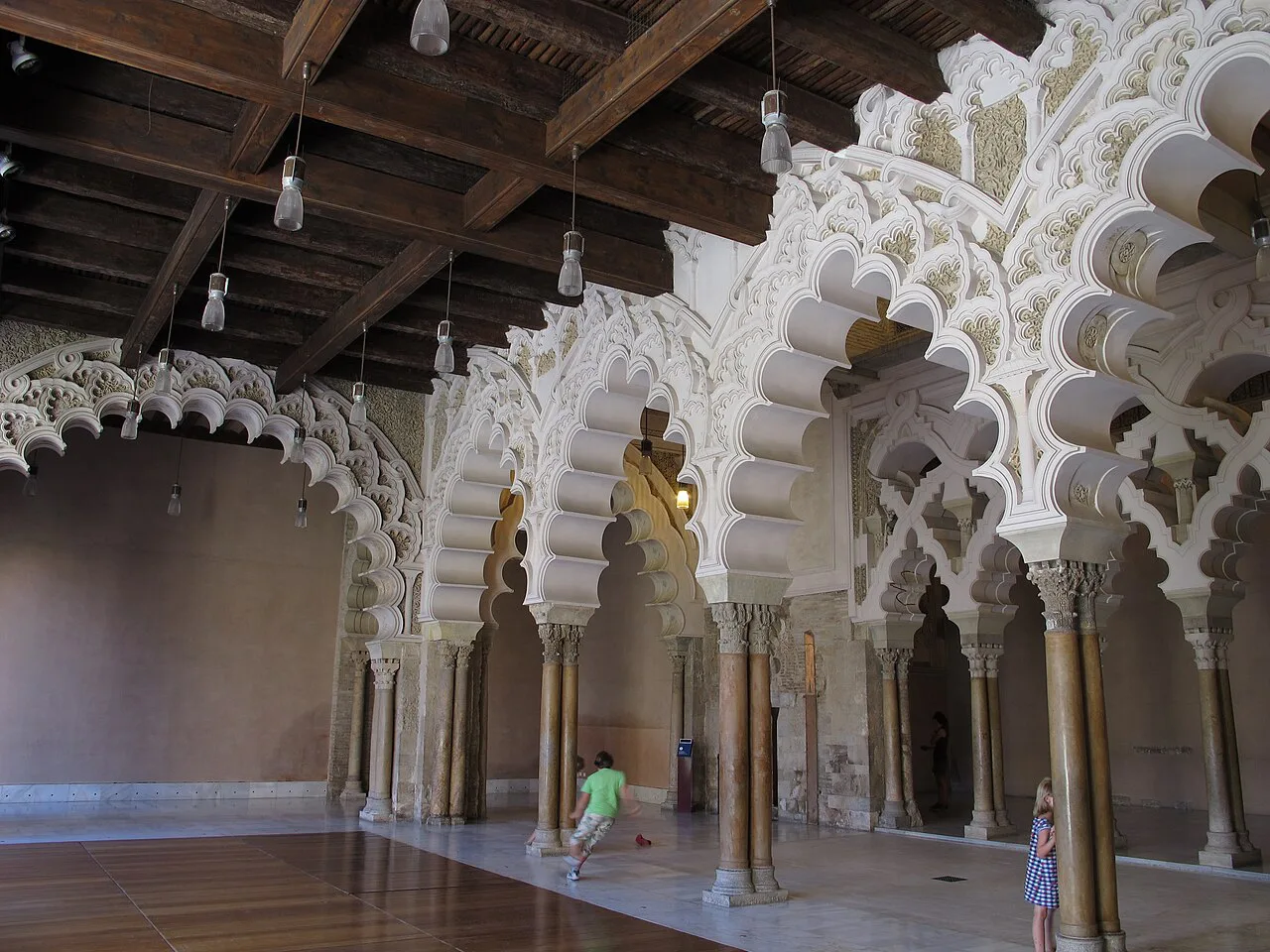
The heart of the taifa palace is a rectangular courtyard with a pool at each end, framed by side porticoes whose arches mix straight and polygonal lines with lobed forms. Stand at one end first to take in the proportions before you move into the porticoes. The effect is deliberately delicate: this is a courtyard designed to be looked at slowly, with water doubling the arcades and the sky.
The decoration is the point here, not scale: stucco work in the Islamic manner covers the arcades, and the courtyard gives you the clearest sense of what the eleventh-century palace was for. If you are short of time, this and the Salón del Trono are the two interiors not to skip.
The Torre del Trovador and the oratory
The Torre del Trovador is the oldest part of the complex, a defensive tower that predates the palace's later lives and gives the site its most photographed silhouette above the walls. Its fabric is what matters: this is the piece of the building that anchors the eleventh-century date.
On the north side of the courtyard sits a small octagonal oratory with a mihrab on one wall, decorated in ataurique, the interlaced vegetal carving typical of Islamic work in Spain. It is easy to walk past because it is small and tucked into the portico, so look for it deliberately. The contrast with the ceremonial halls around it is one of the pleasures of the visit.
The Mudéjar palace of Pedro IV
Pedro IV's fourteenth-century additions are where the palace stops being Islamic and becomes a Christian royal residence built by Mudéjar craftsmen. The Iglesia de San Martín and the chapel of San Jorge belong to this phase, along with the painted decoration of the Tale of Jaufré and the alcove of Santa Isabel. These rooms reward a slower pass than the courtyard, because the detail is in the wall paintings and carved plaster rather than the architecture.
The upper floor of the Mudéjar palace holds the chambers of Pedro IV, an outer room over the reception hall and an inner one over the north salon, joined by doorways roughly 1.2 metres wide and 3.1 metres high. The 17-metre north chamber reaches over 8 metres in height, though eighteenth-century alterations divided the space and left traces such as soot on the ceiling beams. Knowing this explains why some surfaces look patched rather than pristine.
The Palacio de los Reyes Católicos
The Catholic Monarchs' palace of 1492 is the most ceremonial part of the route, reached by a monumental staircase and a gallery before a sequence of rooms known as the Pasos Perdidos, roofed with Gothic-Mudéjar carpentry. The sequence builds towards the Salón del Trono, whose coffered ceiling is the single most impressive interior on the site. Plan your attention for the end of this run rather than spending it all in the gallery.
Look down as well as up: the floor tiles of this palace are part of what makes the rooms read as a coherent sixteenth-century ensemble. The lost steps of the name refer to the circulation between these halls, and the whole block shows how quickly Aragonese royal taste absorbed Mudéjar craft into Renaissance planning.
The defences outside the walls
Felipe II turned the palace into an artillery-proof fortification, and his engineer added a sloping barrier with pentagonal bastions at the angles, surrounded by the broad moat you cross to reach the entrance. The neo-Gothic towers on the outer façade are a nineteenth-century barrack conversion, and only two of the four survive. Walk the outside edge before or after your slot; it takes minutes and makes the interior make sense.
The site was used as a barracks for long stretches of the eighteenth and nineteenth centuries, which is why the façade and some interiors were remodelled for military use rather than preserved as royal rooms. Twentieth-century restoration reversed much of that, and the Cortes de Aragón moved in during the 1980s, which is why the complex is both monument and working institution.
How long to allow
Budget an hour and a half for the palace itself, including the exterior, and line that up with a published guided slot rather than arriving mid-session. The tour structure sets the pace: you move with a group, so there is little scope for lingering in the Salón del Trono. If you are photographing the stucco work in the courtyard, add a little time at the start.
Pair it with one other sight rather than trying to fill a day. The palace is absorbing but not large, and the old town across the river deserves its own half-day, so a morning slot at the Aljafería followed by an afternoon in the centre is a comfortable shape for a short break.
What is nearby
Across the river, the Basílica del Pilar and the cathedral of La Seo form the core of historic Zaragoza, and both sit within the same walkable centre. The Basílica del Pilar, Zaragoza is the city's defining monument and pairs naturally with the palace as the two poles of a day. La Seo Cathedral, Zaragoza is a short walk away and covers the city's other great religious interior.
The Museo de Zaragoza holds archaeological and fine-art collections that fill in the periods the palace only hints at, and it is a sensible rainy-day companion. The Museo Goya Zaragoza (Camón Aznar) covers the city's most famous painter if you want a second indoor stop.
Further out, the Cartuja del Aula Dei lies beyond the city and holds a celebrated painting cycle, but it needs its own transport planning and time. The palace's own surroundings are residential and quiet, without a tourist strip to browse afterwards, so treat the Aljafería as a destination in itself.
Which slot to book at the Aljafería
Choose a morning tour slot on a day the published schedule leaves open, and build the rest of the day around the old town across the river. If you are travelling between November and March, avoid a Sunday afternoon; if you are in the city on a Thursday or Friday morning, the palace is not open. The palace is the most historically layered sight in Zaragoza and deserves to anchor a half-day rather than be squeezed between cathedrals.
Explore more Zaragoza guides
Frequently Asked Questions
Who built the Aljafería Palace?
The taifa palace was built in the eleventh century under al-Muqtadir, the Banu Hud ruler of Saraqusta. It was later remodelled as a royal residence by the kings of Aragon, most notably Pedro IV, extended by the Catholic Monarchs from 1492, and converted into a fortress by Felipe II. Since 1987 it has housed the Cortes de Aragón.
Is the Aljafería inside Zaragoza's old town?
No. It stands on Calle de los Diputados, west of the historic centre, so it is a separate stop rather than part of an old-town stroll. Plan it as its own half-day rather than something you pass through between the Pilar and La Seo.
How do you see the interiors of the Aljafería?
The interiors are seen on guided tours at set times rather than by wandering freely, and the published slots fall in the morning and again in the afternoon. Groups of twenty or more should book by telephone; individual visitors join a scheduled slot. Confirm the current times and any parliamentary closures before you set out.