
Plaza Mayor, Salamanca: a Visitor's Guide to the City's Main Square

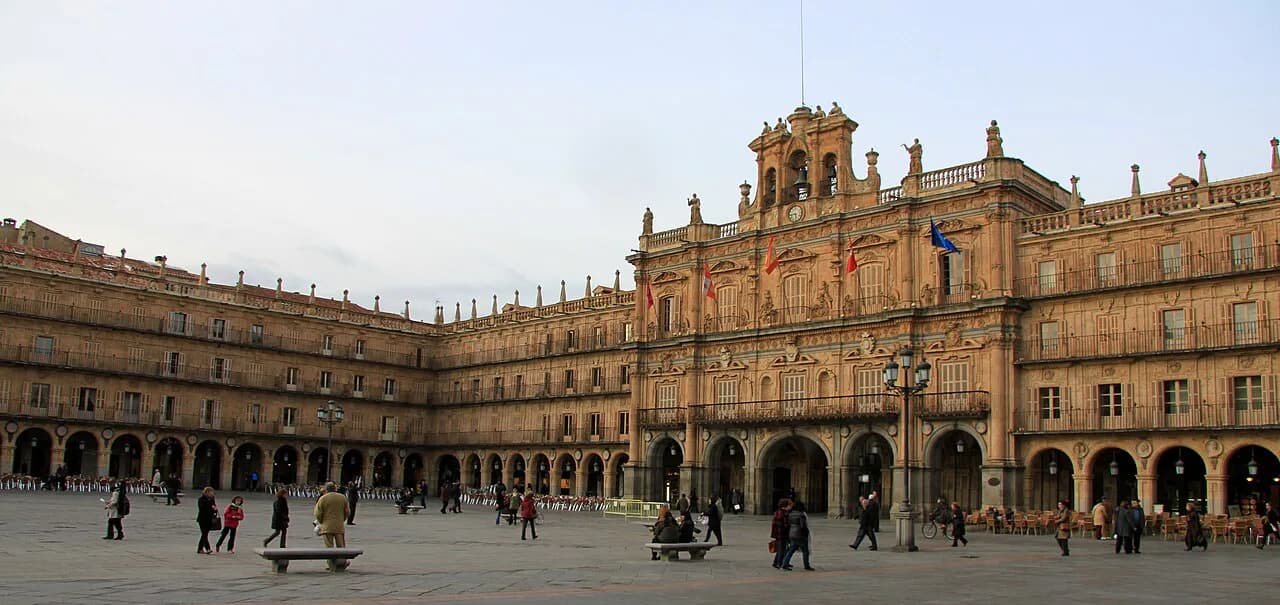
The Plaza Mayor is the first place to go in Salamanca and the easiest landmark to plan a day around: a public square, free to walk into at any hour, ringed by arcades and baroque facades. Allow roughly half an hour to look properly, longer if you sit and watch the square fill up, and treat it as the hinge between the cathedral quarter and the shopping streets of the old town. This guide covers where the square sits, what to look at, how the evening lighting works and which monuments are a short walk away.
Why the Plaza Mayor anchors a Salamanca break
The square is the city's central public space, described as one of the finest in Europe and the nerve centre of Salamanca. It is also the obvious meeting point: guided walks gather at the tourist office on the square, and the arcades make a natural shelter whatever the weather does. Because it is public ground rather than a ticketed monument, you can pass through it several times a day without planning.

Where it is: Plaza Mayor 32 and the Casa de Postas
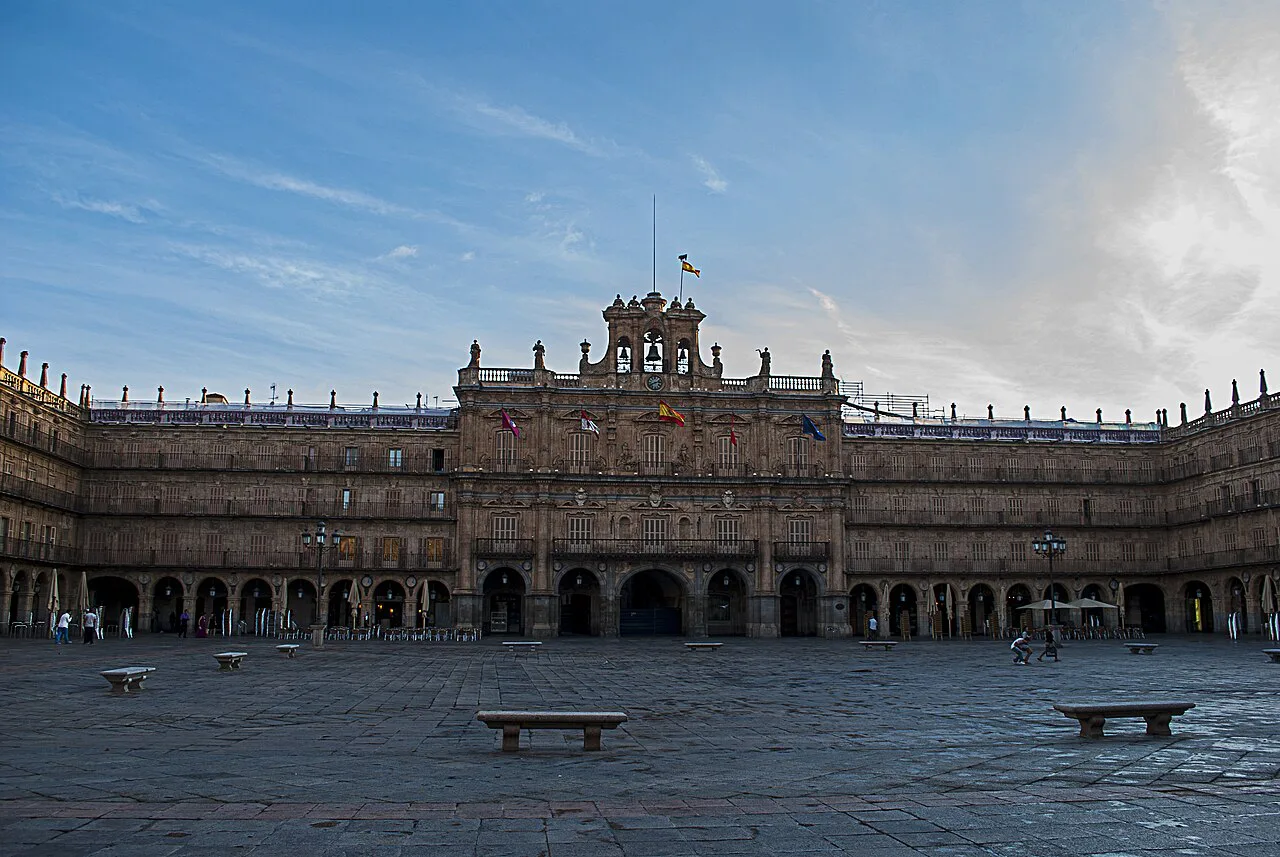
The tourist office sits at Plaza Mayor 32, in the Casa de Postas, and it is the practical address to note before you arrive. Staff there can confirm the city's current opening arrangements and the day's lighting schedule, and the office is the published contact point for guided activities in the city, with telephone numbers listed on the tourism site. Use it as your first stop if you want to book a walk rather than simply wander.

How to get there on foot from the cathedral and the university
Almost every route through the old town leads to the square, and walking is the sensible way to arrive. From the cathedral quarter, the standard approach runs via the Plaza del Corrillo, the small square beside the Plaza Mayor, or through the arcaded lanes off the Calle de la Rúa. From the university's historic building, the walk down through the Plaza de Anaya and past the Clerecía brings you to the square within a few minutes. Neither leg is long enough to justify a bus or taxi.
What to look at: facades, the Pabellón Real and the medallions
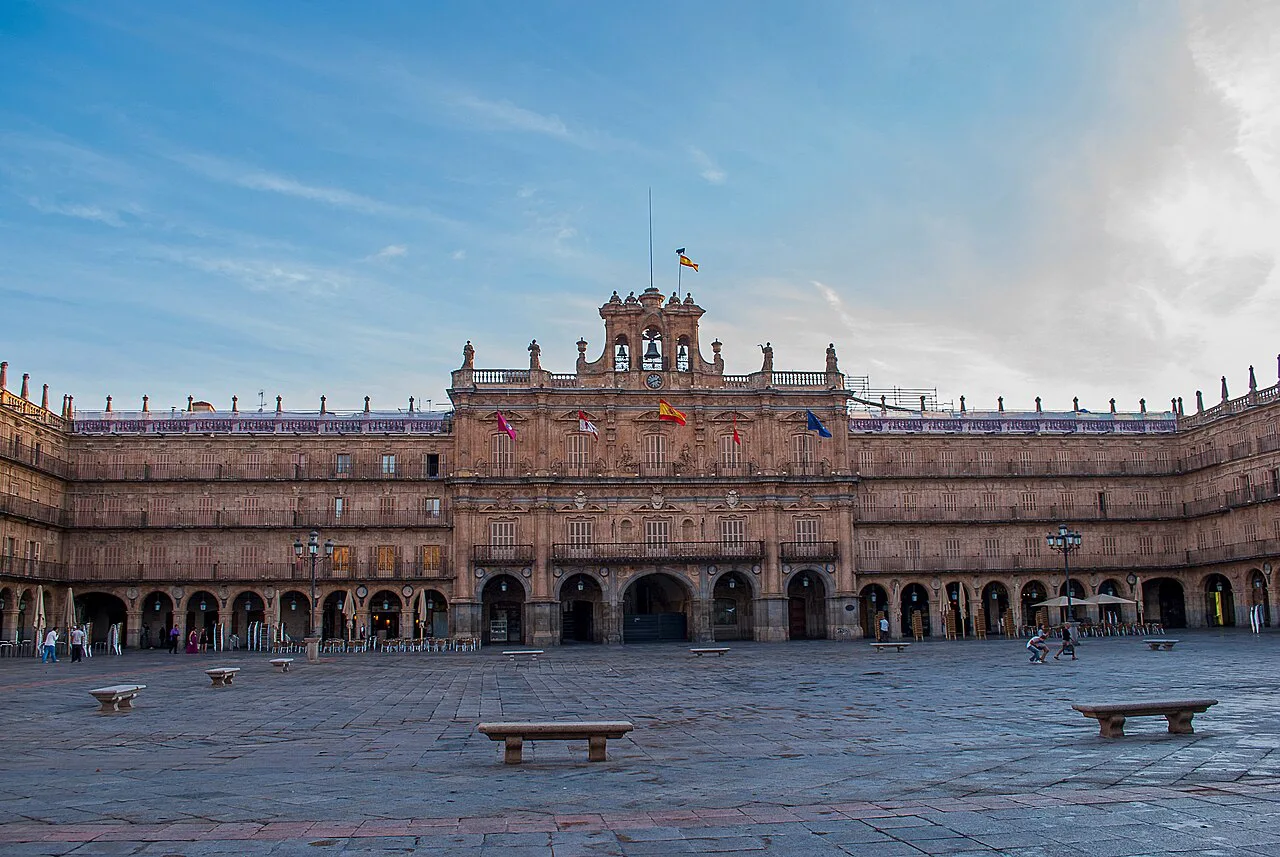
Look up. The square's enclosed, regular plan was designed by Alberto de Churriguera, and the facades are carved with medallions of monarchs, soldiers and discoverers intended to exalt Spanish history; some medallions remain unfinished, and new ones are still being carved by different sculptors. Construction opened with the Pabellón Real, the royal pavilion on one side of the square, which carries a figure of San Fernando rather than the monarch who authorised the project. Above the Ayuntamiento, the municipal building, the espadaña was added later in the nineteenth century and is ornamented with figures of Architecture, Sculpture, Geography and Agriculture.
The square's building history
Work began on 10 May 1729, after royal authorisation earlier that year, with Alberto de Churriguera producing the technical plan. The project stalled more than once through disputes, and the second phase from 1750 was directed by Andrés García de Quiñones; the square was substantially finished by 1755, though the Ayuntamiento's towers were never built and its espadaña arrived in 1852. It was declared a Bien de Interés Cultural in 1973. Knowing this helps you read the square: it is genuine eighteenth-century work, not a reconstruction.
The evening lighting
The square's artistic lighting is now promoted in its own right, and the switch-on has become a reason to return after dark. Across the city, 83 buildings and 38 sculptures are illuminated, so an evening walk takes in far more than the Plaza Mayor alone. The switch-on follows sunset and therefore shifts through the year; the tourist offices publish the day's timing, so ask at the Plaza Mayor office, the Centro de Recepción de Turistas at the Fonda Veracruz or the information point at the cathedral atrium.
The square as the start of a guided walk
If you want the monuments explained rather than simply seen, a guided walk is the efficient way to cover the old centre, and the Plaza Mayor tourist office is the published meeting point for one monumental city tour. That walk lasts roughly two and a half to three hours and visits the Plaza Mayor, the Plaza del Corrillo, the Calle de la Rúa, the Casa de las Conchas and its courtyard, the Clerecía, the Plaza de Anaya, the exteriors of the two cathedrals, the Calle Libreros and the Escuelas Mayores courtyard, finishing inside the cathedrals. The tour price is 12 € per person with a whisper headset included; monument entry is charged separately at 5 € for the historic university building and 7 € for the cathedrals, and children under six go free with half price for ages seven to eleven. It runs in Spanish, generally Monday to Saturday at 10:45, with additional departures on special dates, and needs a minimum of eight paying participants, so book through the organiser before relying on it.
How long to allow, and how to combine it with the monuments
Give the square itself thirty to forty-five minutes on a first pass, then come back in the evening for the lighting. The bigger time commitment is the ring of monuments around it: the university's historic building and the cathedrals each deserve a proper look, and a guided walk bundles them into a half day. If you are seeing them independently, plan the square as a start and finish point rather than a single stop.
What is nearby
Within a few minutes on foot you have the Casa de las Conchas, its shell-covered facade and courtyard on the Calle de la Rúa, the Clerecía with its twin towers, the Plaza de Anaya and the two cathedrals, the Catedral Nueva and the older Catedral Vieja. The university's Escuelas Mayores and its historic lecture rooms sit just beyond the Plaza de Anaya. Night-time visits to the Clerecía towers and the cathedral are separately organised and worth booking ahead if the evening is your focus.
Practical trade-offs
The square is exposed in the middle and shaded under the arcades, which is where you will want to be on a hot inland summer midday; Salamanca's summers are fierce and the paved centre radiates heat. Crowds swell at the switch-on and whenever a large guided group sets off from the tourist office, so time your photographs for the quieter early morning. Churches and monuments around the square keep their own visiting hours, which may break around services, so check each one before you build an afternoon around it.
Is the Plaza Mayor worth building your day around?
Yes, and not because it takes long to see. The square works as a fixed point: tourist office, meeting point, evening spectacle and a five-minute walk from the cathedral, the Clerecía and the university. Start there in the morning, book a walk if you want the history narrated, and come back after sunset when the lighting comes on.
Explore more Salamanca guides
Frequently Asked Questions
Do you need a ticket for the Plaza Mayor in Salamanca?
No. The square is public space and you walk in freely; the tourist office on the square can tell you what is running and when the lighting switches on. Tickets apply to the monuments around it, such as the university's historic building and the cathedrals, which are priced and sold separately.
How old is the Plaza Mayor?
Construction began in 1729 and the square was substantially finished by 1755, with the Ayuntamiento's espadaña added in the nineteenth century. It was declared a Bien de Interés Cultural in 1973.
What language are the guided walks in?
The monumental city tour that meets at the Plaza Mayor tourist office is given in Spanish, so bring a reasonable ear for it or choose a different operator. The tour includes a whisper headset to make the guide easier to follow in a group.
What are the two cathedrals next to the square?
The Catedral Nueva and the older Catedral Vieja stand side by side in the cathedral quarter, a short walk from the Plaza Mayor via the Plaza de Anaya. They are separate monuments with their own visiting arrangements, so check before you go.