
Iglesia de la Concepción, Santa Cruz de Tenerife: what to see and how long to allow

The Iglesia de la Concepción is worth an hour of any Santa Cruz de Tenerife break, and the tower facade alone justifies the walk from the centre. It is the city's mother church, declared a Bien de Interés Cultural in 1983, and much of what you see today followed an eighteenth-century rebuild after a fire.
What follows covers where the church sits above the barranco de Santos, what to look for on the outside and inside, which chapels and images deserve your time, and how the visit slots into a wider day in the city. Practical times are left to the parish rather than guessed at here.
What the Iglesia de la Concepción is and why it matters in Santa Cruz
This is the parish church from which the city grew, founded as a parish in 1499 when it was separated from the beneficio of La Laguna, and it remains an active place of worship rather than a museum piece. Its official name is the Parroquia Matriz de Nuestra Señora de la Concepción, and the title matriz signals its role as the founding church of Santa Cruz.
A fire caused by an oil lamp on 2 July 1652 destroyed the church except for its walls, and the parish set about reconstruction with donations from the faithful. That accretion is why the interior feels like several buildings stitched together, and why the chapels read as a record of the merchant families who paid for them.

Where it is: the barranco de Santos setting and how to reach it on foot
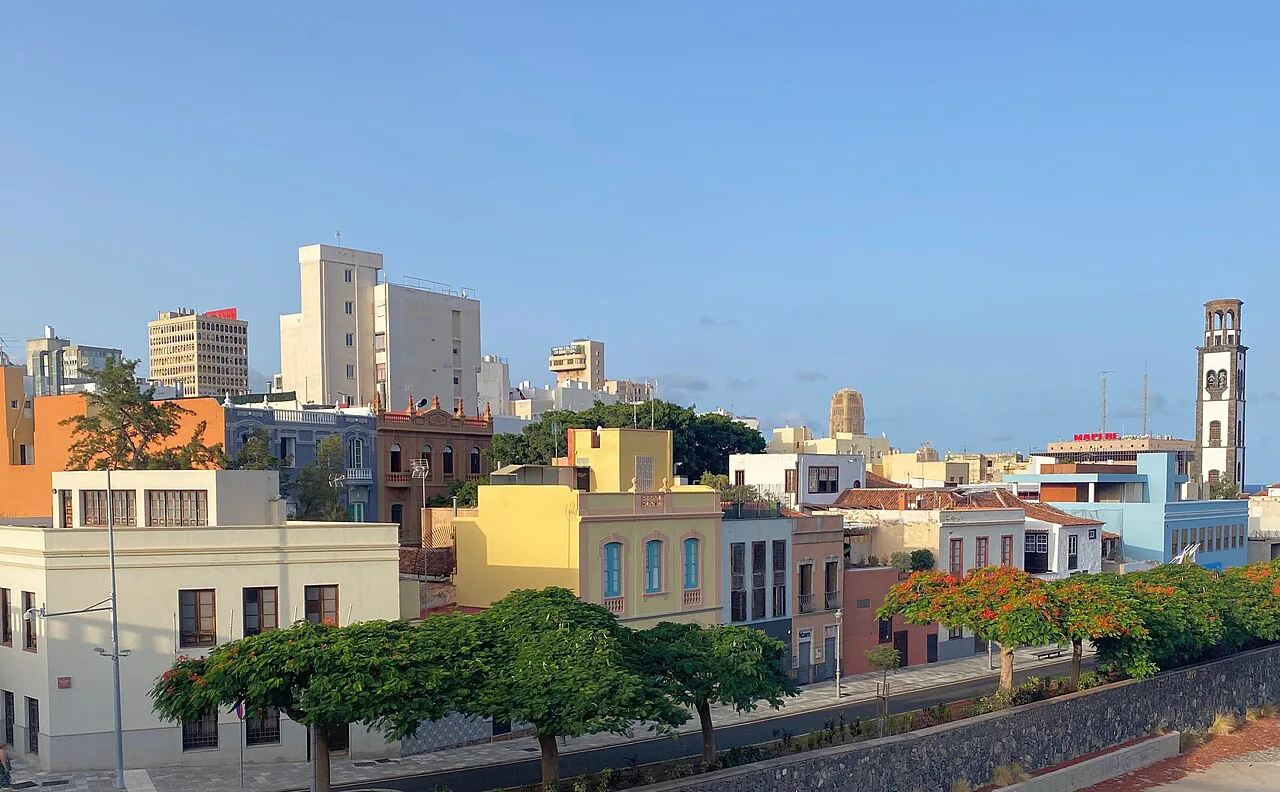
The church stands beside the barranco de Santos, the ravine that once marked the edge of the settlement and now runs through the lower part of the city. Approaching from the centre, the tower appears above the surrounding rooftops before you reach the doors.
It is a straightforward walk from the Plaza de España, Santa Cruz de Tenerife and the main shopping streets, so most visitors reach it on foot without needing transport. Build it into a loop that also takes in the civic squares rather than treating it as a separate outing.
If you are coming from further out, the city's bus and tram network serves the centre, and the last stretch is level walking. Allow for the slope down to the ravine on the return, which is more noticeable in afternoon heat than on the way in.

The exterior: the atrio, the carved stone arches and the Canarian balconies
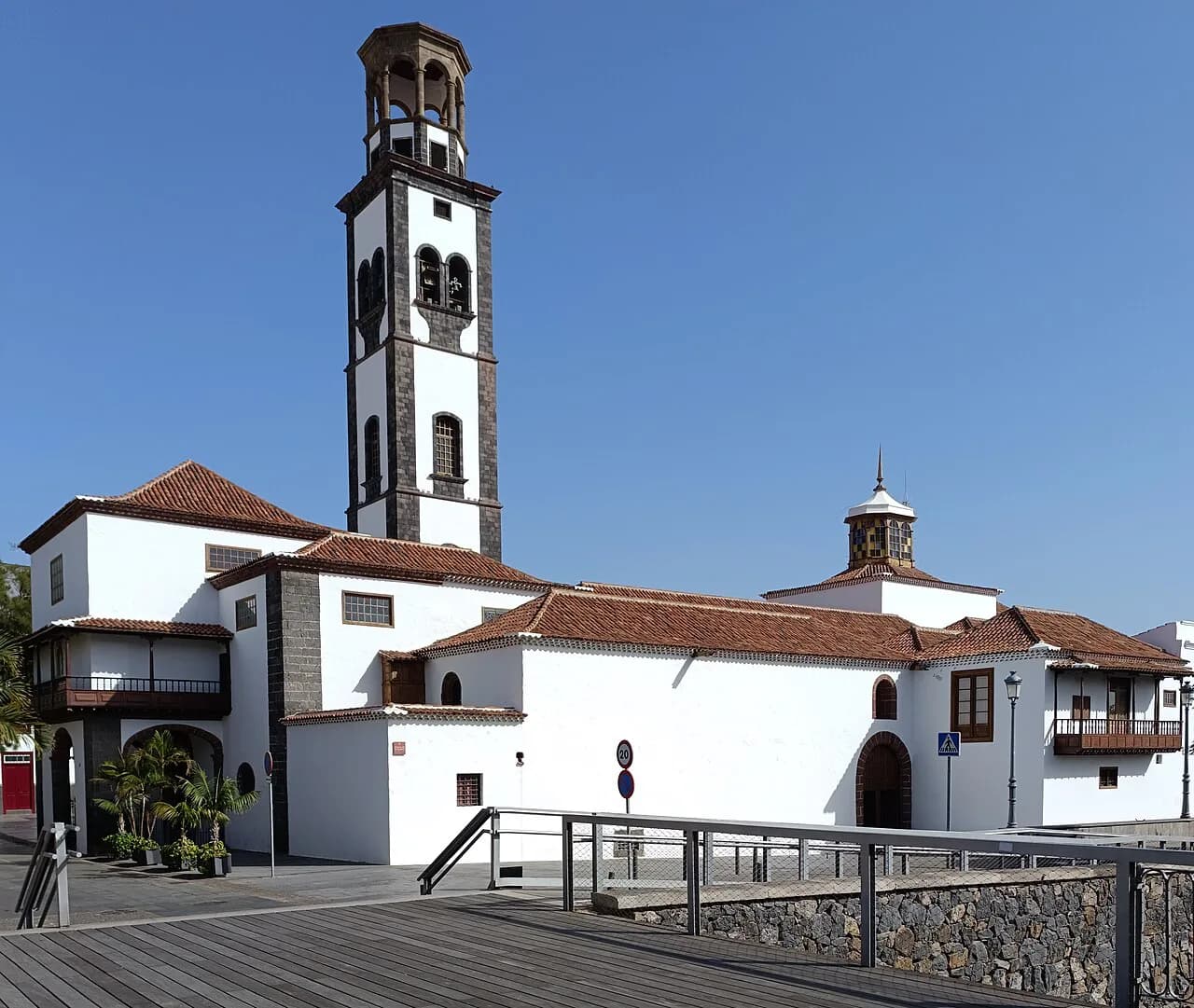
The atrio in front of the main facade was built in the second half of the eighteenth century, and its lowered stone arches and outsized balcony give the church one of the most distinctive profiles in traditional Canarian architecture.
Wooden Canarian balconies project from the exterior, and together with the stonework they make the church a case study in the island's vernacular building style. The lower module of the tower forms a porch, so you enter through the bell tower rather than beside it.
The tower-campanario: four prismatic modules and the octagonal drum
The bell tower is a separate architectural event from the facade. It is built as four prismatic modules, each open on all four sides, stacked to form a tall, airy campanario topped by an octagonal drum whose upper level opens through round stone arches.
The tower was decided on in 1776 by Bishop Juan Bautista Cervera, who donated 8,000 silver reales towards it, and it was finished in 1782. Step back towards the ravine side of the church for the clearest view of the whole stack.
Inside: five naves, the red cantería columns and the mudéjar ceiling
Inside, the church opens into five naves separated by round arches carried on Tuscan columns of red local stone, a layout that makes the interior feel wider than its footprint suggests. The building measures 68 metres long by 25 wide and 11.5 metres high.
The Capilla Mayor rises higher than the rest of the church and is covered by a mudéjar ceiling with an octagonal structure and a central almizate. Look up as soon as you enter the nave: the carpentry is the most important surviving medieval-style work in the building, and the fourteen merchant chapels along the aisles slow any circuit down.
The retablo Mayor and the Inmaculada Concepción by Fernando Estévez de Salas
The high altarpiece is baroque-churrigueresque, with a single body of three sections and an attic. In its central niche stands the Inmaculada Concepción, a candelero image by the Orotava sculptor Fernando Estévez de Salas, flanked by carvings of San Joaquín and Santa Ana by the La Laguna sculptor José Rodríguez de la Oliva.
Visitors often assume this is the church's most revered image; it is not. The high altarpiece is the artistic centrepiece, while the church's oldest Marian figure sits in a side nave, and knowing the difference saves confusion.
The Virgen de la Consolación, patron of Santa Cruz
In the altarpiece of the nave of the Evangelio you find the Virgen de la Consolación, described as the oldest Marian image in Tenerife and the patron of Santa Cruz. This is the image to seek out if you only have time for one chapel.
Popular devotion in Santa Cruz attaches to the Consolación rather than to the Inmaculada over the high altar, so approach the side nave with that hierarchy in mind. Tenerife's wider patronal devotion is a separate story centred elsewhere on the island.
The Capilla de San Matías and its cedar retablo
The Capilla de San Matías, near the passage from the nave of the Epístola to the sacristy, was commissioned in 1740 by Matías Rodríguez Carta as a family pantheon. Its retablo, carved in cedar and barbusano wood, is the work of the French artist Guillermo Veraud, with a single body of three sections and salomonic columns crowned by an octagonal vault and a lantern that admits light from above.
The carved figures of San Matías, San Andrés and San Carlos Borromeo were brought from Genoa in 1737. Look for the light effect rather than just the carving, since the lantern above the retablo picks out the figures against the gloom of the side aisle.
The Cruz Fundacional and other treasures to look for
The parish's most treasured relic is the Cruz Fundacional, the founding cross that gives the city its name. A large wooden cross was planted on the beach at Añazo, where mass was celebrated on 3 May 1494, and a settlement grew around it.
Other movable works include a marble pulpit imported from Genoa and presented in 1736 by Captain Matías Rodríguez Carta, a painting of Ánimas by Luis José Curbelo, and an Adoration of the Shepherds by Juan de Miranda.
At the entrance you pass the tomb of Antonio Benavides, lieutenant general of the Royal Armies, who died in 1762. The chapel of Santiago holds the two flags taken from Nelson's force after the 1797 attack on the city, and the chapel of the Virgen del Carmen keeps a relic of Saint Clement donated to the parish in 1703 by the abbot Giovanni Battista Sidotti.
How long to allow and when to go
An hour covers the exterior, the tower view and a circuit of the naves with the main chapels; ninety minutes lets you read the memorials and sit with the retablos. Trying to see all fourteen chapels in detail is not realistic on a short break.
Go in the morning if you want the facade lit and the interior quieter. This is an active parish, so sightseeing can be curtailed around services, and a visit timed to avoid mass is more rewarding than one that clashes with it.
The walk down to the ravine and back is exposed, so carry water and treat the church as a cool pause rather than a full afternoon.
Opening hours, mass times and free entry: how to check
The Santa Cruz parish publishes its mass times and office schedule on its own pages, and the parish office handles enquiries on a limited weekly schedule, so checking ahead by phone or email is more reliable than turning up. Entry arrangements are not posted on the pages linked here, so ask the parish directly.
Do not confuse this church with the similarly named Parroquia de la Concepción in La Orotava, which has its own address and schedule; the Santa Cruz church is the one beside the barranco de Santos.
What is nearby in Santa Cruz
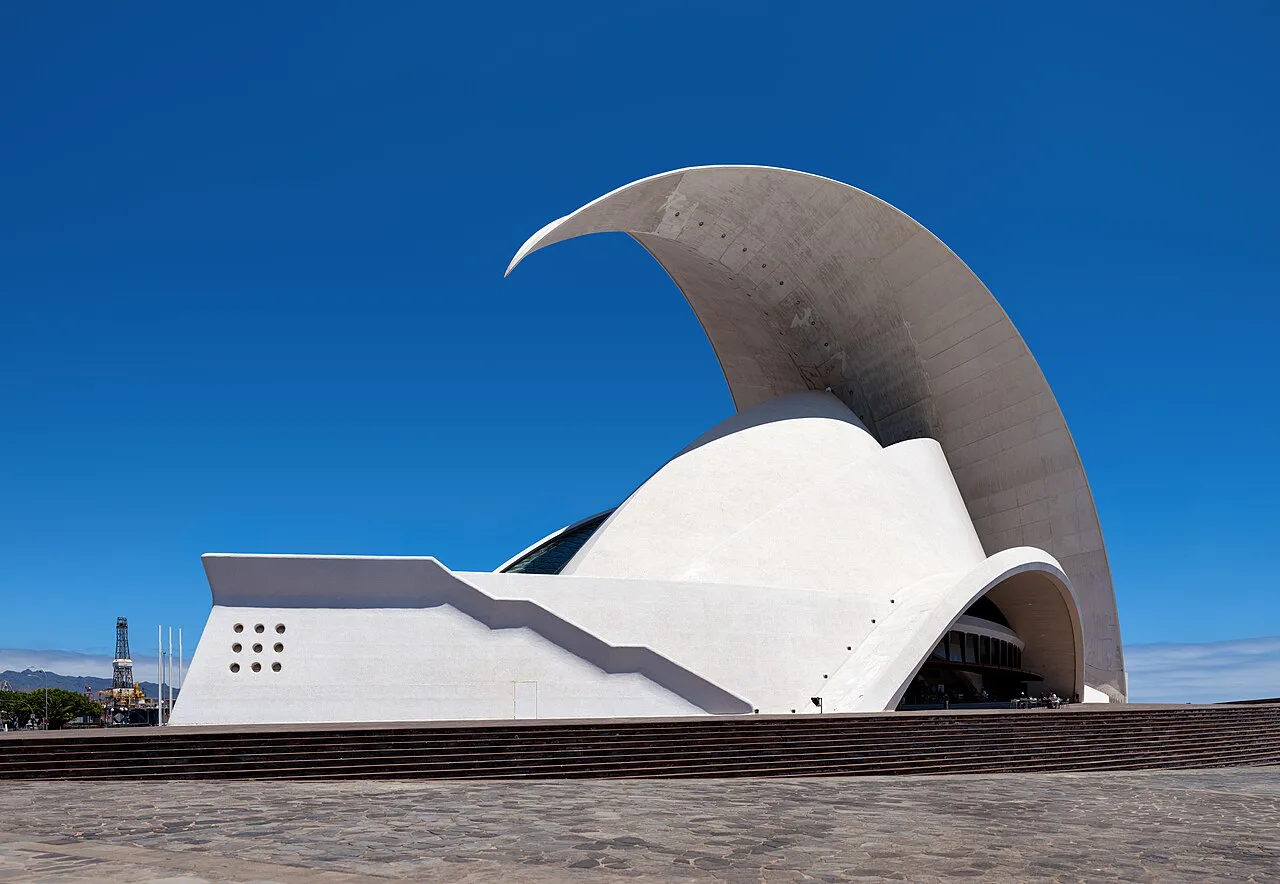
The Auditorio de Tenerife, the city's landmark concert hall, is a short walk away and a natural pairing with the church if you are following the city's architecture. Check its programme separately if you want to catch the Sinfónica de Tenerife or an Ópera de Tenerife performance.
The Castillo de San Cristóbal, Santa Cruz de Tenerife, the small fortified remnant of the city's defences, sits close to the Plaza de España and fits neatly into the same walk. The Palmetum Santa Cruz de Tenerife, a botanical garden above the coast, is a longer but worthwhile extension for plant lovers.
For a slower afternoon, the Parque García Sanabria, Santa Cruz de Tenerife offers shade and a break from the streets around the church, and between these stops you can build a full day on foot without leaving the centre.
Should the Iglesia de la Concepción be your first stop in Santa Cruz?
Yes, if you want to understand the city rather than tick off a monument. The Iglesia de la Concepción gives you the founding cross, the merchant chapels, the mudéjar ceiling and the tower in one compact visit, and it sets up everything else you see in Santa Cruz.
Give it an hour, arrive in the morning, and confirm service times with the parish before you set out. Then walk down to the Plaza de España and let the city's civic squares finish the story.
Frequently Asked Questions
How old is the Iglesia de la Concepción in Santa Cruz de Tenerife?
The parish was founded in 1499, but the building has been rebuilt several times, most decisively after the fire of 2 July 1652. The tower was completed in 1782, so the church you see is a composite of five centuries rather than a single date.
Who is the patron virgin of Santa Cruz de Tenerife?
The Virgen de la Consolación is the patron of Santa Cruz and is described as the oldest Marian image in Tenerife. She stands in the altarpiece of the nave of the Evangelio, not in the high altarpiece, where the Inmaculada Concepción by Fernando Estévez de Salas is displayed.
Is the church free to enter?
The sources linked here do not state a ticket price or a free-entry slot. Ask the parish office directly before you travel if entry arrangements affect your plans.