
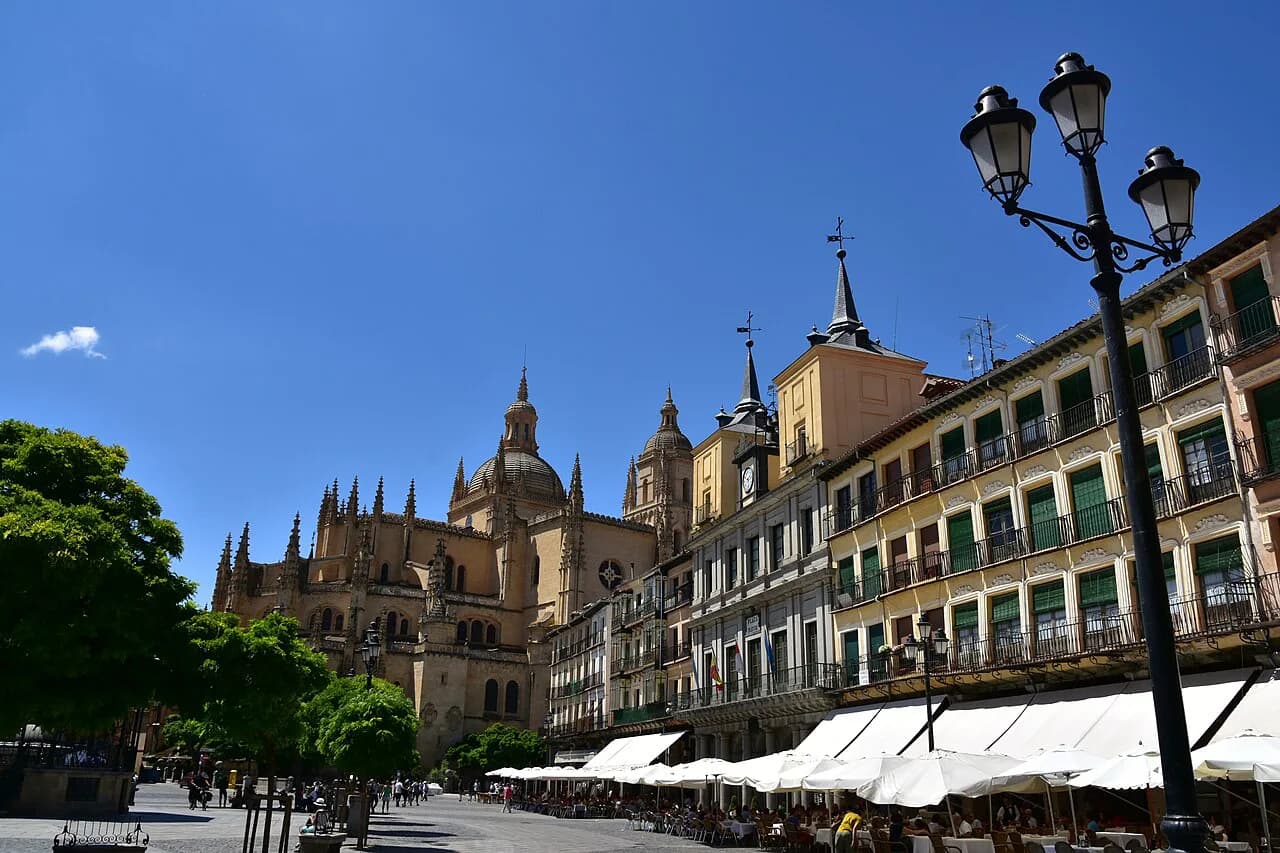
Plaza Mayor, Segovia: the Square at the Centre of the Old Town

Plaza Mayor is the social centre of old Segovia and costs nothing to walk through: it is a public square, open at all hours, with the cathedral apse rising behind its eastern edge. Treat it as the hinge of a day in the old town rather than a sight with a turnstile, and it slots neatly between the aqueduct and the Alcázar. This guide covers where the square sits, how to reach it on foot, what to look at once you are there, and which ticketed sights lie within a few minutes of its edges.
Where Plaza Mayor sits in the old town
The square occupies the middle of the walled old town, on the ridge between the Azoguejo and the Alcázar. It opens directly onto the lanes of the Judería on its northern side, which makes it a natural orientation point on arrival. Because the old town is compact and largely pedestrian, you will cross the square rather than detour to it.
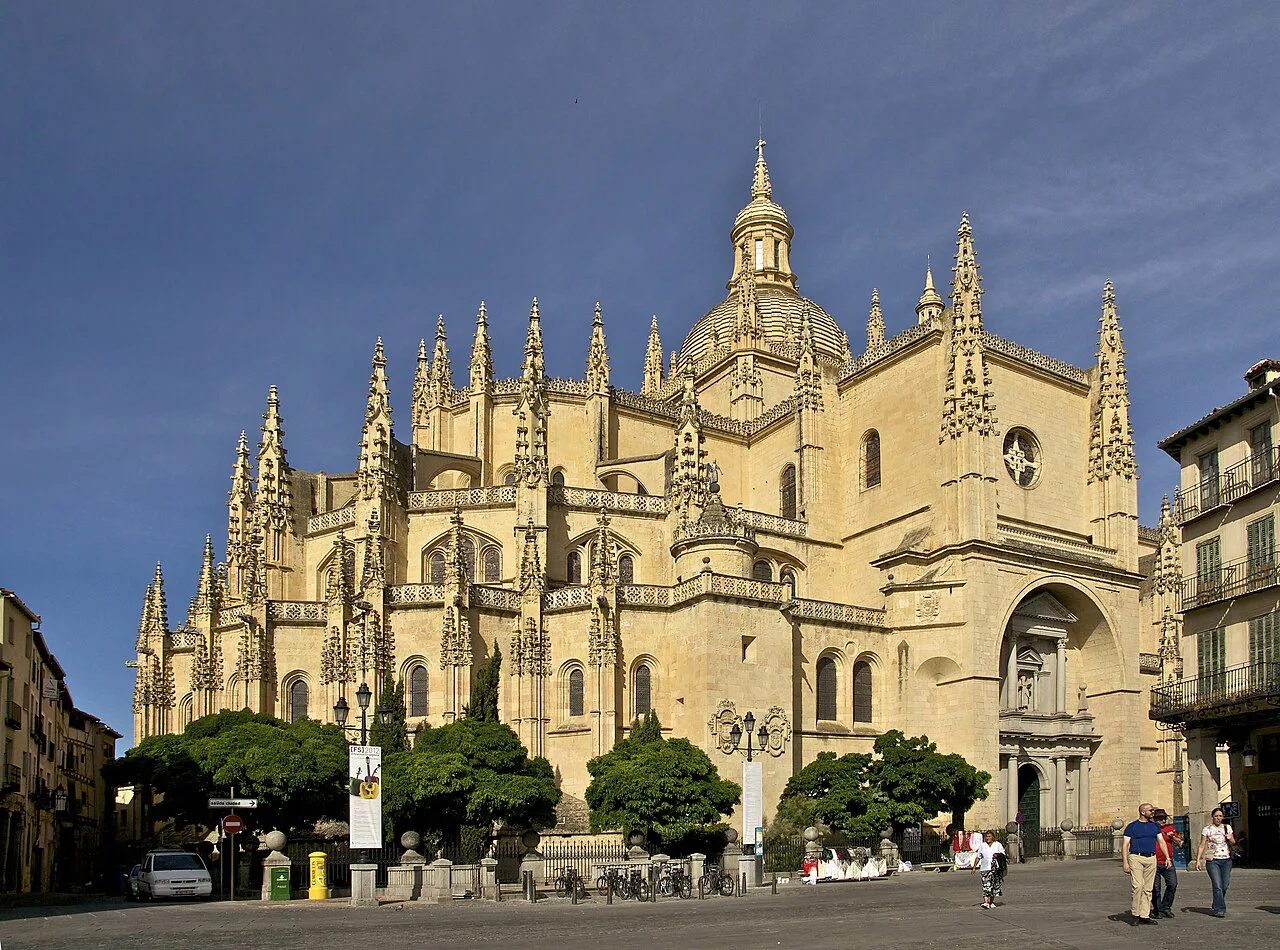
The cathedral's rear wall forms the square's most photographed backdrop, so the building you see from the terrace tables is the apse, not the main door. The visitor entrance is round the corner on Calle Marqués del Arco. Knowing this saves a lap of the cathedral when you decide to go inside.

Getting there from the Aqueduct and the Azoguejo
Most visitors arrive on foot from the Azoguejo, the plaza at the foot of the aqueduct, then climb through the old town. The tourist office at Plaza del Azoguejo sits roughly half a kilometre from the square on the direct line, which makes it a sensible last stop for a map before the climb. From the aqueduct the route is uphill and cobbled, so allow more time than the distance suggests.
By train or bus you arrive below the old town and finish the approach on foot or by local bus; the climb is short but steady. Read the square as the midpoint of a route rather than a destination, then use the wider Segovia Attractions guides to sequence the rest of the day. To carry on uphill afterwards, the Alcázar sits about 750 metres from the square.
Walking is the only practical way around the old town centre, and the lanes between the Azoguejo and the square are stepped in places. Comfortable shoes matter more than any timetable here, and the reward is that the aqueduct, cathedral and Alcázar all fall within one continuous walk.
What you see in the square: bandstand, balconies and cafés
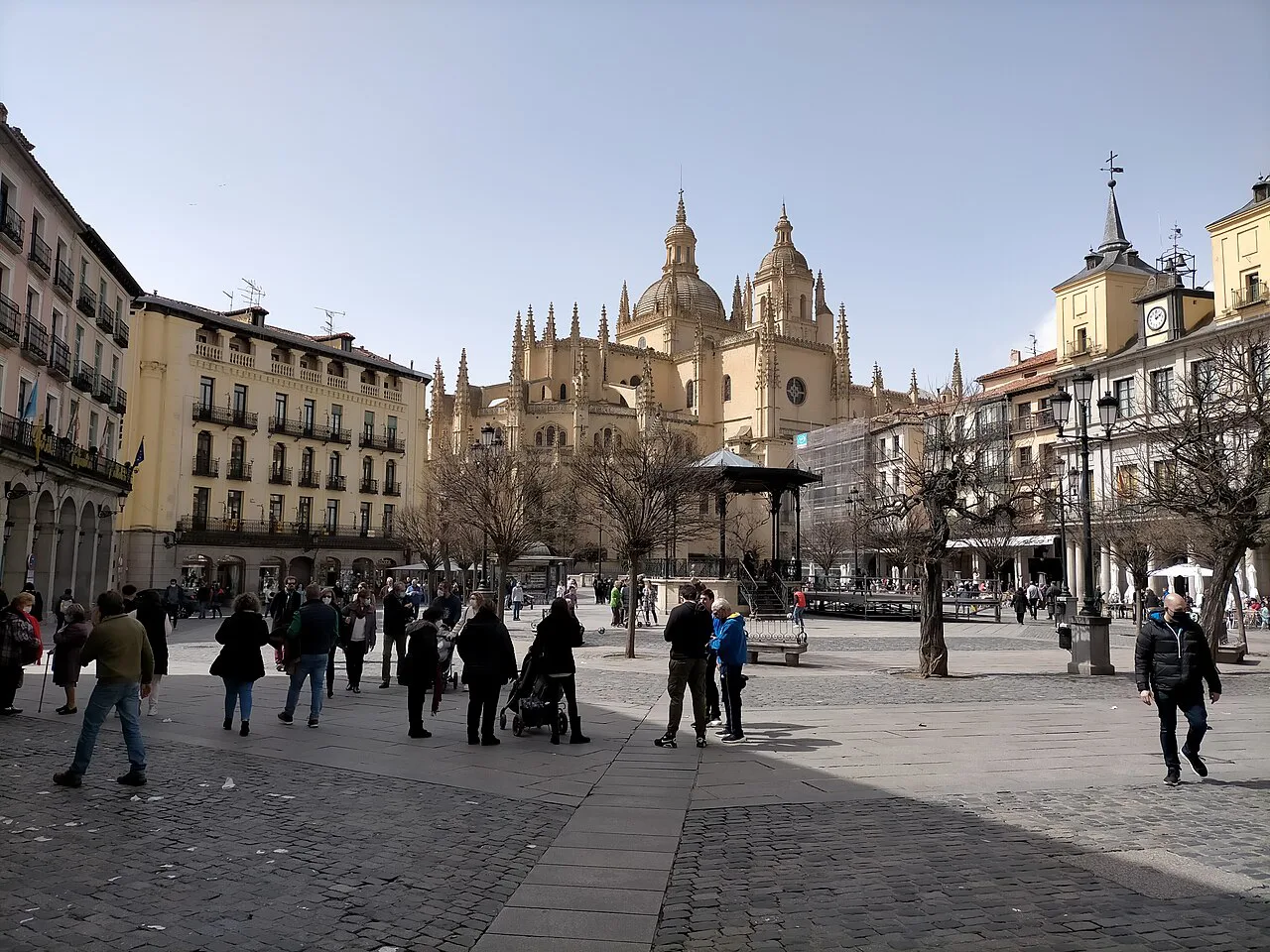
In the middle of the paving stands a small bandstand, or templete, used for musical performances, with café terraces spread around it. The surrounding buildings carry the elegant iron balconies and glazed galleries that give the square its look, and arcades at ground level shelter the tables. It is a place to sit for twenty minutes rather than to tick off.
Two civic buildings anchor the square: the Ayuntamiento, which dates from the seventeenth century, and the Teatro Juan Bravo, built in 1917. Both are exterior landmarks on the square rather than standard visitor attractions, so admire the façades and look separately at what might be on. The square also hosts markets and public events, so the scene changes with the calendar and a crowd can occupy the centre without warning.
The square's history: San Miguel and Isabel la Católica
The square was formerly known as the Plaza de San Miguel, and it was here in 1474 that Isabel la Católica was proclaimed queen of Castile. That makes the paving worth a second look: you are standing where a crown changed hands. The church that gave the square its old name was demolished in 1532 to enlarge the open space, and a later church of San Miguel now stands nearby.
The square as you see it is therefore the product of a deliberate sixteenth-century clearance rather than an accident of medieval planning. That helps explain why the open space feels so generous in a town of tight lanes and why the cathedral apse dominates one side.
The cathedral seen from the square's edge
The apse wall closes off one side of the square, while the cathedral's visitor route begins on Calle Marqués del Arco, 1, roughly a hundred metres away. The distance from the café tables to the ticket desk is therefore under two minutes, which makes the square a convenient waiting point if you arrive before the doors open. Tickets, tower access and visitor hours are managed separately from the square, so settle those on the day.
The square itself has no gate, ticket or closing time, which is why it works as a buffer around the ticketed stops. Guide-led cathedral visits sold by operators price themselves separately, so compare their offer against buying at the cathedral door before committing.
How long to allow and how it fits a walk
Give the square fifteen to thirty minutes if you are passing through, or an hour with a coffee and a look at the cathedral apse. It works best as the midpoint of a half-day route: aqueduct and Azoguejo first, then the climb to Plaza Mayor, then the lanes to the castle. The Alcázar de Segovia keeps seasonal hours that differ between winter and summer and closes on a handful of public holidays, so check before you commit to a late-afternoon slot.
The walk from the square to the castle takes perhaps ten to fifteen minutes through the old streets. Suitcases and tired legs struggle on the cobbles, so leave bulky bags behind. If the climb back is too much, the square's terraces make a fair reward for the effort either way.

Nearby sights within a few minutes
The Judería Vieja begins immediately north of the square, and the Centro Didáctico de la Judería on Calle la Judería Vieja sits about 105 metres away. The Palacio Episcopal, on Plaza San Esteban, is roughly 143 metres off, and the Casa-Museo de Antonio Machado on Calle los Desamparados is about 218 metres. All three are short hops that fit around a square visit.
The Museo de Segovia, housed in the Casa del Sol on Calle del Socorro, is around 412 metres from the square, and the Colección de Títeres Francisco Peralta on Calle la Puerta de Santiago is about 464 metres. These smaller museums reward an unhurried hour each and are useful when the weather turns.
Opening days vary by museum here: the Real Casa de la Moneda shuts on Mondays and Tuesdays, while the Casa-Museo de Antonio Machado opens on Monday and Tuesday mornings, and the Centro Didáctico de la Judería and the Títeres collection follow their own patterns. Check each one's hours on the day rather than assuming a single city-wide schedule.
Further out, the Casa de los Picos and the Vera Cruz Church sit on the far side of the old town and can be folded into the same walk if you start early. Both are exterior-first sights that take minutes rather than hours.
Practical points: free square, ticketed sights
The square itself is open and free to wander at any hour. Everything around it is ticketed separately, so budget for the cathedral and the museums rather than for the square. Summer afternoons on the paving are hot and exposed, with shade limited to the arcades, so plan a midday pause under the galleries or save the square for the cooler ends of the day.
Combined bus-and-monument packages exist that bundle cathedral and castle entry with a hop-on hop-off bus and a guided walk, priced by the operator. Buy only if the bundle beats paying at each door, and confirm what is included before booking.
Make the square your midpoint, not your destination
Plaza Mayor earns its place by being free, central and open whenever you arrive, which makes it the natural pivot between the aqueduct below and the castle above. Give it half an hour, use it to rest and reorient, and treat the ticketed sights around it as separate stops with their own hours.
Check the cathedral's and the museums' current opening days before you set out, then build the rest of the day around the square rather than rushing through it.