
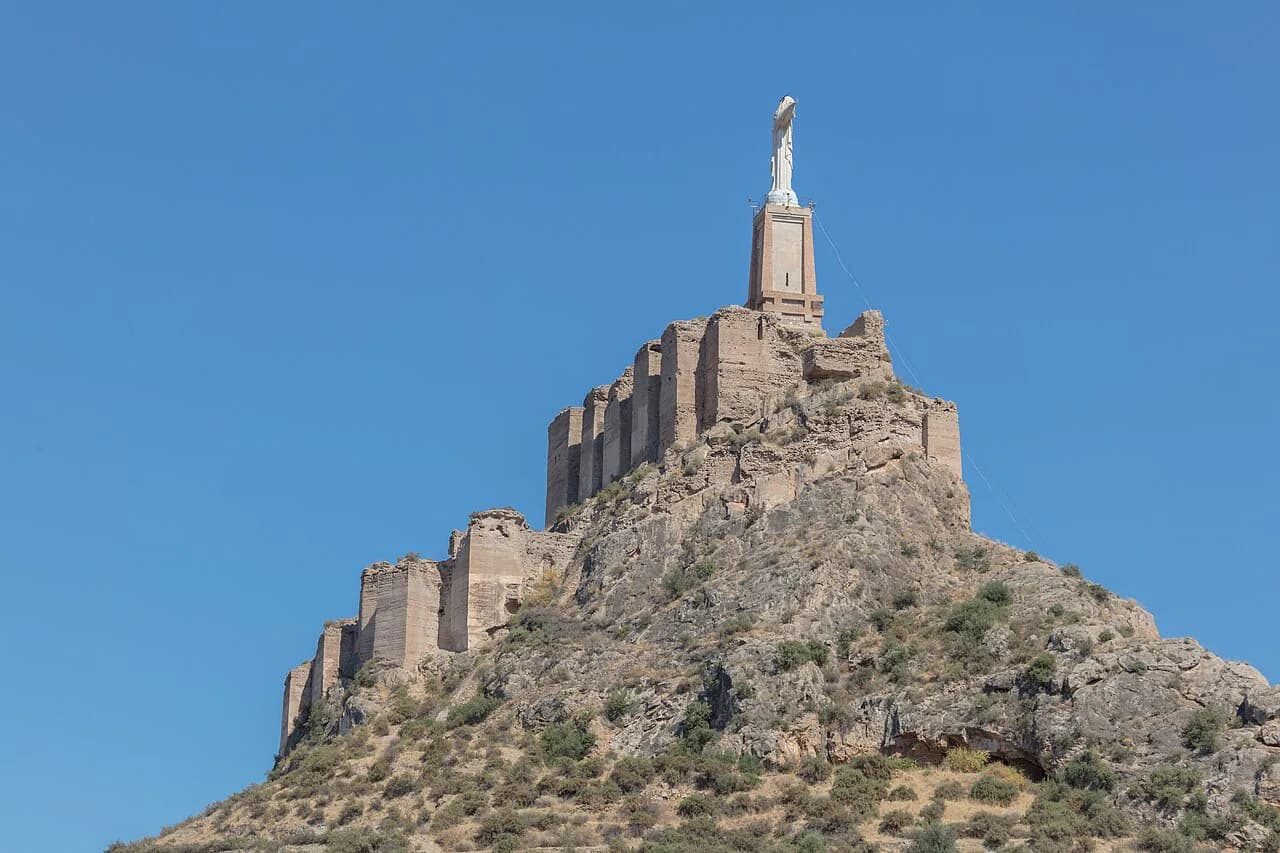
Castillo de Monteagudo: the fortress, the Cristo and the mirador

The Castillo de Monteagudo is an Islamic-period fortress on a rocky spur 149 metres above sea level, dominating the Huerta de Murcia and crowned by a 14-metre sculpture of Christ. You cannot reach the summit or the statue's base: the Turismo de Murcia site states that access to both is closed, and the visit is made from a mirador set halfway up the hill. This page covers where Monteagudo is, how to get there, the Cristo's history, what the visitor centre holds and why the Castillejo and Larache belong to the same outing.
Allow half a day for the visitor centre and the viewpoint, or most of a morning if you add the circular Sendero de los Castillos. The centre sits at the foot of the castle in the village of Monteagudo, a few kilometres north-east of the city, and pairs well with a separate day among the squares of Murcia.
Where Monteagudo is and how to get there
Monteagudo is a village in the municipality of Murcia, set on the old road that linked the Alicante and Castilla routes, which is why the hill has been settled continuously from the Argaric culture through Iberians, Romans and Arabs. The castle's spur rises directly above the village, so you see the Cristo well before you arrive. The visitor centre's address is Plaza Iglesia in Monteagudo, postal code 30160.
Bus línea 36 runs to Monteagudo, with a stop called Desvío de Monteagudo, which puts you within reach of the centre and the start of the hill. Cars are the obvious alternative if you are combining the castle with other places outside the city. From the centre, treat the trip as a short hop rather than a day out in itself.

The Cristo de Monteagudo
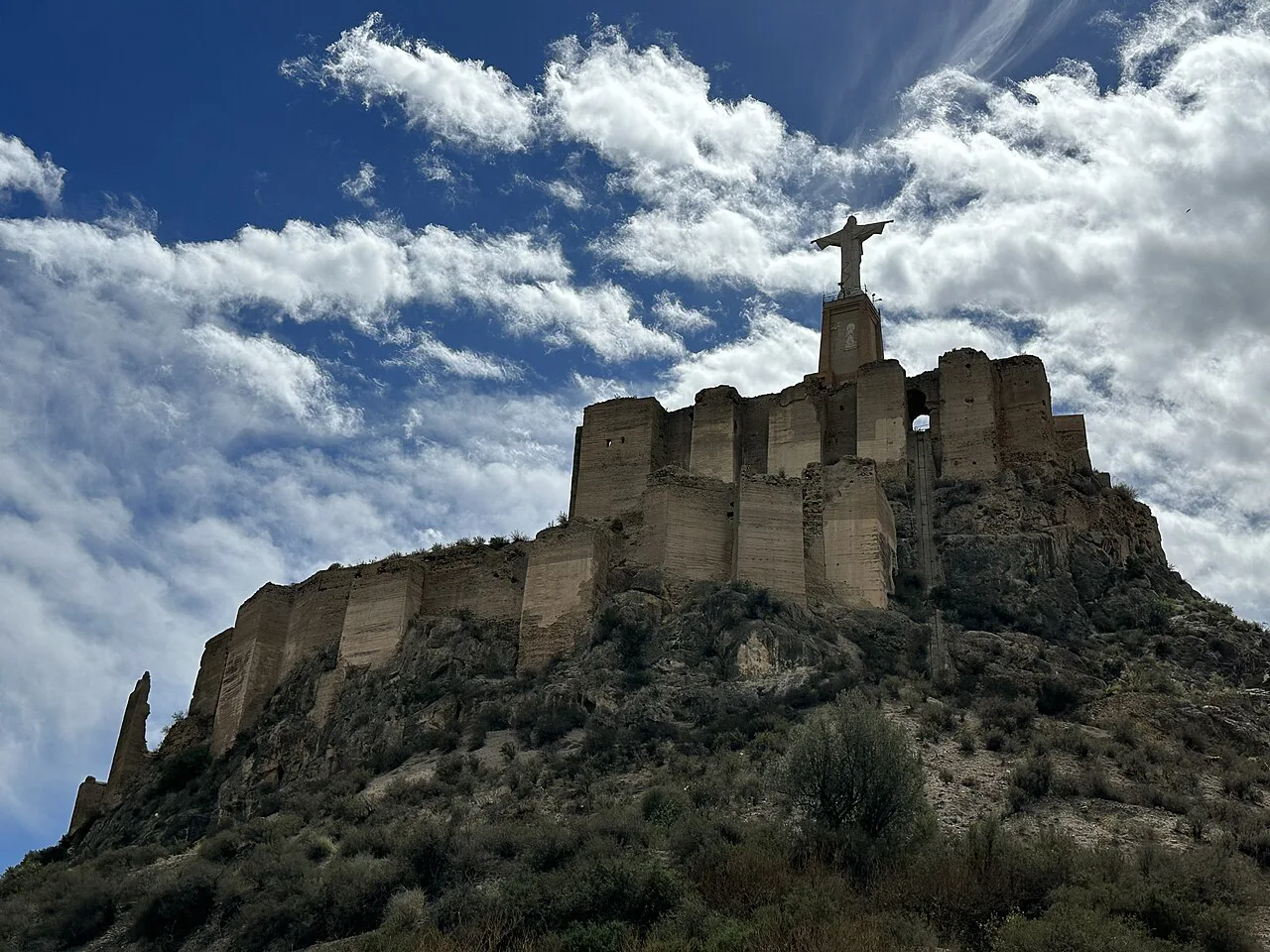
The Cristo de Monteagudo was originally erected in 1926, was pulled down during the Spanish Civil War and was raised again in 1951. The statue on the skyline is the post-war replacement, standing 14 metres tall on the remains of the fortress. Its silhouette over the huerta is the reason many travellers recognise the hill at all.
Because the statue's base is off limits, the Cristo works as a landmark and a photograph rather than something you walk around. The gain from climbing partway up is the panorama, not proximity to the sculpture.

Ibn Mardanish, Alfonso X and a line of three castles
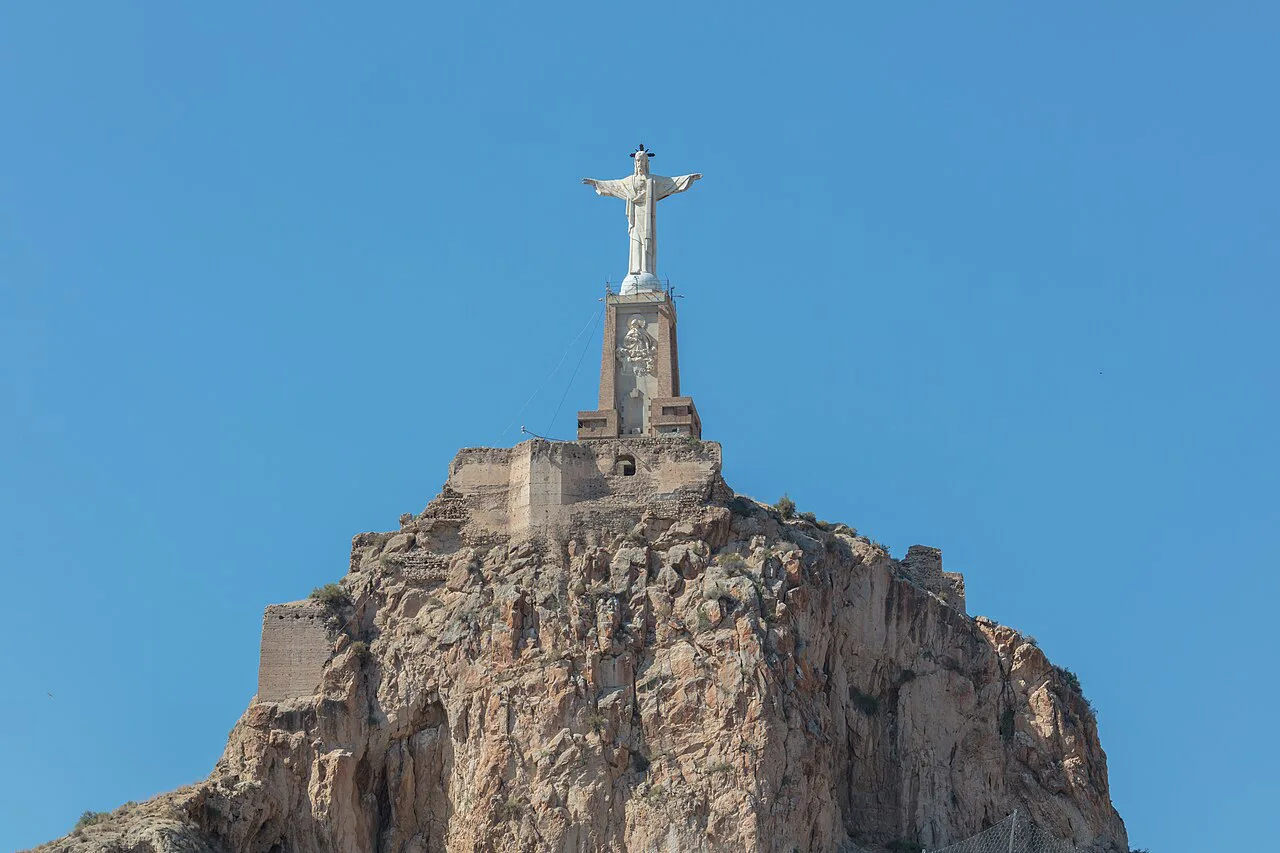
The surviving architecture dates from the Islamic period, when Ibn Mardanish, known as the Wolf King, ruled from 1147 to 1172 and built a defensive line made up of the Castillo de Monteagudo, the Castillejo and the Castillo de Larache. He also had irrigation pools built nearby, which the Murcia tourism board describes as the most important medieval Islamic archaeology in the area. After the Christian conquest the hill passed to the Crown of Castile, and Alfonso X the Wise kept his Murcian residence there.
Read the hill that way and the Castillejo and Larache stop looking like rival outings: they are the other posts in one defensive system, connected by the same footpaths and irrigation channels. If you only have time for one, the Monteagudo spur gives you the Cristo, the mirador and the visitor centre in one place.
Access: what you can and cannot reach
Access to the castle itself and to the foot of the Cristo is not permitted. A mirador has been laid out partway up the hill, and from it you get wide views over Murcia city and the huerta that surrounds it. Plan on that being the high point of the climb.
The ground is rough, so the practical question is footwear rather than equipment. The guided tour operator describes a route of roughly 3.5 to 4 kilometres over dirt paths with some flights of stairs and a slope, graded medium to low difficulty, and advises comfortable shoes, a water bottle, a cap and sunglasses. It also says the walk is not recommended for people with reduced mobility.
Centro de Visitantes de Monteagudo (San Cayetano)
At the foot of the castle, the Centro de Visitantes de Monteagudo occupies Plaza Iglesia and takes you through five thousand years of settlement on the hill, from the Argaric and Iberian cultures to the Roman and Arab periods. Entry is free, and audioguides in Spanish and English are included. The building is listed as accessible for disabled visitors, which makes it the comfortable part of the day.
The centre closes on Mondays and public holidays all year. The standard pattern is Tuesday to Saturday from 9:30 to 14:00 and 17:00 to 19:30, and Sunday from 10:00 to 14:00. In August the Sunday opening drops away as well, leaving Tuesday to Saturday only, with Monday and public holidays closed. Groups of more than 20 need to book.
The centre is also the sensible first stop if you intend to walk the trail, since it sets out the history you are about to walk through. Without it, the ruins on the hillside read as stones; with it, the pools, paths and three forts make sense as one landscape.
The Sendero de los Castillos
The Sendero de los Castillos is a circular route of about six kilometres that links the castle, the Castillejo and Larache, passing the irrigation pools and the recreational estates attached to the latter two. It also takes in the traditional irrigation system that has watered the huerta since medieval times. The visitor centre recommends it as a straightforward way to see the most emblematic corners of the area.
Treat the six-kilometre figure as a serious half-day in warm weather rather than a quick loop, because much of the route is exposed. In summer, start early and carry more water than you think you need.
Guided walks on the hill
Official guided visits start at the visitor centre, work through its rooms and then climb to the mirador at the base of the castle, continuing to the Castillejo and on through orchards to Larache before returning past the irrigation pools. The operator puts the distance at roughly 3.5 to 4 kilometres and the duration at about three and a half hours, with a medium to low difficulty grade and uneven ground. Toilets on the route are available only at the visitor centre.
These tours are led by official guides and must be booked in advance, by phone or email, with payment made directly to the guide before the walk begins. The operator's listing charges 10 euros per person, with a reduced rate for children aged four to seven. Ask for the current fee and the next available date when you reserve.
How long to allow
For the visitor centre and the mirador, two to three hours is comfortable, including the walk up and a slow look at the exhibitions. Add the full Sendero de los Castillos and you are into half a day, because the loop is roughly six kilometres on uneven ground. Guided visits take around three and a half hours, so book them as the main event of a morning.
If you are squeezing Monteagudo into a short break, pair it with something indoors later the same day rather than another exposed site. The Murcia cathedral and the Real Casino Murcia both sit in the city centre and make a natural afternoon contrast to a morning on a dusty hill.
Heat and timing on an exposed hill
The castle spur stands 149 metres above sea level with almost no shade along the paths, and the huerta below reflects heat through the middle of the day. In summer, aim for the first slot after opening and keep the afternoon for the visitor centre or the city. The advice to bring water, a cap and sunglasses is not ceremonial.
Mondays and public holidays take the centre out of play entirely, which matters if you planned to combine the exhibition with the walk, and August adds a Sunday closure. Build flexibility into a short break rather than fixing the day around a single opening slot.
Nearby: the Castillejo and Larache
The Castillejo and the Castillo de Larache are the other two posts in Ibn Mardanish's defensive line and are seen on the same trail rather than as separate excursions. The Castillejo, with its palace remains, and Larache, with its almunias or country estates, are the reason the six-kilometre loop exists at all. If you only have an hour, stay with the mirador and the visitor centre.
Is the mirador enough on its own?
For most visitors, yes: the Cristo, the view over the huerta and the free visitor centre justify the trip without the full trail. Choose the mirador plus the centre if you have half a day, and the circular route if you want the Castillejo and Larache as well. Book a guided walk only if you want the history narrated on site and can commit three and a half hours.
Back in the city, the Plaza del Cardenal Belluga squares up to the cathedral and the episcopal palace, and the Teatro Romea anchors a separate wander through the old centre. That gives a short break in Murcia a hilltop morning and an urban afternoon without repeating the same kind of sight.
Frequently Asked Questions
Can you go inside the Castillo de Monteagudo?
No. Access to the castle and to the foot of the Cristo de Monteagudo is not permitted; visitors use the mirador laid out partway up the hill, which gives the view over Murcia and the huerta. The visitor centre at the foot of the hill in Plaza Iglesia covers the site's history instead.
How do you get to Monteagudo from Murcia city?
Bus línea 36 serves Monteagudo, with a stop named Desvío de Monteagudo. The village sits on the old road that linked the Alicante and Castilla routes, north-east of the city centre, and the visitor centre is on Plaza Iglesia.
Is the Monteagudo visitor centre free?
Entry is free, and audioguides in Spanish and English come at no charge. The centre closes on Mondays and public holidays, and in August it also closes on Sundays, so check the calendar before you set out.
How long is the Sendero de los Castillos?
The circular route is about six kilometres and links the castle with the Castillejo and Larache, passing the medieval irrigation pools and channels. Guided versions run roughly 3.5 to 4 kilometres over about three and a half hours and need advance booking.