
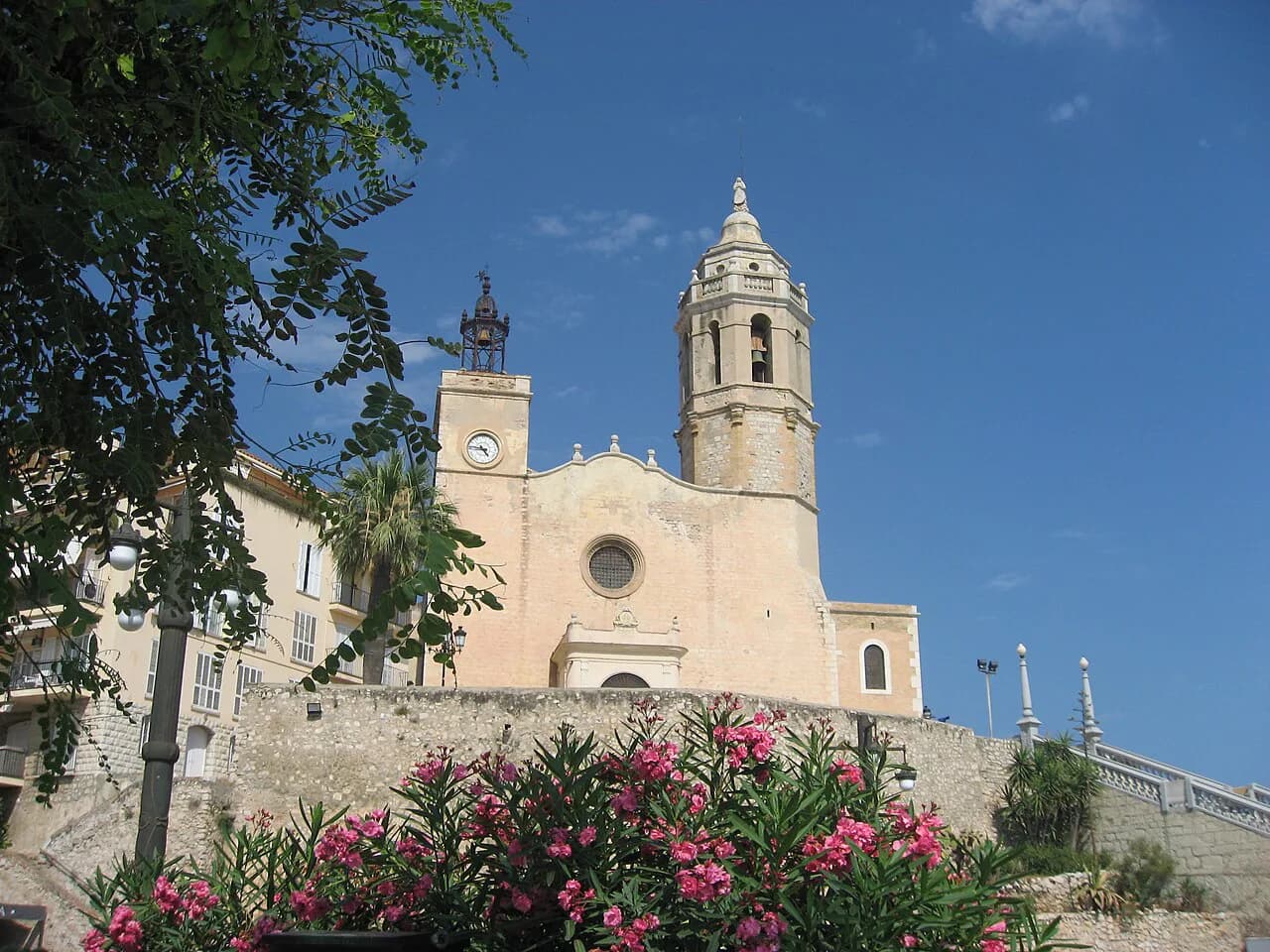
Sant Bartomeu i Santa Tecla: Sitges' Seafront Church

Sant Bartomeu i Santa Tecla is Sitges' parish church, and it sits on the rocky headland of La Punta between the town's two main beaches, with its doorway on Plaça Baluard. Allow about an hour if you want to step inside as well as walk the point, or fifteen minutes for the exterior and the views alone. This guide covers the approach on foot, what is worth looking at inside, how worship shapes visiting hours, and the sights packed into the streets immediately behind it.
Treat it as the anchor of a half-day in the old town rather than a destination in its own right. The building is small, the pleasures are the setting and the detail inside, and the surrounding lanes hold the Maricel complex and several small museums that fill out the rest of a morning.
Where the church stands and why it is the symbol of Sitges
The church occupies the tip of La Punta, a low rocky platform that pushes into the sea between Sitges' two main beaches. Its position means you see it in profile from almost anywhere on the promenade, and that white-and-stone silhouette against the water is what most people picture when they think of Sitges. The address is Plaça Baluard in the old town.
The building is often described as Gothic in style, though it was built in the 17th century. That mix matters when you look at it: the massing and the defensive, almost fortress-like outline belong to a church that grew up with a fishing village pressed against the shore, while the interior belongs to a later, more ornamented era. It is still the working parish church of the town, not a deconsecrated monument.
There are traces of a church on this site going back to the 14th and 15th centuries, which is part of why the fabric reads as layers rather than a single design.
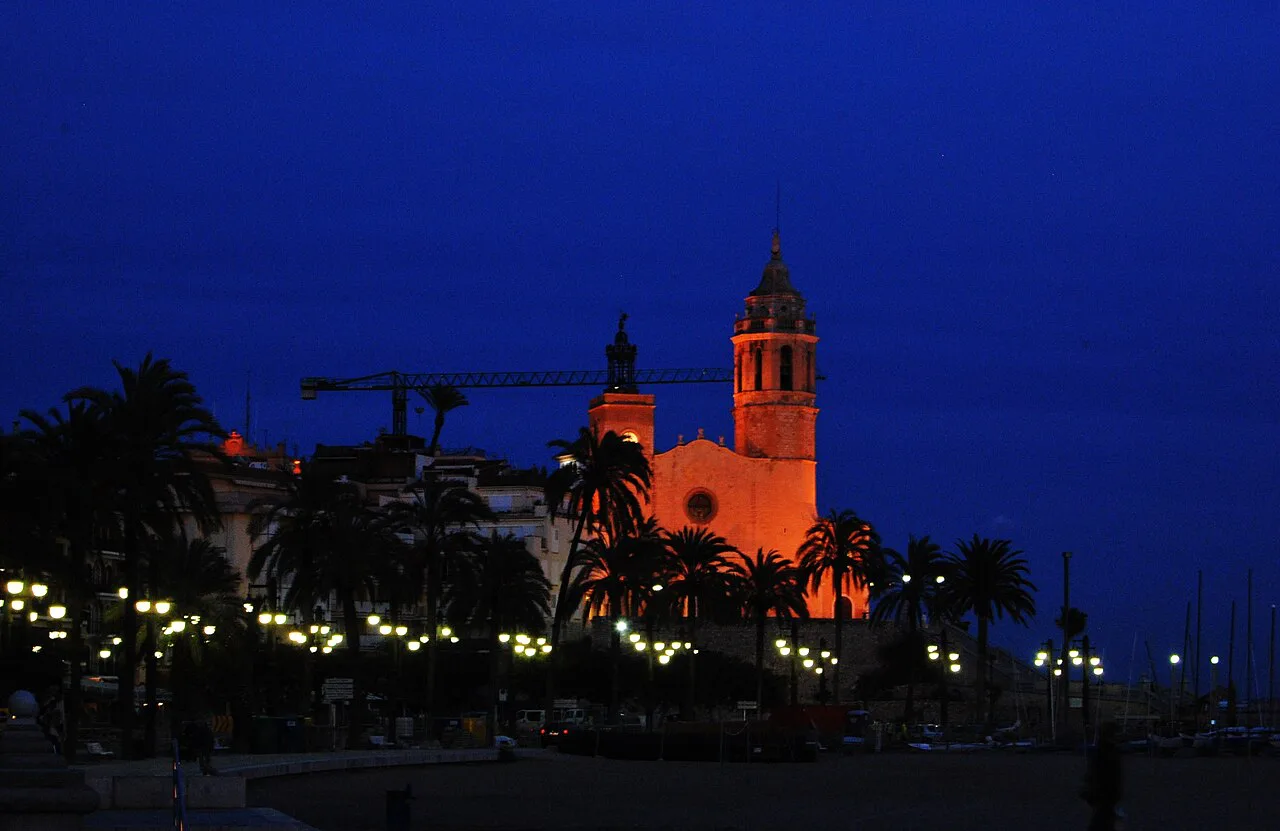

Walking to the point from the seafront
The pleasant approach is on foot along the seafront, coming from the town centre past the old town and the Palau de Maricel, then continuing out onto the point. The final stretch involves a short climb up steps and uneven stone, so it is not a level stroll, but it is manageable in ordinary shoes.
If you are combining the church with the museums on the seafront, note that the Maricel Museum (Museu de Maricel) sits in the same complex of buildings you pass on the way, which makes a natural pairing before or after the church.
Sitges is small enough that the church is walkable from most of the town, and the railway station sits inland within the same compact centre. If you are arriving by train or bus, check current timetables with the operator before you travel rather than relying on a remembered schedule.
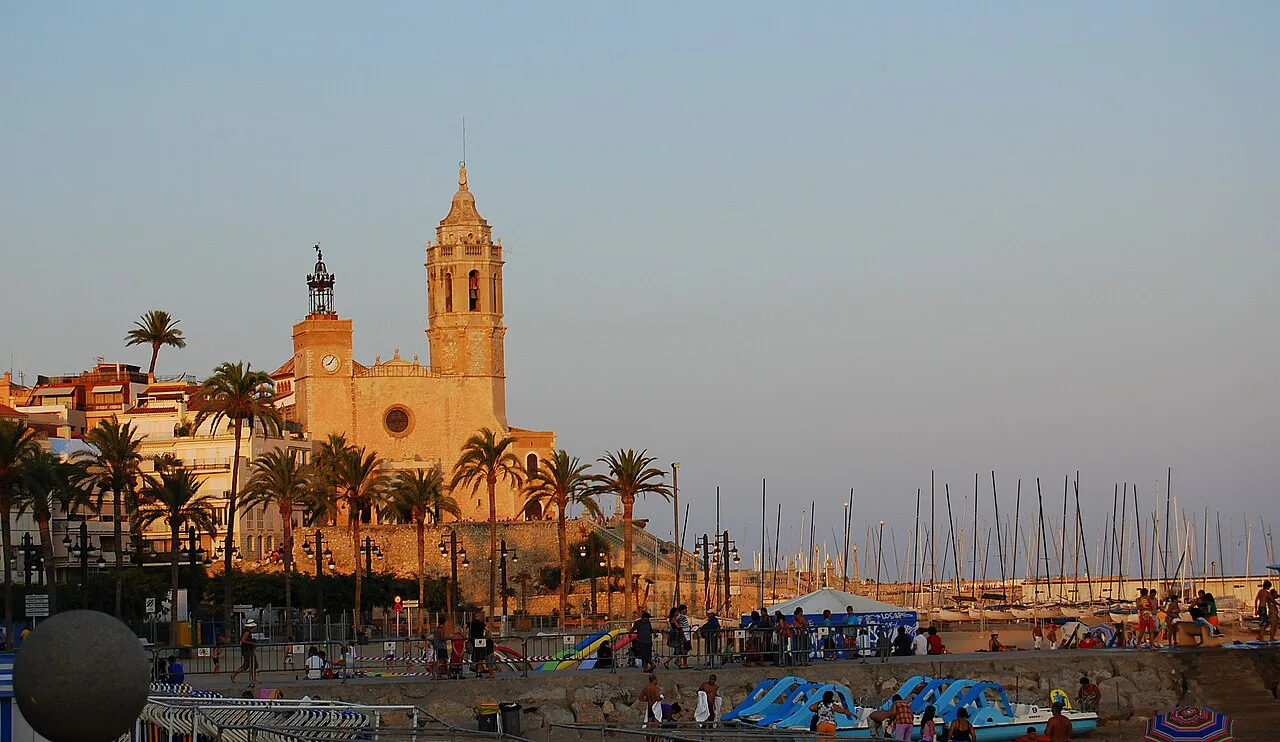

Inside: baroque altarpieces and a 1699 organ
The interior holds some fine baroque altarpieces from the 17th century, and the parish organ, dating to 1699, is noted for its richness. These are the two things to seek out if you have only a short window inside; the rest of the nave rewards a slow look rather than a checklist.
Because this is an active place of worship, sightseeing has to fit around services. If a Mass is running, wait outside or come back later rather than walking the aisles, and keep voices low and cameras discreet near anyone praying.
Mass times and how they shape a visit
From September to June, weekday and Saturday evening Mass is at 7:30 PM, with Sunday Masses at 9:00 AM, 11:00 AM in Spanish, 12:30 PM and 7:30 PM. In July and August the pattern changes: weekday and Saturday Mass is at 7:30 PM, and Sunday Mass is at 12:00 PM in Spanish and 7:30 PM in Catalan.
In practice that means late afternoon and early evening are the least promising times to wander in during most of the year, while mid-morning on a weekday is usually the easiest window. Sunday mornings are busy with services, so plan the interior for another slot and enjoy the exterior and the headland instead.
How long to allow, and the exterior-versus-interior trade-off
A quick stop for the exterior, the headland and the sea views takes roughly fifteen minutes, and that is enough for many visitors because the setting does most of the work. Add another thirty to forty-five minutes if you want to sit inside, look at the altarpieces and the organ, and read the interpretative material.
The honest trade-off is that the interior is modest in scale compared with the great cathedrals of Catalonia, so do not build a day around it. Come for the silhouette and the point, and treat the inside as a bonus if the doors are open and no service is underway.
What is close by
The old town lanes begin immediately behind the church, and the seafront promenade runs along both sides of the point, so you can loop back through the centre without retracing your steps. The Maricel complex, with the Palau de Maricel and the Maricel museum, is a couple of minutes inland along the front.
The Cau Ferrat Museum in Sitges, once the home and studio of the artist Santiago Rusiñol, sits in the same cluster of seafront buildings and pairs naturally with the church and Maricel on a single walk. Opening days and admission are best checked directly with the museum before you go, since they vary by season.
If you want a quieter counterpoint to the busy seafront, the Terramar Gardens Sitges sit further along the coast and make a gentle add-on. Inland, the Museu Romàntic Can Llopis Sitges occupies a townhouse that shows a different side of the town's 19th-century life.
Practical points and the parish office
For anything not covered by published visitor information, the parish office is the right place to ask; it keeps set hours on Tuesdays, Thursdays and Saturdays, and the phone number is listed on the parish page. The VisitSitges page for the church carries the address, contact details and the seasonal Mass schedule in one place.
There is no ticketed visitor entrance advertised, but it is a working parish, so opening depends on services and parish activity rather than a fixed tourist timetable. Check the current schedule before making a special trip, especially in July and August when the pattern differs.
Sitges Attractions: 5 Visitor Guides gathers the town's main sights, including the church, so you can see at a glance how it fits alongside the museums and the old town.
Make the point the start of your Sitges walk
Start at La Punta, see the church against the sea, and then let the old town pull you inland. That order gives you the town's best view first and leaves the Maricel complex, the Cau Ferrat Museum and the lanes behind the church as a natural continuation rather than a detour.
Time your arrival to miss Mass, keep the visit short and focused, and use the parish office or the church's published page for any detail that matters to your plans.
Frequently Asked Questions
Is there an entrance fee for Sant Bartomeu i Santa Tecla?
No ticketed visitor entrance is advertised; it is a working parish, so visiting depends on the doors being open around services. Check the published Mass schedule before travelling, since the pattern changes in July and August.
What is the church in Sitges called?
It is the Església de Sant Bartomeu i Santa Tecla, often shortened to Sant Bartomeu, and it is popularly known as La Punta after the rocky point it stands on. It sits on Plaça Baluard between the town's two main beaches.
When are Masses held at Sant Bartomeu i Santa Tecla?
From September to June, weekday and Saturday Mass is at 7:30 PM and Sunday Masses are at 9:00 AM, 11:00 AM in Spanish, 12:30 PM and 7:30 PM. In July and August, weekday and Saturday Mass stays at 7:30 PM while Sunday Mass is at 12:00 PM in Spanish and 7:30 PM in Catalan.