
Alicante Town Hall: What to See at the Ayuntamiento

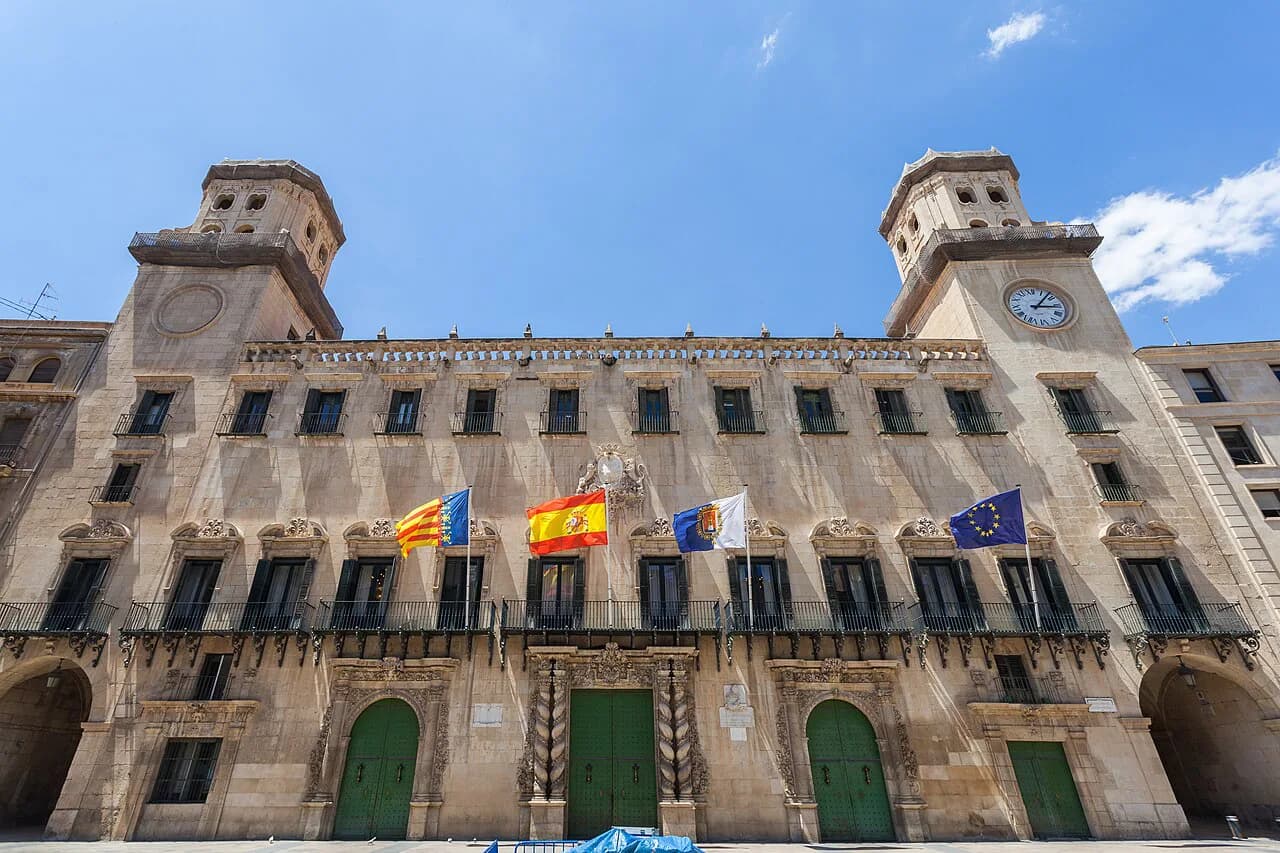
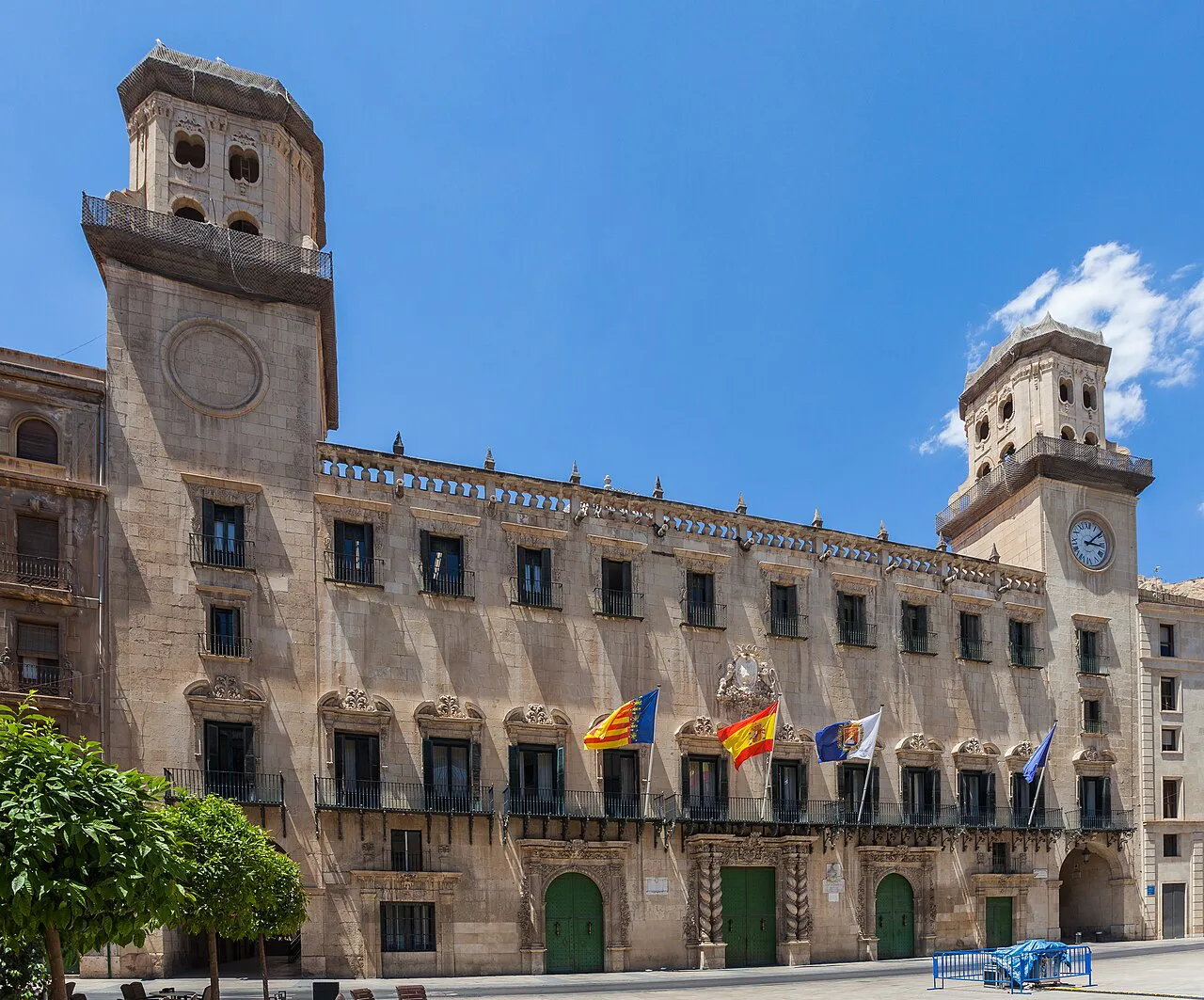
Alicante Town Hall is worth twenty minutes of a city-centre morning: an 18th-century baroque palace with a tower at each end, three storeys and a balustrade along the top, standing on Plaza del Ayuntamiento at the edge of the old quarter. The reason to go inside rather than just photograph the facade is a handful of specifics: the Blue Room, the Council Chamber, a chapel, and one staircase step that fixes the height of every place in Spain.
What Alicante Town Hall is and where it stands
The Ayuntamiento de Alicante occupies the side of the former Casa de la Ciudad on Plaza del Ayuntamiento, a square separating the old quarter from the Explanada and the port. It is an 18th-century baroque building designed by Lorenzo Chápuli, flanked by a tower at either end, divided into three storeys and finished with a balustrade. The address is Plaza del Ayuntamiento, 1, in the 03002 postcode, a few minutes' walk from the marina.
Treat it as the anchor of a city-centre circuit rather than a destination in itself: the cathedral, the Basílica de Santa María and the climb to the castle all sit in the old quarter behind it. The Alicante Attractions: 6 Visitor Guides page maps the main stops around this square if you want the layout before you arrive.

Getting there from the old quarter, the Explanada and the port
On foot is the sensible way: the town hall faces the top of the Explanada de España and backs onto the lanes of the old quarter, so anyone near the port, the marina or the cathedral reaches it in a few minutes. From the bus or train stations it is a longer walk or a local bus into the centre, since the square is a junction of pedestrian streets.
Arriving on a flight into Alicante, the town hall makes an easy first stop because the facade needs no booking. The interior is a weekday-morning slot, so a late-afternoon arrival means seeing the outside and coming back. Pair it with the Castillo de Santa Bárbara on Mount Benacantil, reached by a lift opposite El Postiguet Beach or by a road up the northern slope.

The facade: twin towers, three storeys and a balustrade
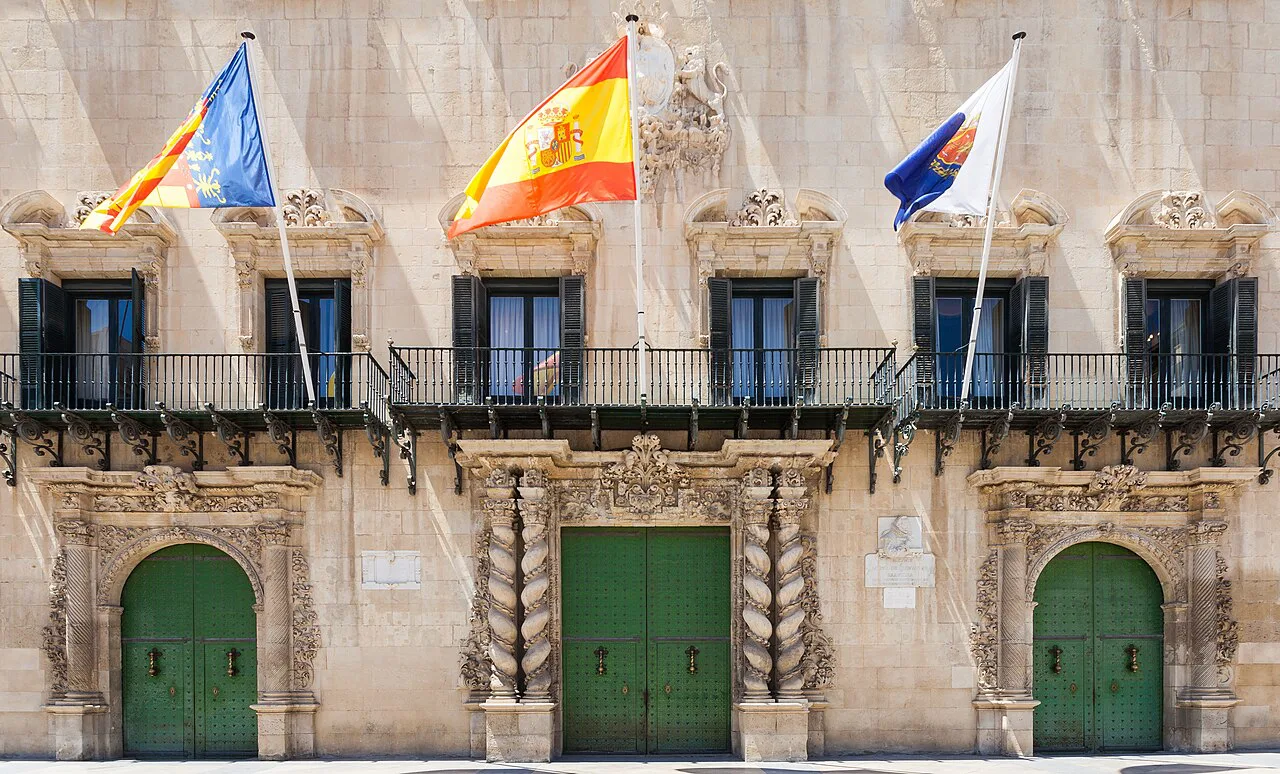
Look at the outline first. The building is symmetrical about its central section, with a square tower closing each end, three horizontal bands of windows and a balustrade running between the towers across the roofline. The square in front is open enough to step back and take in the whole composition, which the tighter streets behind do not allow.
The palace was built on the side of the former Casa de la Ciudad, which explains why it reads as an addition to an older civic core, and the design is credited to Lorenzo Chápuli. Photograph it in the morning, when the square is in shade and the stone is evenly lit rather than half in shadow.
Inside: the Blue Room, the Council Chamber and the chapel
The interior has three rooms worth seeking out. The Blue Room is the most striking, the Council Chamber is the civic heart of the building, and the chapel holds a papal privilege: a bull signed by Pope Pius VI allows mass to be said there. Ask at the entrance which rooms are open on the day, since this is a working council building.
Do not expect a museum route with labels and a one-way flow. This is a functioning town hall, so you move through civic spaces, and the reward is architectural and historical rather than exhibitionary. The interior visit takes well under an hour.
Cota cero: the step that measures Spain
The best detail in the building is under your feet. The first step of the main staircase is the reference point from which the height above sea level of any place in Spain is measured, known as cota cero. Look down for it as you enter rather than up at the balustrade.
Knowing this changes how you read the entrance hall: look down at the step before you look up at the balustrade. It gives the town hall a reason for a stop beyond the photograph, since the measurement is national infrastructure disguised as civic architecture.
La Ciudad descubierta in the adjoining basement
In the basement of the adjoining building, which also houses local council offices, the exhibition La Ciudad descubierta (The city uncovered) displays archaeological remains preserved from medieval times to the modern day. It is part of the same stop rather than a separate museum trip, and it is the reason to walk around the side of the palace rather than turning back at the square.
The remains give context to the old quarter above ground: the city's layers sit in one room, which is useful before you walk the lanes towards the cathedral. Ask at the entrance whether the basement display is open on the day, as it sits within a working council building rather than a standalone museum.
When you can go in: weekday mornings
The published visiting window is Monday to Friday, 9am to 2pm, which is a weekday-morning slot and nothing more. No weekend opening is listed, so a Saturday or Sunday in Alicante means seeing the facade, the square and the cota cero story from outside, while a weekday morning gives you the rooms. Build the itinerary around a weekday if the interior matters.
No ticket price is published for the town hall or for La Ciudad descubierta, so budget nothing in advance and ask at the entrance. The same weekday logic applies to pairing the visit with Alicante Cathedral (Concatedral de San Nicolás de Bari), a few minutes away in the old quarter, whose tourist access follows its own hours rather than the town hall's.
How long to allow, and what to pair it with
Give the town hall twenty to thirty minutes: the facade, the entrance hall and the cota cero step, the three interior rooms if they are open, and the basement exhibition. That is a coffee-stop length, not a morning, which makes it ideal for the gap after a flight arrival or before a train out.
For a fuller half-day, walk from the square up through the old quarter to the Basílica de Santa María, then on to the castle lift or the road up Mount Benacantil. The basilica Santa Maria has its own visiting pattern and the castle keeps different hours again, so treat the town hall as the one fixed weekday-morning element and build the rest around it.
Nearby: San Nicolás, the old quarter and the museums
The old quarter behind the square holds the co-cathedral of San Nicolás, a Herrerian Renaissance building with a 15th-century cloister and a 45-metre blue dome, and its interior decoration is the reason to step inside rather than pass the door. The surrounding lanes are the nicest part of central Alicante for a slow walk.
Two museums extend the day if the town hall leaves you wanting more city history. The Museo de Arte Contemporáneo de Alicante sits near the Plaza de Santa María in the old quarter, while the MARQ, the Museo Arqueológico de Alicante, covers the archaeology that La Ciudad descubierta only sketches. Both keep their own hours and ticket arrangements.
Guided walking tours of the old town are sold locally and online, and many include the town hall square among their stops alongside the Castle of Santa Barbara, which suits anyone who wants the civic history narrated rather than read from a plaque. Independent visits and tours are different products, so compare what each includes before booking.
Is the town hall worth a weekday morning?
Yes, if you are in Alicante on a weekday and can reach the square before 2pm: the Blue Room, the Council Chamber, the chapel and the cota cero step together justify a short stop that costs you almost no time. If your only days in the city are at the weekend, see the facade and the square and put the hours into the castle and the old quarter instead.
Build the stop into a walking loop from the Explanada through the old quarter rather than making a special journey, and confirm the day's access at the entrance before you commit the morning.
Frequently Asked Questions
Can you go inside Alicante Town Hall at the weekend?
The published visiting hours are Monday to Friday, 9am to 2pm, and no weekend access is listed. Plan a weekday morning if the interior rooms and the cota cero step matter to you, and treat a weekend visit as an exterior stop on Plaza del Ayuntamiento.
Where exactly is the cota cero step in Alicante Town Hall?
It is the first step of the main staircase inside the building, easy to walk over without noticing. It is the reference point from which heights above sea level are measured across Spain, so look down as you enter rather than up at the ceiling.
How long does a visit to Alicante Town Hall take?
Allow twenty to thirty minutes for the facade, the entrance hall and the cota cero step, the Blue Room, Council Chamber and chapel if they are open, and the basement archaeology display. It works as a short stop between the Explanada and the old quarter rather than a morning in itself.