
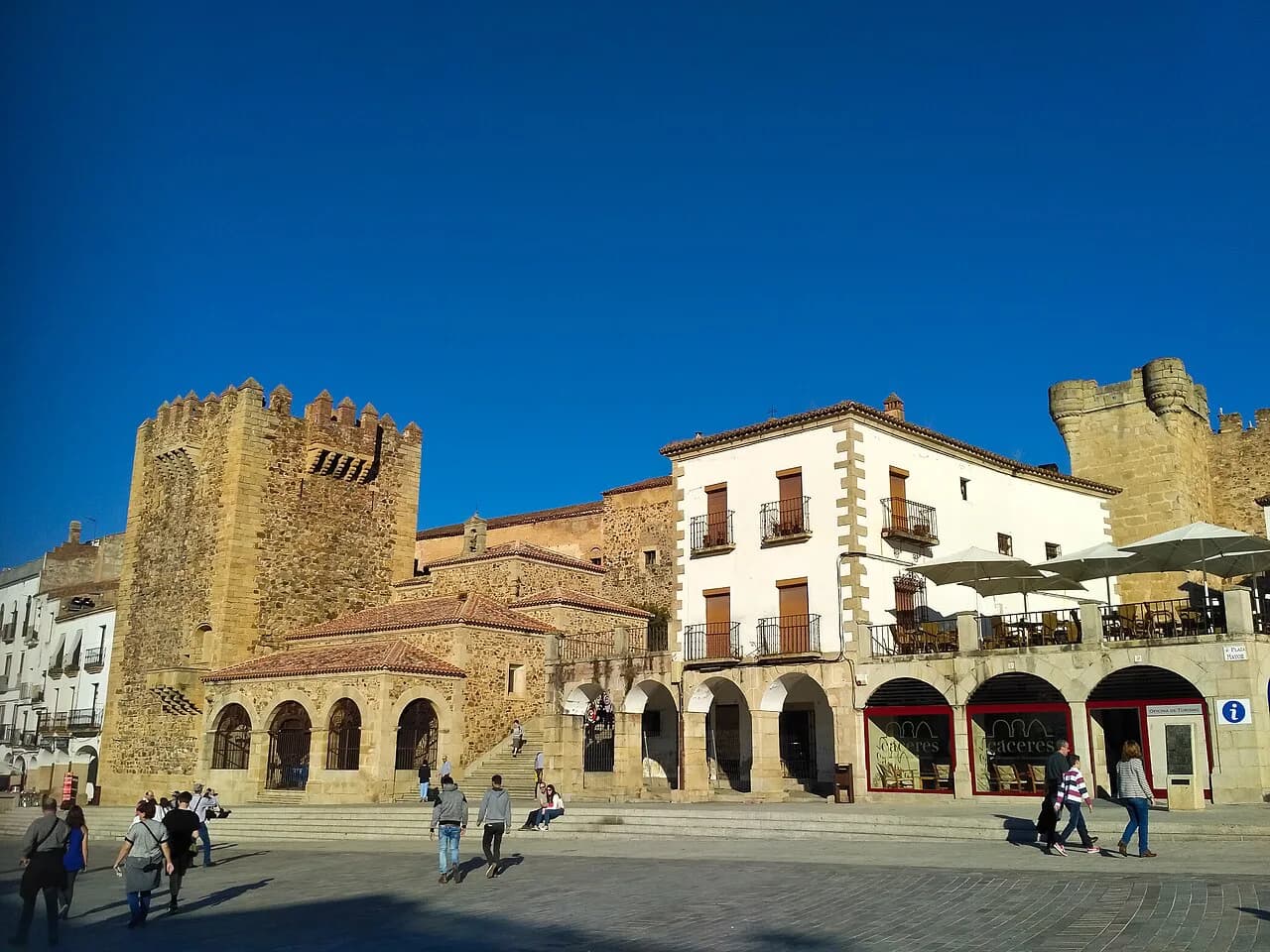
Torre de Bujaco: Cáceres's Almohad tower on the Plaza Mayor

Torre de Bujaco is the tall Almohad tower on Cáceres's Plaza Mayor, a twelfth-century gate-tower that rises 25 metres and doubles as the entry point to the walkable stretch of city wall. It stands beside the Arco de la Estrella, so a visit is really two things: the tower itself and the rampart walk that begins at its base. This page covers where to find it, what to look at from the square, the legend attached to its name, the restoration work on its battlements and the sights within a minute or two of its foot.
The tower has been closed to tourism during the third phase of the wall restoration, which began in December 2025, and the city's heritage councillor said at the start of the works that it would stay shut for between four and six months. Plan the tower as a piece of the square's skyline first and a climb second, and check access locally before building the day around it.
What the Torre de Bujaco is
The tower was built in the twelfth century by the Almohads, the North African dynasty that fortified much of western Iberia, and it has been altered repeatedly since. It watches over the Plaza Mayor at its address on the square, numbered 32 to 34, and it is the most prominent piece of the almohade wall to survive in Cáceres. Treat it as a gate-tower and a lookout rather than a palace or a museum.
Its 25 metres make it a privileged viewpoint over the old town, and the climb rewards you with a sweep across the rooftops and church towers of the monumental quarter. The same height explains why the tower reads as the anchor of the square from every angle, even when you are not going up.

Where to find the tower
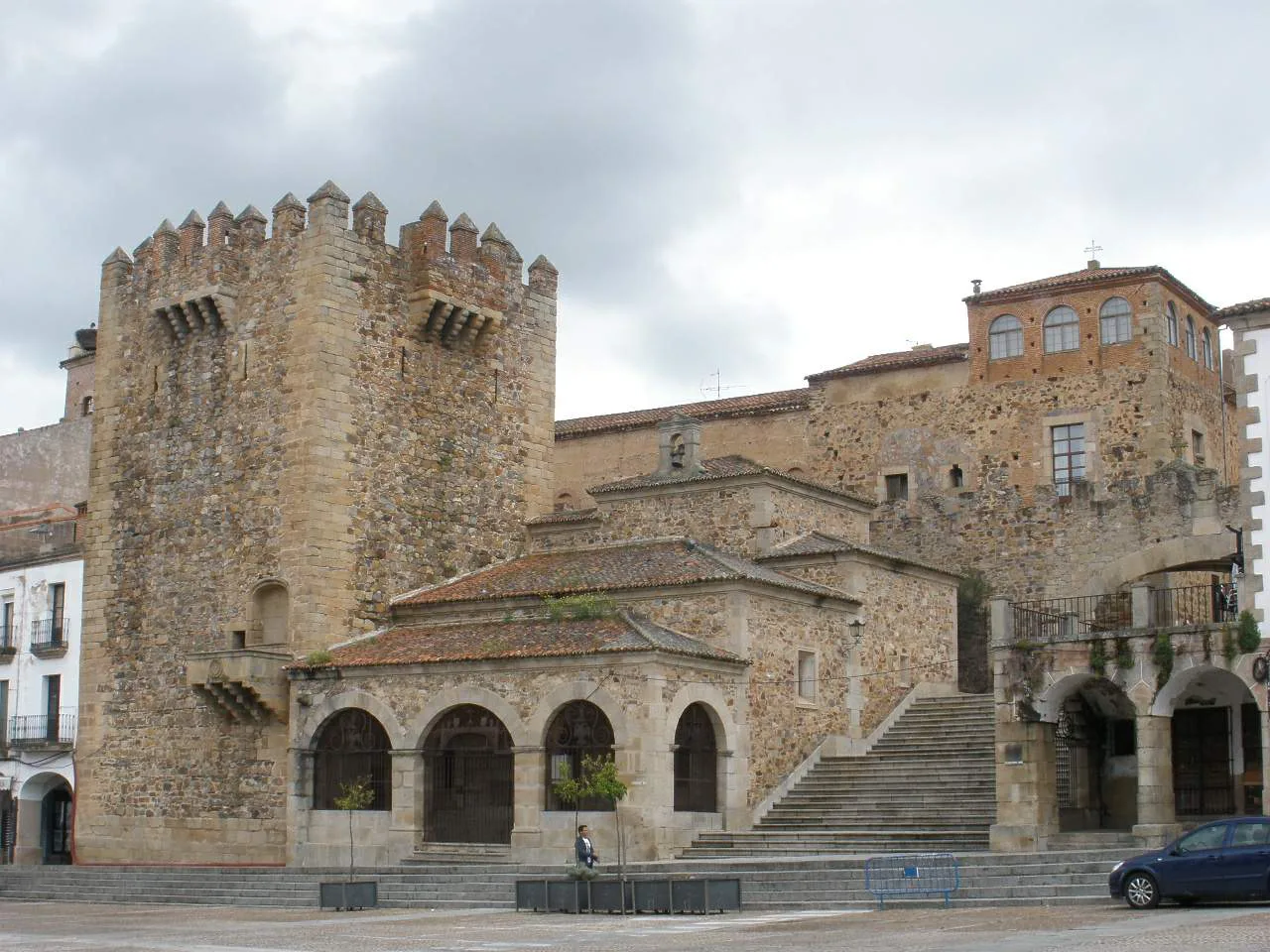
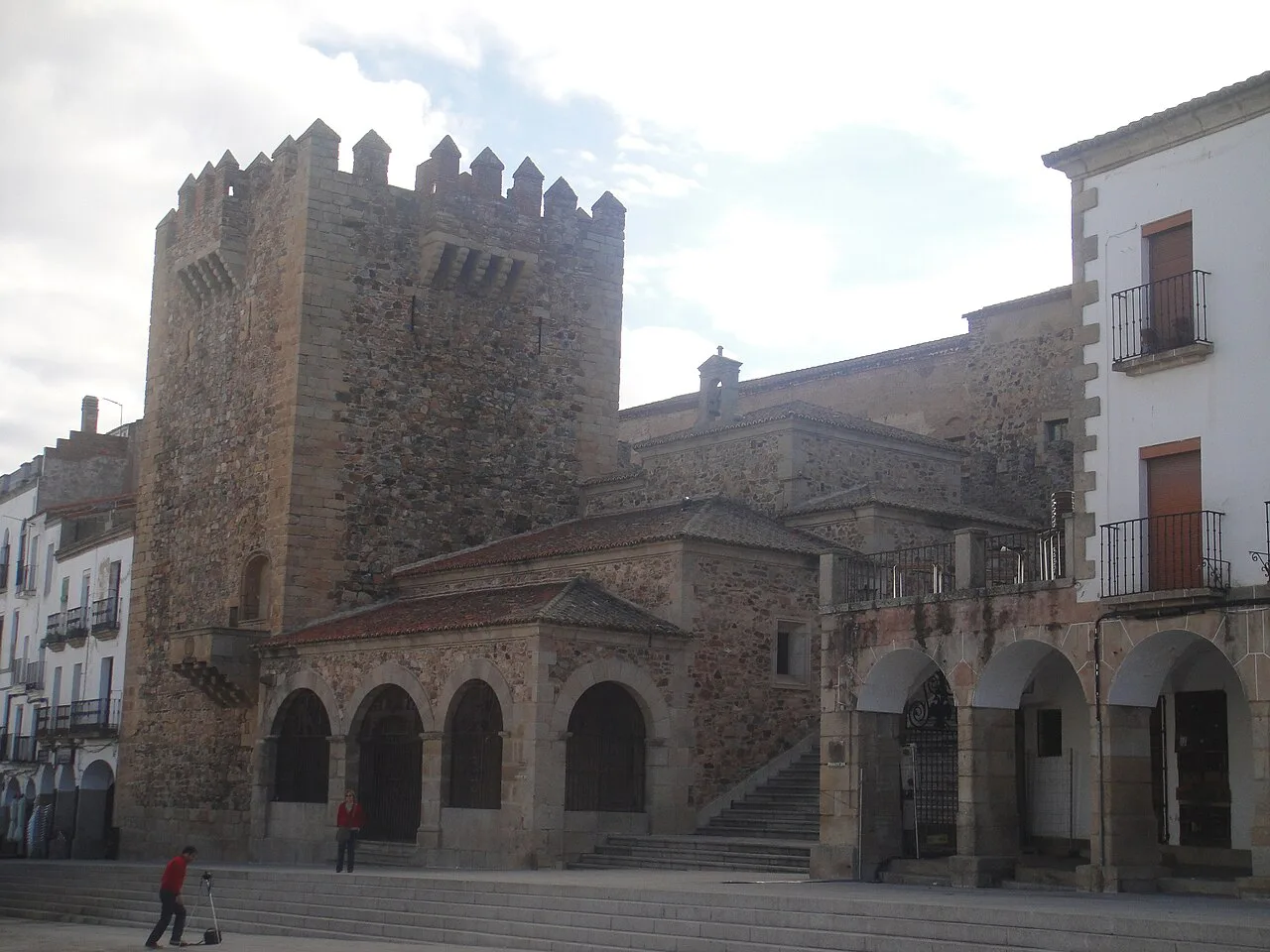
You will find it on the Plaza Mayor, the broad arcaded square that separates the modern town from the walled old centre. The Arco de la Estrella, the arched gateway that most visitors pass through on the way into the historic quarter, sits immediately beside it, and the Ermita de la Paz is built against the tower's flank. That cluster makes the square's north side the natural place to start any walk into the old town.
The Ermita de la Paz is an eighteenth-century chapel and holds an image of the Virgen de la Paz carved by Pedro Correa. It is a small stop rather than a destination, but it sits at the tower's side, so it costs nothing in walking time to look in.
The name and the legend of the forty knights
The tower's name is linked to the caliph Abú-Ya qub, who took the city in 1173, and a legend holds that forty Christian knights were beheaded on the spot. The story is tradition rather than documented history, so take it as the kind of tale that clings to border fortresses. It does explain why the tower carries such weight in local telling out of proportion to its size.
What to look for from the square
From the Plaza Mayor, the features to pick out are the battlements along the top, the brickwork of the faces and the balcony that projects towards the square. The battlements are crowned with pyramidal tops, and restoration work has left them a noticeably lighter colour than before, because they have been re-rendered with lime mortars mixed to resemble the originals. The brick faces have been cleaned, so the orange tone of the material now reads far more clearly than it did under years of grime.
The balcony over the Plaza Mayor was among the most laborious parts of the cleaning, and it is the detail that most clearly ties the tower to the life of the square below. Look up from the arcades and you will see the tower change character with the light: brick, lime mortar and shadow rather than one flat colour.
Climbing the tower and walking the wall
The tower is the gateway to the walkable section of Almohad wall that runs above the Arco de la Estrella and continues to the Torre de los Púlpitos. The walk is short and linear, so it suits a short stop rather than an afternoon, and it puts you above the rooftops rather than among them. If the tower itself is shut, the surrounding streets still let you read the line of the wall from below.
The third phase of restoration aims to extend the visitable stretch beyond its current end, continuing to the Torre de la Yerba and the Foro de los Balbos. That extension is planned work rather than an open route, so do not count on walking it yet. What you can count on is that the wall you see is a living conservation site, not a finished exhibit.
Restoration works and access
The third phase of work on the almohade wall started in December 2025 at the Torre de Bujaco itself, with scaffolding first raised on the side facing the adarve Obispo Álvarez de Castro and later extended to the Plaza Mayor frontage after the Christmas period. The works have also taken account of nesting swifts, with voids in the structure adapted for the birds after the conservation group SEO/BirdLife raised concerns. Expect the possibility of scaffolding on any given visit while the programme runs.
Because the tower was closed to tourism for the duration of this phase, the climb and the wall walk should be treated as things to confirm rather than assume. Ask at the city's tourist information point on or near the square before you set aside time for the ascent. Mention the tower when you ask, since the wall route and the tower do not always open and close together.

Nearby on the same visit
The Foro de los Balbos sits at the foot of the wall near the tower, and the Torre de la Yerba stands close by; both belong to the same defensive story and are minutes apart on foot. The Aljibe de Cáceres, the cistern that survives from the Almohad military enclosure and still collects rainwater, is another short add-on in the same quarter. None of these needs a separate trip.
The Cáceres Cathedral (Concatedral de Santa María) sits inside the old town a few minutes' walk from the Arco de la Estrella and pairs naturally with the tower. The Palacio de Carvajal and the Iglesia San Mateo are likewise within the walled quarter and can be folded into the same circuit without turning the day into a checklist.
How much time to allow and when to come
Set aside a short block for the tower and the wall walk if both are open, plus a little more for the square, the chapel and the cistern. The tower is exposed, so the middle of a summer day is the least comfortable time to be on the battlements; early morning or late afternoon suits both the light and the temperature. Allow more if you plan to carry on into the old town's palaces and churches.
Make the tower the start of your old-town walk
Torre de Bujaco works best as the first five minutes of a Cáceres visit rather than a destination in itself: read the battlements and the balcony from the square, then pass through the Arco de la Estrella and let the wall route and the nearby palaces carry you uphill. If the tower is shut for the restoration, the square and the gateway still deliver the essential view.
Explore more Cáceres guides
Frequently Asked Questions
Is the Torre de Bujaco open to visitors?
It was closed to tourism during the third phase of the wall restoration, which began in December 2025, and the heritage councillor said at the start that the closure would last between four and six months. Treat the climb and the wall walk as things to confirm locally rather than assume, and check before you build the day around them.
What else should I see near the Torre de Bujaco?
The Arco de la Estrella, the Ermita de la Paz built against the tower, the Aljibe de Cáceres and the Foro de los Balbos are all within a couple of minutes on foot. The cathedral and the old-town palaces are a short walk further inside the walled quarter.