
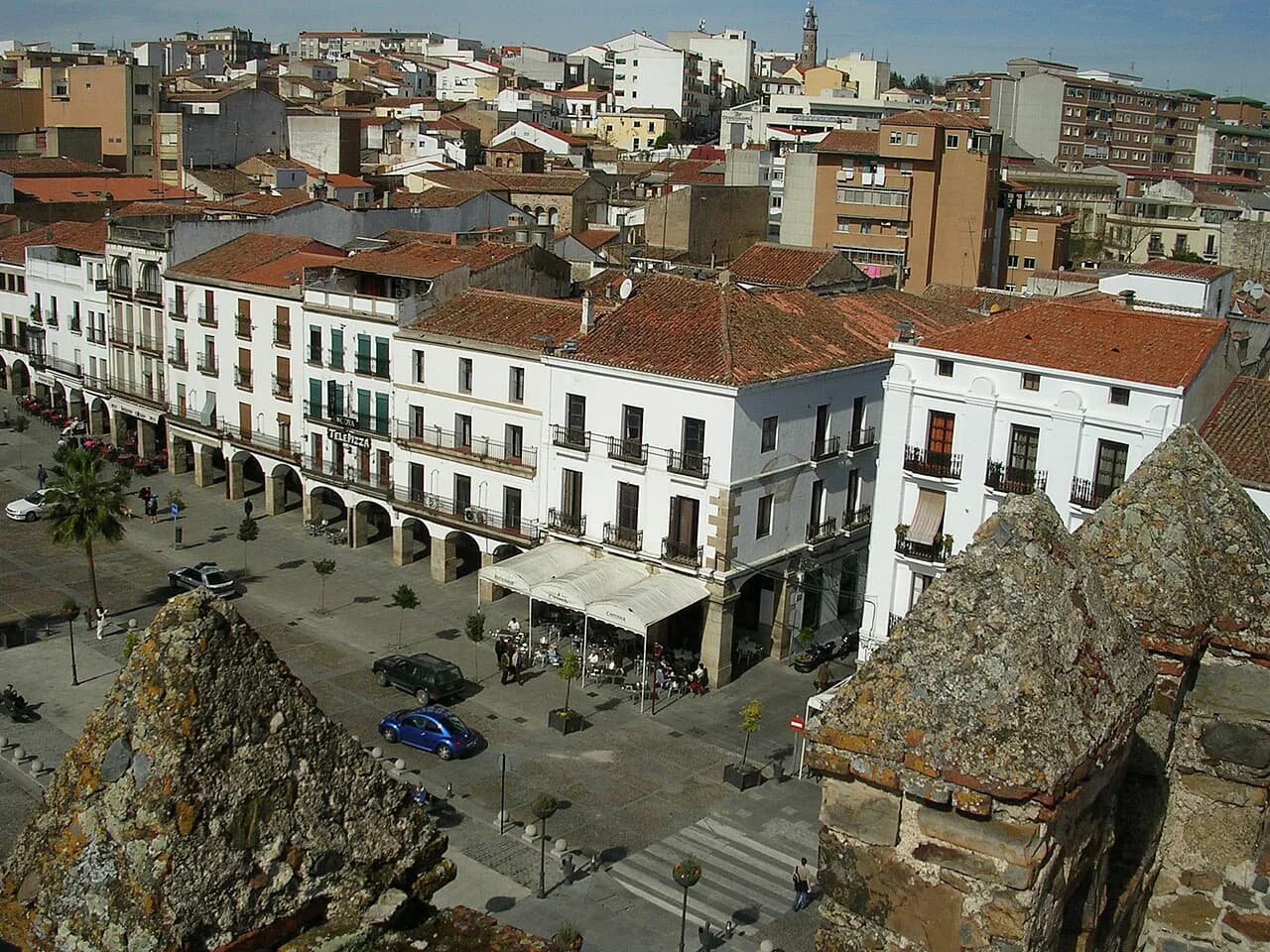
Plaza Mayor de Cáceres: the square at the old town's gate

Plaza Mayor de Cáceres is the square at the gate of the monumental old town, and the obvious first stop before you walk through the Arco de la Estrella. Allow twenty to thirty minutes to read the buildings around it and take the classic photo, then step through the arch. This guide names what frames the square, explains the arcades, and sets out the monuments that sit within a minute or two of it.
The square is not a monument you queue for; it is a working junction between the modern city and the walled centre. Cáceres spread down Calle Pintores and Calle Gran Vía towards it, so you will arrive from the shopping streets rather than through a grand ceremonial approach.
What Plaza Mayor de Cáceres is
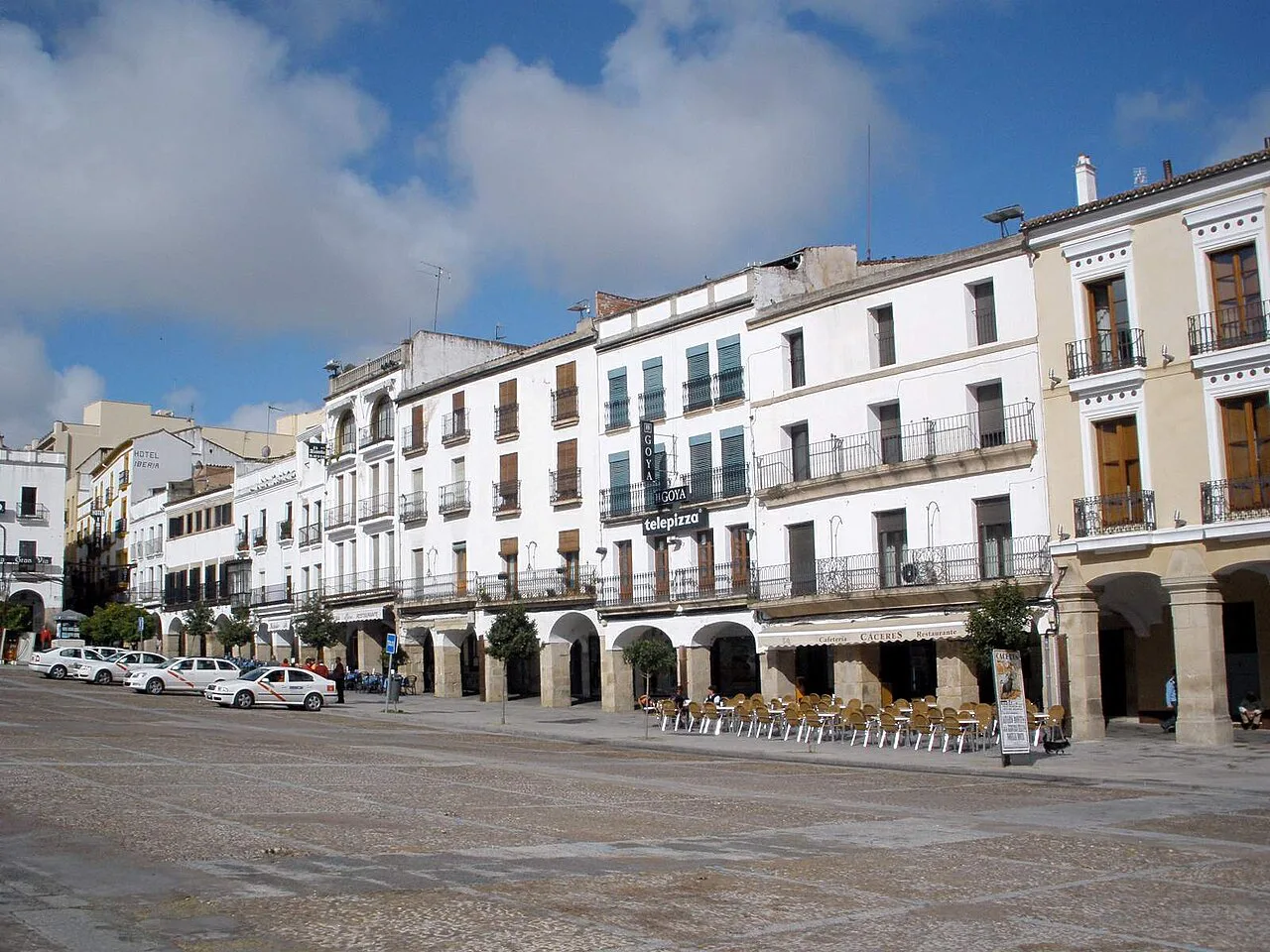
The square began in the twelfth century around an annual fair that drew large crowds, and it grew into one of the widest squares in Spain. Its arcades, carried on stone pillars and round arches, date from the fifteenth century, while the porticoed galleries around the square were built in the sixteenth. Read it as a gateway rather than a sight in itself: the Arco de la Estrella gives access to the old town from beside it.
Because the square sits directly against the old town, it works as a fixed landmark for the day. Meet here, orientate yourself, look up at the towers, then commit to the lanes inside the walls. Everything else in the historic centre is a short walk from this point.

Where the square sits and how you get into the old town
Plaza Mayor occupies the low ground just before the old town, reached by walking down Calle Pintores or Calle Gran Vía. The main way in is the Arco de la Estrella, the city's best-known gate and the one you will almost certainly pass through. Treat the arch as your entry point and the square as its forecourt.
The city tourist office is given a plaza address, 10003 Cáceres, with telephone +34 927 111 222 and email turismo@ayto-caceres.es. Use it for hours, tickets and anything current before you head through the gate.

What you can see from the square
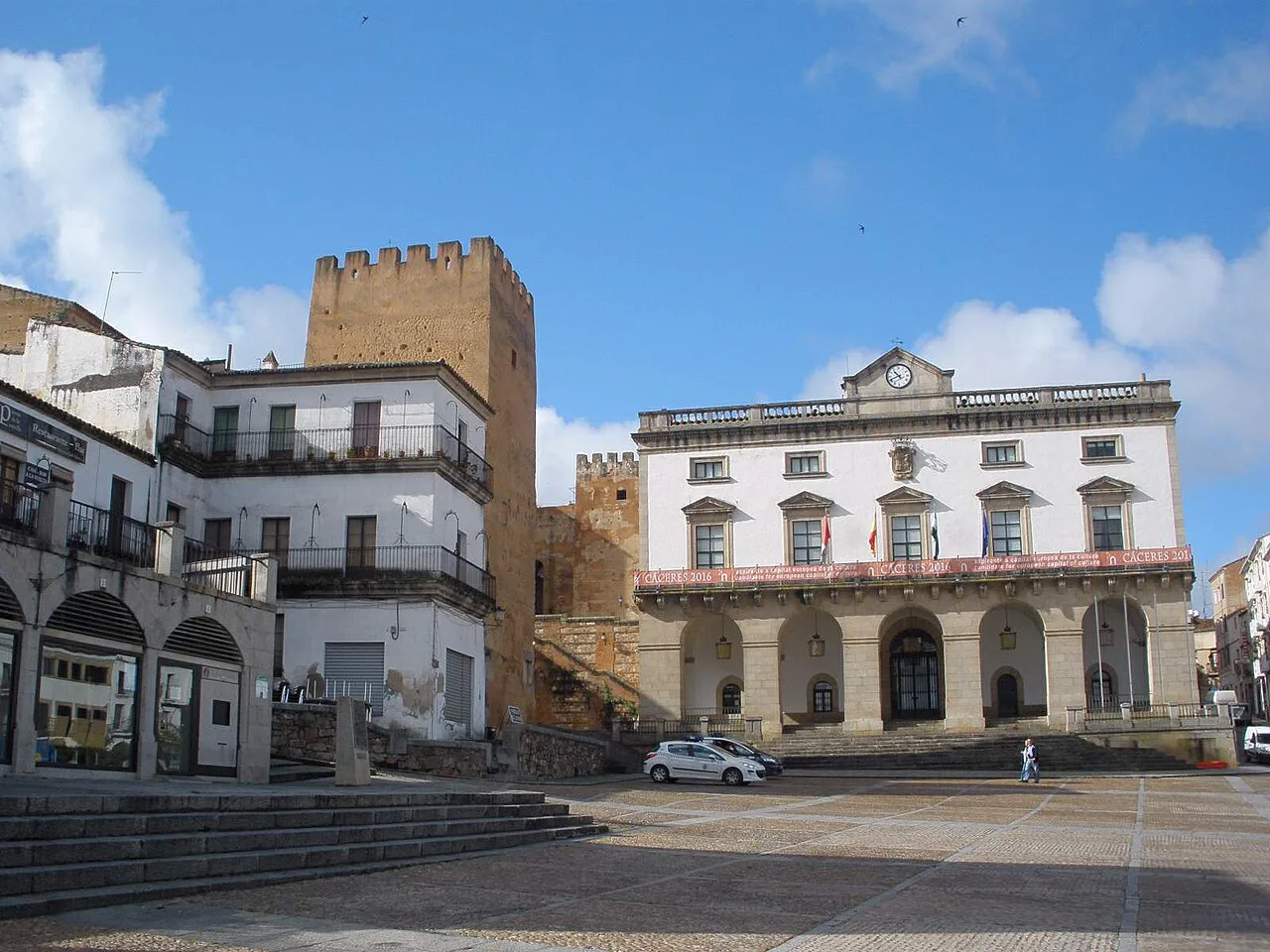
Stand in the middle and turn slowly: the Arco de la Estrella, the Torre de Bujaco, the Torre de los Púlpitos, the Torre de la Yerba, the Ayuntamiento, the Foro de los Balbos, the Torre del Horno and the Ermita de la Paz all come into view. That ring of towers and civic buildings is what makes the square worth a deliberate stop rather than a pass-through.
The buildings around the edge date from different periods, so the square reads as a layer cake of Cáceres rather than a single design. The porticoed arcades are the sixteenth-century layer; the square has been remodelled more recently to host events held in it.
The arcades: shelter, shops and souvenirs
The arcades along the square are carried on stone pillars, and they are the practical reason to linger. Bars and souvenir shops sit inside them, and they are a genuine refuge when rain sweeps across the square. On a hot inland day they give you shade without giving up the view.
Walk the full circuit under the pillars before crossing to the arch. It takes a few minutes, keeps you out of the worst of the weather, and gives you a closer look at the stonework than the middle of the square allows.
The Cáceres letters and the photo to take
Large letters spelling CÁCERES stand on the square, positioned so the old town sits behind you in the frame. It is the obvious photo stop and the reason many people pause here longer than they planned. Take it early or late if you want the towers behind you without a scrum of other photographers.
For a different angle, walk a few steps back and use the arcades as a frame instead of standing directly in front of the letters. The square is wide enough to get the towers and the gateway in one shot.
Climbing the Torre de Bujaco for the view back down
The Torre de Bujaco rises at the corner of the square, and its top gives the view back over Plaza Mayor, which makes the climb a natural companion to the square rather than a separate outing. Walk the square first, then go up with the layout already in your head.
The tower's ticket price, opening hours and any closing days are not set out here. Ask at the tourist office on the square, or check at the tower entrance, before you plan the climb into a tight schedule.
What is within a minute or two of the square
Through or beside the Arco de la Estrella you reach the core of the monumental city. The Palacio de los Golfines de Abajo, the Palacio Episcopal, the Palacio de Mayoralgo, the Palacio de Carvajal and the Cáceres cathedral (Concatedral de Santa María) all sit within roughly 0.2 km of the square. Plan the square as your first stop, then take these in on foot.
The Palacio de Carvajal is one of the closest, and it is the sort of stop that fills a gap between the square and the lanes deeper inside the walls. Its own visiting arrangements are worth confirming before you build a morning around it.
If you want a break from stone and towers, the Museo Helga de Alvear is the contemporary counterweight in the city, best treated as a separate stop rather than something to squeeze in on the way through the arch.
How long to allow and the trade-offs
Twenty to thirty minutes covers the square itself: the circuit of the arcades, the letters, the towers and the gate. Add time on top if you climb the Torre de Bujaco or step into the tourist office. The square rewards a slow look rather than a snapshot.
The real trade-offs are heat and congestion. Cáceres is an inland Extremaduran city, and midday summer sun on an open square is punishing, so use the arcades and plan the walk through the old town for earlier or later. The Arco de la Estrella is the best-known gate into the old town, so expect company there when groups arrive together.
Should Plaza Mayor be your first stop in Cáceres?
Yes, if you treat it as the door to the old town rather than a destination in its own right. Walk down Calle Pintores or Calle Gran Vía, circle the arcades, take the photo at the letters, look up at the Torre de Bujaco, and then go through the Arco de la Estrella with the palace-and-church cluster ahead of you.
Confirm tower tickets and monument hours at the tourist office on the square before you commit the morning. The square itself costs nothing and takes little time, which is exactly why it belongs at the start of the day.
Explore more Cáceres guides
Frequently Asked Questions
How old is Plaza Mayor de Cáceres?
The square originated in the twelfth century around an annual fair. Its arcades, carried on stone pillars and round arches, date from the fifteenth century, while the porticoed galleries around the square were built in the sixteenth. The buildings around the edge come from several different periods, so the square reads as a layered space rather than a single construction.
Do you need a ticket for Plaza Mayor de Cáceres?
No, the square is an open public space and you walk through it to reach the Arco de la Estrella and the old town. Individual monuments around it, including the Torre de Bujaco, have their own arrangements, which the tourist office can confirm.
What was filmed in Cáceres?
Cáceres is widely known as a filming location, and its monumental old town has appeared on screen. For specifics, the city tourist office is the reliable place to ask rather than relying on hearsay.