
San Julián de los Prados: Oviedo's Santullano Church

San Julián de los Prados, almost always called Santullano, is the church you visit for its painted interior rather than its size. Entry works by timed guided visit, roughly every 45 minutes and lasting about 30 minutes, so you build the trip around a slot instead of wandering in. This guide covers where the church stands, how to reach it, the seasonal timetable, ticket prices and the details worth seeking out inside.
The church was begun under Alfonso II and belongs to the Asturian pre-Romanesque group inscribed by UNESCO in 1998. Its wall paintings, applied in fresco, carry late Roman and early Christian decorative schemes further than any other church of its era in western Europe, which is the real reason to plan the detour.
What San Julián de los Prados is and why it matters
Alfonso II, known as the Chaste, ordered the church built in Oviedo, likely as a statement that his monarchy inherited the Visigothic legacy. The design points that way: a basilica-style plan with three naves and painted walls that echo Roman models. It is the only surviving building of a suburban palace complex built for the king.
The dedication is to the martyrs Julian and Basilissa, with the Trinity probably intended as well, since the number three governs the design. Three naves, three arches and three chapels recur throughout, and a triforium window on the east front hints at a hidden treasury chamber with no internal access.
What you see today is largely the result of Fortunato Selgas's restoration between 1912 and 1915, which also brought the murals back to view. The church was declared a Monumento Histórico Artístico in 1917 and forms part of the Asturian pre-Romanesque group inscribed by UNESCO in 1998, which places it in a wider Oviedo picture alongside the cathedral and the hillside churches.
The setting is a working parish, not a museum with a fixed opening. Visiting hours are subject to change for extraordinary celebrations, so the slot printed for your month is the one to plan around rather than a guaranteed daily routine.

Where it is: Santullano, on the edge of Oviedo
Santullano sits outside the old centre, in the neighbourhood that gives the church its nickname, and the approach on foot is part of the visit rather than a chore. It also pairs naturally with the two Naranco churches on the hillside above the city, which share the same pre-Romanesque label.
The city bus network is the practical answer for anyone staying near the cathedral. Read the timetable and route before you set out, because the church is not on a main pedestrian drag.

How visits work: timed slots and bookings
You do not buy a ticket and walk in. Guided visits run every 45 minutes with a 30-minute duration, led by a monument guide you can telephone during visiting hours. Groups need to reserve in advance, and the parish asks visitors generally to arrange the visit.
Bookings and information go through the email address and phone number on the parish visits page. Group reservations are required from 15 people in one line of that page and from more than 20 in another, so confirm the threshold when you write.
Opening times by season, and closing days
The timetable changes several times a year, and the differences matter. From October to April visits run Monday to Saturday at 10:00, 10:45 and 11:30 only, so winter is a morning visit. May and June add afternoon slots at 16:00 and 16:45 from Tuesday to Saturday, with Monday still mornings only.
July to September is the most generous stretch, with slots from 9:30 to 17:30 from Tuesday to Friday and a shorter Saturday pattern from 9:30. Monday keeps four morning departures up to 12:15. Holy Week follows its own expanded programme, with extra afternoon visits on several days and no visits on Good Friday.
The church is closed to visitors every Sunday of the year, and on 1 and 6 January, 1 November, 8 and 21 September, and 9, 24, 25 and 31 December. On 15 August it opens only in the afternoon, with visits from 16:00 to 18:15. The parish also closes on its local holiday and on Good Friday, whose calendar date moves each year.
Tickets: adult, child and group prices
Adults pay 4 € and children aged 7 to 12 pay 1 €. Groups pay 3 € each, though the page gives the threshold as both 15 and more than 20, so confirm it when you book. Entry is free on the first Monday of the month, which is the obvious saving on a short break.
Because the guided visit is the only way in, the ticket and the slot come together: turning up without a place in the next departure risks a wasted journey if a group has filled it. Groups should settle the arrangement by email when they book.
What to see outside: plan, espadaña and garden
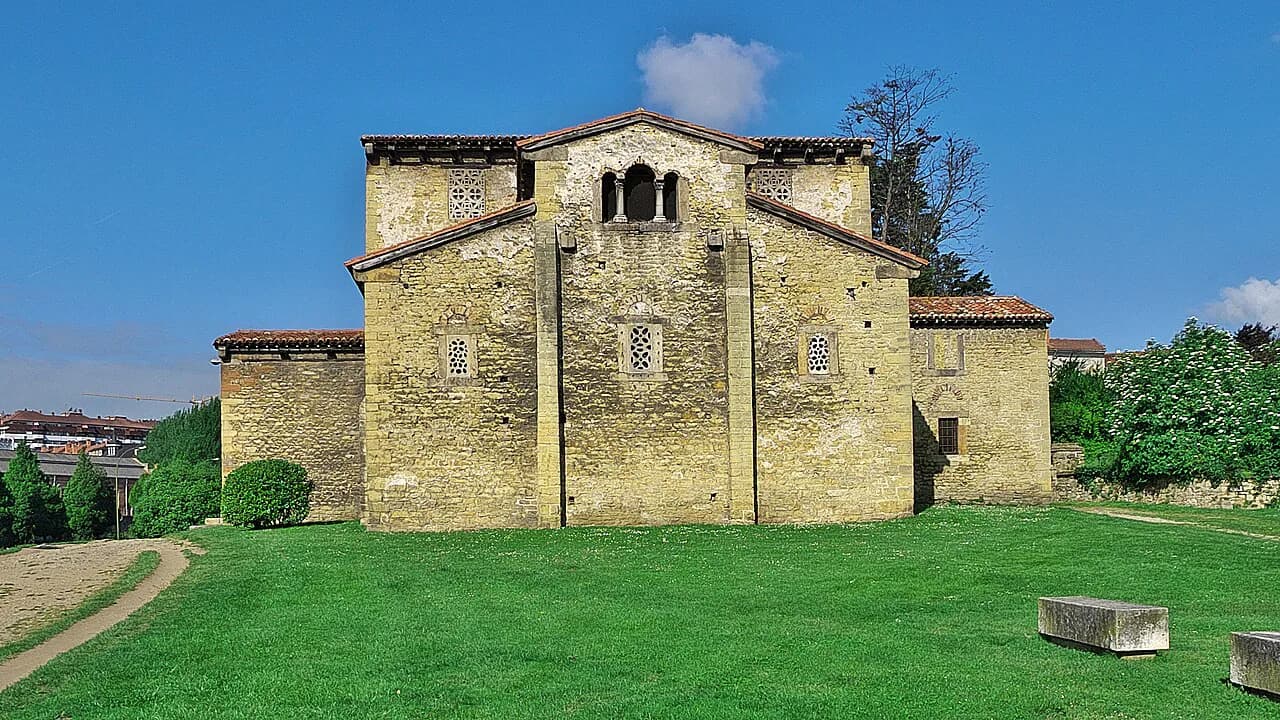
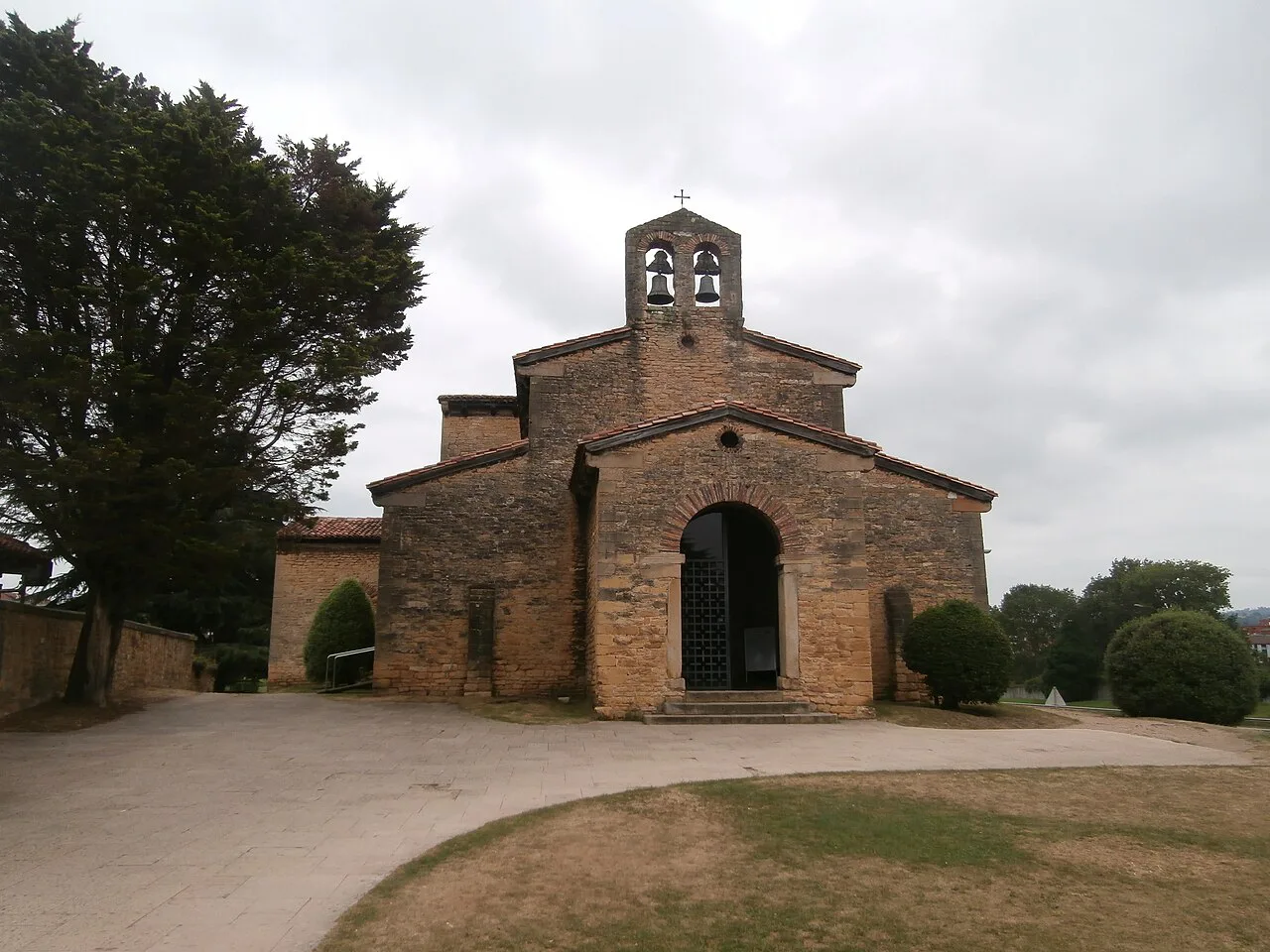
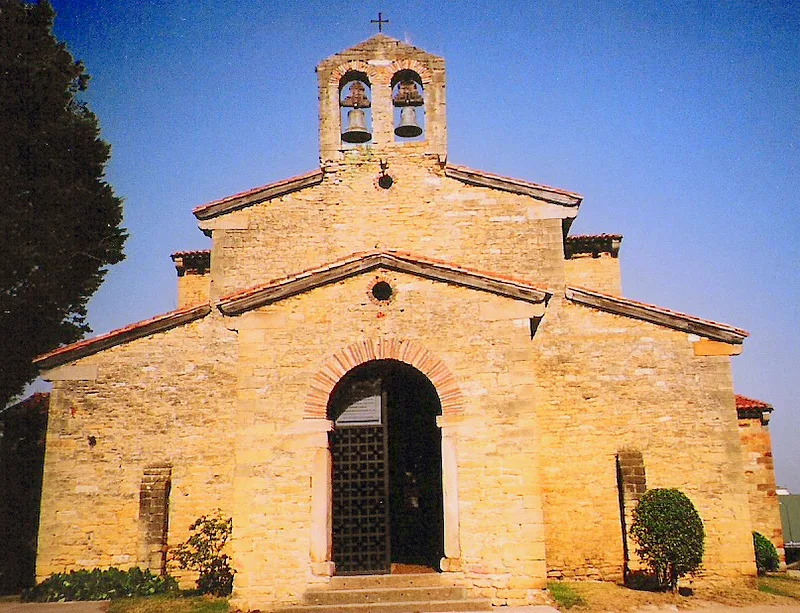
Start with the shape. The church has a rectangular plan with three naves of differing heights, crossed by a transept, a straight east end and three side chapels, with three more chapels at the chevet. The walls are rubble masonry with dressed stone at the corners.
Above the central chapel on the east front, a two-eyed espadaña holds the bells, and a three-light window marks the hidden chamber behind. At the rear, a small walled garden survives from the plot's former use as the church cemetery.
What to see inside: frescoes and the Crosses of Victory
The interior feels wider and brighter than the exterior suggests, thanks to the broad central nave and the window openings. The paintings are the reason to come: geometric motifs, palace hangings and buildings arranged in three horizontal bands, with the four Crosses of Victory carrying Alpha and Omega as the only Christian symbol in the scheme. The palette is grey-blue, ochre-yellow and crimson.
In the central chapel, look for the near life-size Cristo del Consuelo, a thirteenth-century image that dominates the space. The murals were painted al fresco, a Roman technique used in no other Asturian pre-Romanesque church, which is why the interior repays a slow look rather than a quick circuit.
How long to allow, and pairing it with the Naranco churches
The guided visit itself takes about 30 minutes, so the church fits into a half-day rather than eating a whole one. The trade-off is the journey out and back, which makes it sensible to combine Santullano with the hillside monuments in a single outing.
Santa María del Naranco and San Miguel de Lillo stand above the city and share the same UNESCO inscription, so the three together give you the full Asturian pre-Romanesque picture in one day. Check each site's own visiting arrangements before you go, since they run on separate timetables.
Nearby: back to the old town
On the return leg, the Oviedo cathedral, properly the Catedral de San Salvador de Oviedo, anchors the old town and is the natural next stop for anyone following the city's monument trail.
For a quieter hour, the Museo de Bellas Artes de Asturias holds a strong collection in the centre, and the Campo de San Francisco gives you a green pause between monument visits.
Which slot to book at Santullano
Aim for a morning slot if you are travelling between October and April, and use the afternoon departures if you are in Oviedo in summer. Build the day around one timed visit and then add the Naranco churches to see the pre-Romanesque sites without doubling back through the city.
If your dates include the first Monday of the month, aim for that free slot and put the saving towards the rest of your Oviedo itinerary — and book the departure in advance, since the free Mondays fall inside the same guided-visit system as every other day.
Frequently Asked Questions
Do I need to book San Julián de los Prados in advance?
Individual visitors join the next guided departure, but the parish asks visitors to arrange the visit and requires group reservations. Email or telephone before you travel, especially for a group, and confirm the departure that fits your day.
Is San Julián de los Prados open on Sundays?
No. The church is closed to visitors every Sunday of the year, and also on a list of public and parish holidays published on the visits page. Weekdays from Monday to Saturday are the reliable choice.
How much time should I allow at the church?
The guided visit lasts about 30 minutes, so allow roughly an hour once you factor in arriving for the slot. If you are combining it with Santa María del Naranco and San Miguel de Lillo, set aside a half day.