Arrecife Old Town: What to See in Lanzarote's Historic Quarter
Arrecife old town is compact: the Charco de San Ginés, the Castillo de San Gabriel, Calle Real and the Iglesia de San Ginés fit a single afternoon walk.
On this page
Arrecife old town suits an afternoon, not a day: its historic quarter is a working capital's centre, not a preserved walled town, and the sights sit within a short walk of each other. You come for the water inlet the fishing quarter grew around, a castle on a causeway, a church with baroque and Mudéjar elements in the same building and the main shopping street that threads through it all. This guide sets out what each part is like and gives a walking order that avoids doubling back.
Arrecife has been Lanzarote's capital since the second half of the nineteenth century and remains the island's administrative and commercial centre. Its marine character and its old defensive role are still legible in the street plan. Expect a city going about its business, with the historic buildings embedded in it.
What the old town of Arrecife actually covers
The historic core clusters around the Charco de San Ginés and the streets running inland from it, chiefly Calle Real, also called Calle León y Castillo. The Iglesia de San Ginés and the adjoining Recova Municipal anchor the old market corner, and La Casa Amarilla sits in the same central area. The Castillo de San Gabriel is reached by a stone causeway from the edge of this core.
Two sights sit apart and are often wrongly bundled with the rest: the MIAC in the Castillo de San José, on the bay of the Puerto de los Mármoles, and the CIC El Almacén in the centre. The Castillo de San José is the one that needs a deliberate detour, so plan it as a separate leg rather than expecting to pass it between the church and the market.
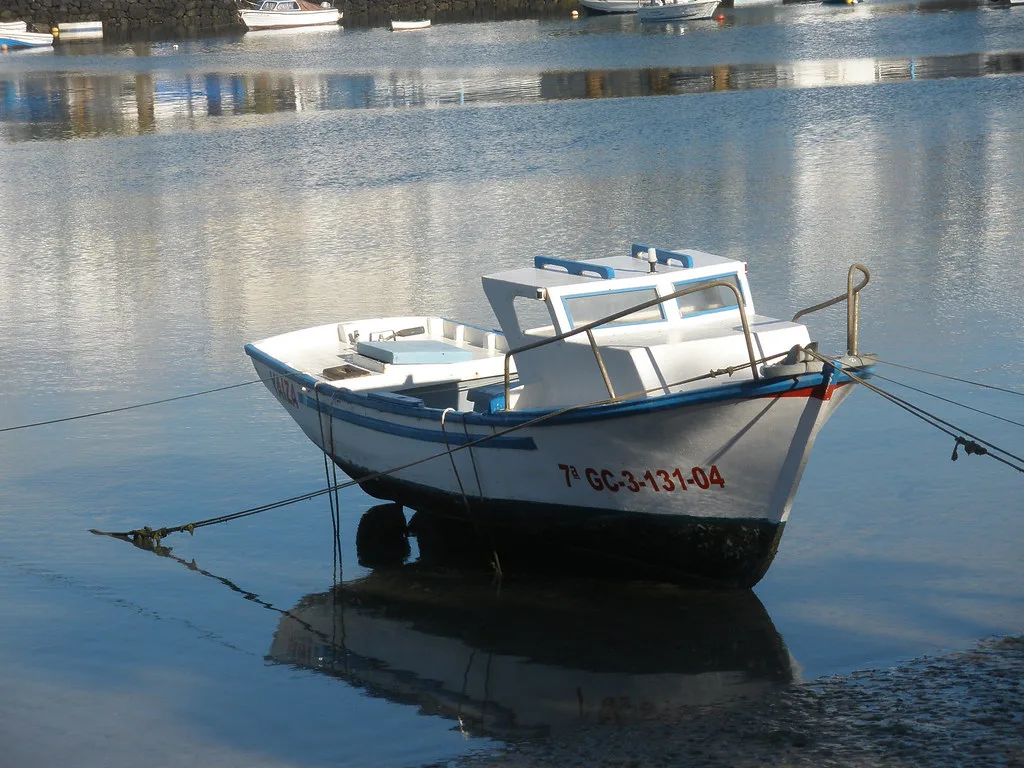
Start at the Charco de San Ginés
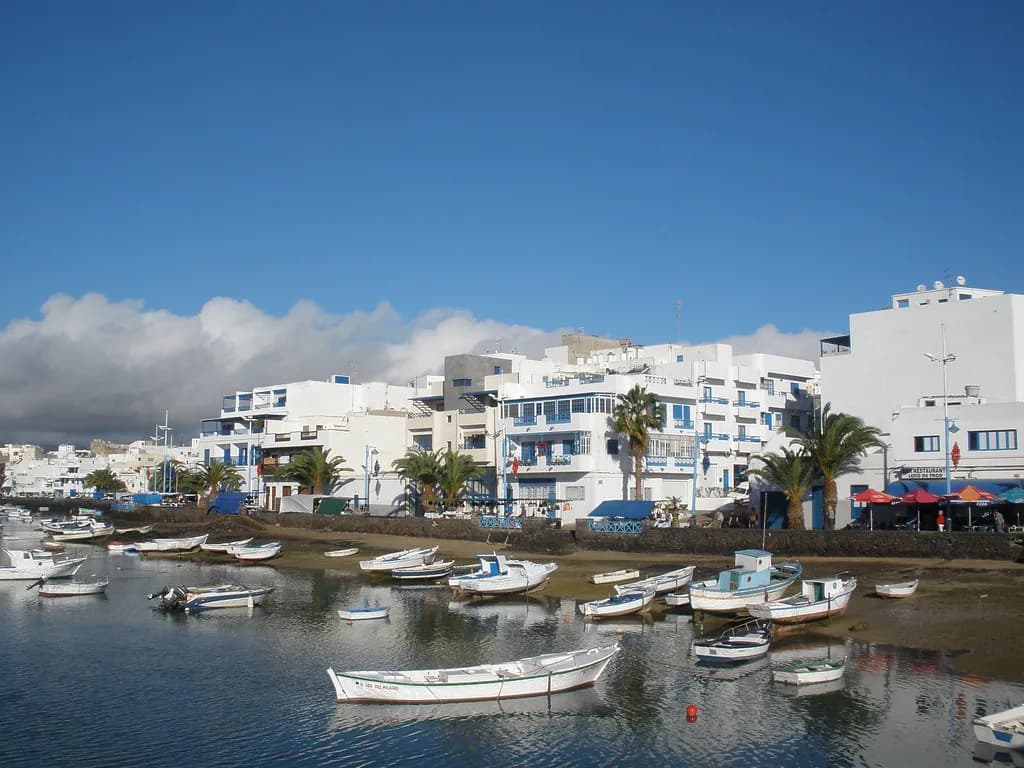
The Charco is an inlet of seawater in the heart of the capital, and the first fishing settlement on the island grew up around it. Its presence once earned Arrecife the name Venice of the Atlantic. It has since been remodelled to a design by César Manrique and is now used to moor small boats.
Treat it as a place to pause rather than a sight to tick off: the water, the moored boats and the surrounding bars and eating places make it the natural opening to a walk. Because the inlet sits at the heart of the old town, most other stops radiate from it.
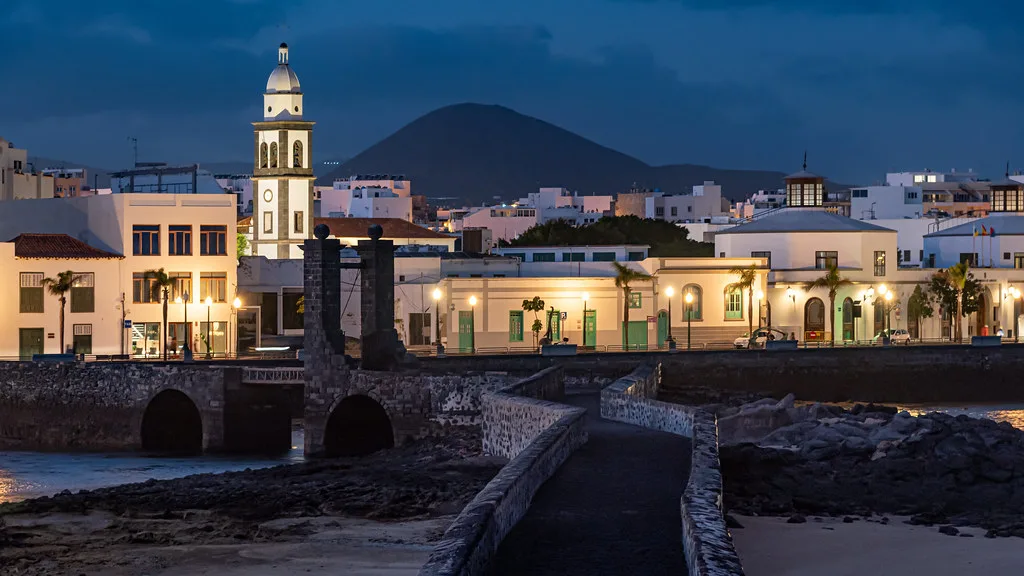
The Puente de las Bolas and Castillo de San Gabriel
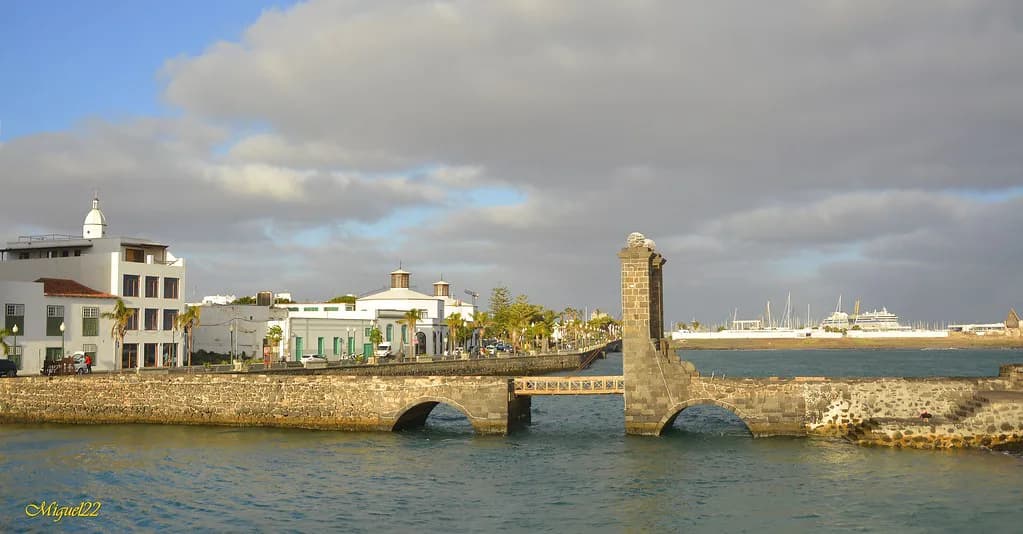
The Puente de las Bolas is a cobbled bridge built in the sixteenth century that served as the approach to the Castillo de San Gabriel. Its 175 metres link the fortress to the mainland, so the crossing is part of the visit rather than a means to it. The castle now houses a museum of the history of Arrecife.
Walk out over the bridge, look back at the town from the fortress and come back the same way; the castle is an island outpost, not a link to another part of the centre. That makes it a natural first or last stop on the loop rather than a mid-route cut-through.
Iglesia de San Ginés and the Recova Municipal
The Iglesia de San Ginés carries the dedication of the French bishop Saint Ginés, whose chapel on this site was founded in 1630 by a French merchant, Francisco García Santaella. The building shows the eclectic mix typical of Canarian architecture, with baroque elements alongside Mudéjar details and neoclassical façades.
Beside the church, in the old Plaza del Mercado, the Recova Municipal holds market stalls inside a fully renovated historic building. It is the obvious place to combine a look at the church with a browse under cover, and the two are effectively one stop. What is on the stalls changes, so go for the building and the market atmosphere rather than a particular trader.
Calle Real (Calle León y Castillo)
Calle Real, also known as Calle León y Castillo, runs beside the old part of the city and is one of Arrecife's principal streets. It is lined with shops and eating places, from quick food to traditional island dishes and newer cooking. Plan on browsing and lunch around it rather than treating it as a set route from sight to sight.
Because the street is a shopping street first, the historic buildings are on and around it rather than arranged in a sequence along it. Walk it once for the feel of the centre, then double back for the church and market corner. Shops keep Spanish retail hours, so a midday pause is normal.
La Casa Amarilla and the Plaza del Mercado corner
La Casa Amarilla, as locals call it, is a central building that once housed the Cabildo de Lanzarote and was declared a cultural asset in 2002. Its ground floor now holds temporary exhibitions on Lanzarote's ethnographic knowledge and memory. The building is a short step from the church and market, which makes it easy to fold into the same stop.
The MIAC in the Castillo de San José
The Castillo de San José stands on the bay of the Puerto de los Mármoles and contains the Museo Internacional de Arte Contemporáneo, founded in 1975 to promote, gather and show significant modern art. The building also holds a restaurant with panoramic views over the harbour. Treat this as a separate leg of the day, since it is not on the same stretch as the Puente de las Bolas.
El Almacén and the Islote de Fermina on the waterfront
CIC El Almacén is a cultural centre in the middle of Arrecife with exhibition rooms, a cinema showing films in their original version, a nursery for creative businesses and a bar. It is a place to look in on rather than a fixed stop, since the programme changes. Finish a walk here or at the waterfront if you want an indoor close to the afternoon.
The Islote de Fermina, designed by César Manrique in the 1970s, is a multifunctional space combining culture, leisure and nature, open to the public since 2023. It holds the Centro de Interpretación de la Bahía and a café with views over the water, and runs daytime and nighttime activities. Beyond the old town, Marina Lanzarote and the 500-metre Playa El Reducto are a waterfront extension worth knowing about if you have time left.
A walking order that links the old town sights
Begin at the Charco de San Ginés to get your bearings, then cross to the Castillo de San Gabriel over the Puente de las Bolas and return the same way. From there head inland to the Iglesia de San Ginés, the Recova Municipal and La Casa Amarilla, all within a few minutes of each other. Calle Real is the spine for browsing and a meal between stops.
Leave the Castillo de San José and its MIAC for a separate leg, and finish at El Almacén or the Islote de Fermina on the water. Two things to plan around: inland Lanzarote heat makes midday uncomfortable in summer, and churches close to tourists during mass. Both argue for starting early and keeping the waterfront for the afternoon.
Should the old town be your first stop in Lanzarote?
If you are flying into Lanzarote and staying anywhere on the island, give Arrecife old town an afternoon at the start rather than the end of the trip. It explains the island's capital in a way the resort strips do not, and it costs nothing to walk. Save the Castillo de San José for a second visit or a morning when you have transport.
If you want a preserved historic town instead, Teguise, Lanzarote's former capital, is the better fit. Arrecife rewards you for accepting it as a living city with monuments in it.
Explore more Arrecife guides
Frequently Asked Questions
Is Arrecife, Lanzarote worth visiting?
Yes, for an afternoon. The old town packs a saltwater inlet, a sixteenth-century causeway and castle, a parish church with baroque and Mudéjar elements, a covered market and a main shopping street into a compact area you can walk. It is a working capital rather than a preserved walled town, so come for the streets and the monuments embedded in them, not for a stage set.
Where is Lanzarote?
Lanzarote is one of the Canary Islands, in the Atlantic off the coast of north-west Africa, and Arrecife is its capital. It is a Spanish island and a common short-break destination from the UK.
Sources
Notes for your next Spanish town break
Optional updates to our guides.
You might also like
Continue reading
More guides you'll find useful