
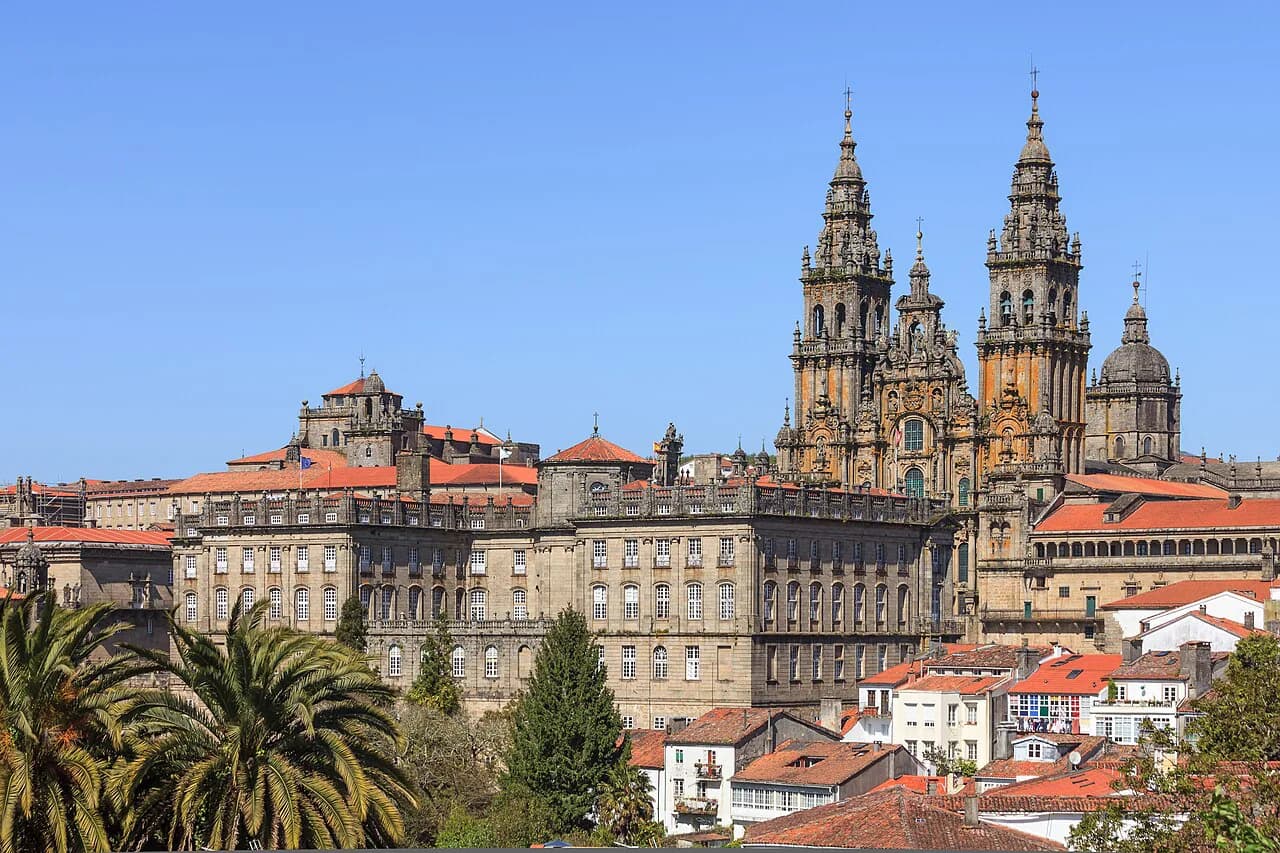
Pazo de Raxoi: the Neoclassical Palace on the Obradoiro

The Pazo de Raxoi is a ten-minute stop, not an attraction with a ticket desk: the palace closes the west side of the Praza do Obradoiro, and only its exterior is open to visitors. It earns its place on any walk across the square because of what the facade carries — a fourteen-arch granite arcade, a marble relief of the Battle of Clavijo and a statue of Santiago on horseback above it. This guide covers where the building stands, how to read the facade, what happens inside and what to see immediately around it.
What the Pazo de Raxoi is and where it stands
The palace faces the west front of the cathedral on the Praza do Obradoiro, the address given as Praza do Obradoiro, s/n, 15705 Santiago de Compostela. It was commissioned by Archbishop Raxoi and designed by Carlos Lemaur, whose neoclassical scheme sits on a granite arcade running the length of the ground floor. Arriving on foot from the old-town lanes, you meet it head-on as the square opens out, with the cathedral behind you.
Its original purpose was ecclesiastical rather than civic: it served as a seminary for confessors and as a residence for the cathedral choirboys. That history explains the plain, repeating arcade at street level, which reads more like a cloister range than a town hall front. The building sits within the Santiago de Compostela Attractions cluster of old-town sights, all reachable on foot from this one square.
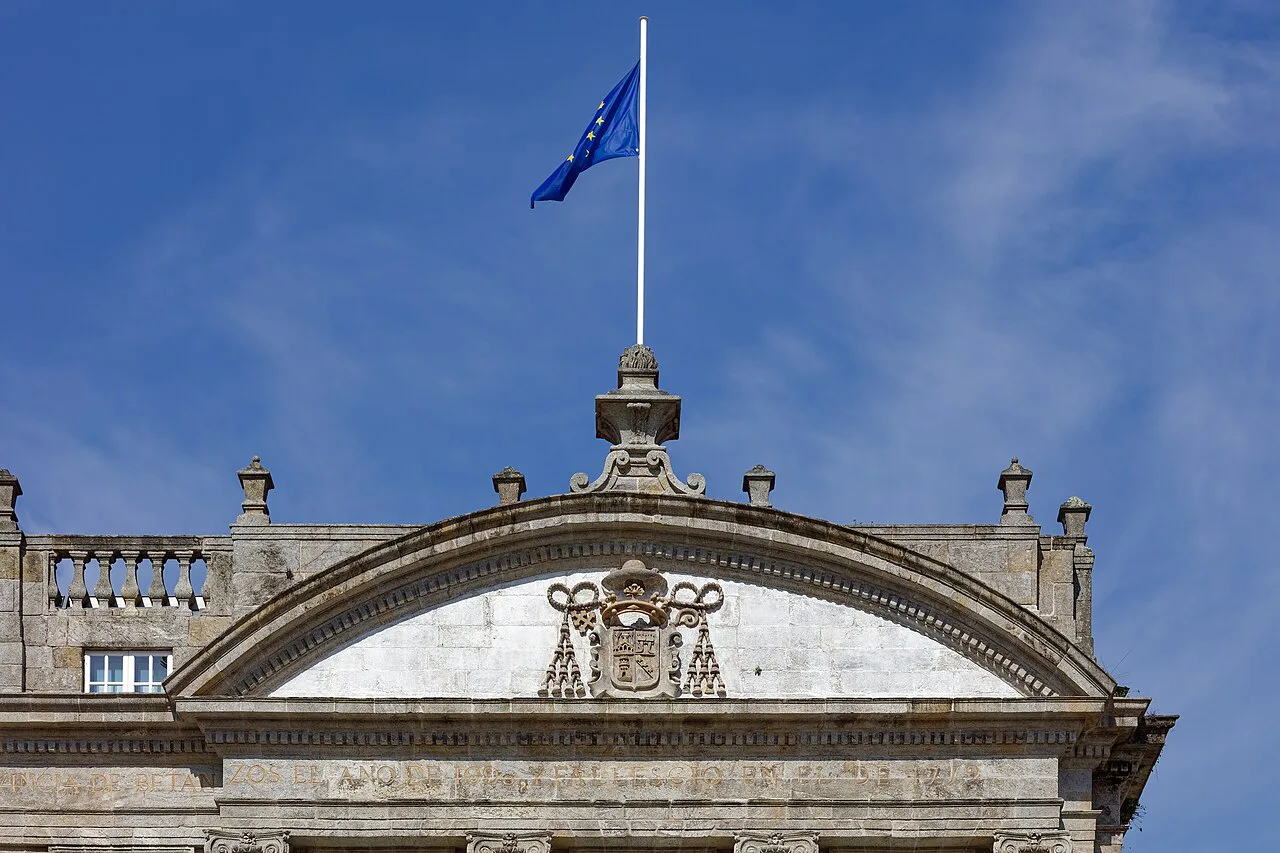

The neoclassical facade: arcade, Clavijo relief and equestrian Santiago
Start at ground level, where fourteen round-headed granite arches form an arcade across the whole front. Above them the facade is dressed in smooth neoclassical masonry, a deliberate contrast with the weathered stonework of the cathedral opposite. The proportions are calm and horizontal, which is why the palace photographs as a long backdrop rather than a monument in its own right.
In the centre of the facade, a pediment holds a marble relief of the Battle of Clavijo, carved by Gambino and Ferreiro. The composition is crowned by an equestrian statue of Santiago, the apostle whose relics made the city a pilgrimage destination. Stand back towards the cathedral steps to see the relief and statue together; from directly beneath the arcade they disappear above the cornice.
The building is listed as an eighteenth-century neoclassical palace, and the InSpain entry dates its construction to 1776 under Lemaur's authorship. Treat the figure as the design date rather than a completion certificate; the palace reads as a single, coherent campaign of building rather than a patchwork of later additions.
Inside: the rococo staircase and the building's working role
Behind the arcade, the feature worth knowing about is a rococo staircase, also designed by Lemaur. It is not part of the public visit, so the description is as close as most travellers get: a curving interior set-piece hidden behind a very restrained exterior. The contrast is the interesting part — the facade plays it straight, the stair does not.
The reason there is no interior visit is straightforward: the palace now houses the Presidency of the Xunta de Galicia and the city council of Santiago de Compostela. It is a working government building, with the security and access arrangements that implies. Plan the Pazo de Raxoi as something you look at and photograph from the square, then spend your indoor time at the cathedral or a museum instead.
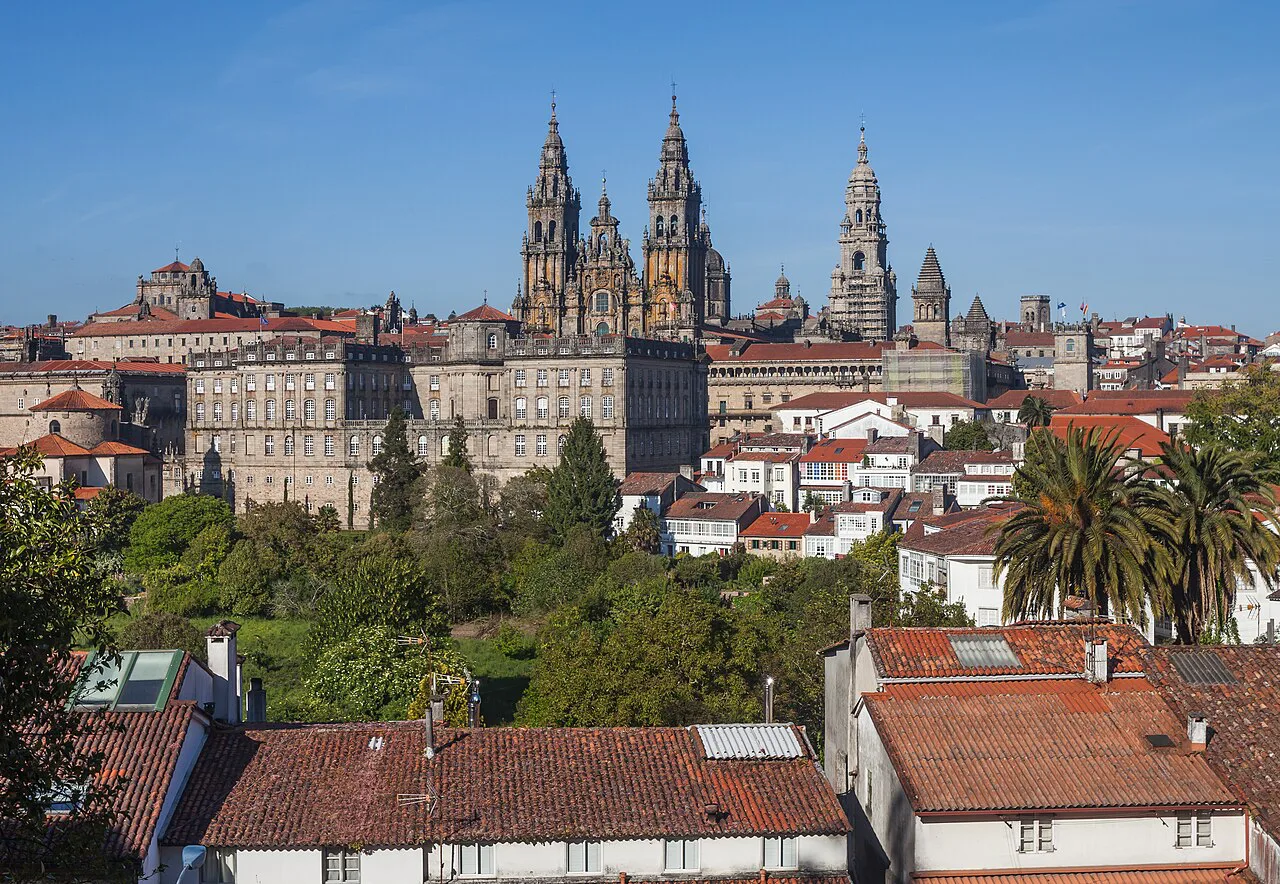

Visiting: exterior only, and how long to allow
Only the outside of the monument can be visited, so there is no ticket to buy, no queue and no opening time to work around. That makes it the most flexible sight on the Obradoiro: it fits before a cathedral visit, after dinner or in a gap between two old-town stops. Allow about ten minutes to walk the arcade, read the facade and take in the square from the palace side.
The square is at its best in low, angled light, when the relief and the equestrian statue pick up shadow and the granite arcade stops looking flat. Rain is common in Galicia, and the arcade itself gives little shelter, so keep the palace for a dry slot and use the cathedral or a museum when it turns. Santiago de Compostela rewards slow walking between sights rather than a ticked list.
What to see around the Obradoiro: the cathedral's west facade
The obvious companion is the Santiago de Compostela cathedral, whose west facade rises directly opposite the palace and forms the other half of the square's great composition. Step between the two and the scale changes completely: the cathedral's baroque front is vertical and theatrical, the palace horizontal and restrained. Seeing them as a pair is the point of standing in the middle of the Obradoiro.
The cathedral is a working place of worship, and tourist access is adjusted around services, so time your entry around mass rather than assuming continuous visitor opening. Ticket prices and free-entry slots vary and are worth checking against the cathedral's own published information before you plan the day. The west facade, at least, costs nothing and is visible at any hour.
Nearby in the old town: Praza das Praterías and the Casa do Cabido
Walk through the cathedral's south side and you reach the Praza das Praterías, closed on one side by the Casa do Cabido. That building was conceived as an urban embellishment, with the cut-plate decoration typical of Galician baroque, and it is the most photographed small facade in the old town. It sits opposite the cathedral and is free to look at.
The old town behind the palace holds more than the Obradoiro: the Praza da Quintana Santiago spreads out behind the cathedral's apse, a broad, quieter space that works well at the end of a loop through the lanes. Continue downhill and the streets lead towards the Museo do Pobo Galego, housed in the Mosteiro de San Domingos de Bonaval, with the Parque de Bonaval Santiago beside it for a break from stone.
For a sense of the medieval city boundary, the Arco de Mazarelos is the single surviving gate of the old wall and stood on the route into the town. It is a brief look rather than a destination, but it rounds off a walk that starts at the palace and threads through the old town.
How to slot the Pazo de Raxoi into an Obradoiro morning
Treat the palace as the opening move of an Obradoiro visit: ten minutes reading the arcade, the Clavijo relief and the equestrian Santiago, then cross the square to the cathedral's west facade. Because there is no interior access and no ticket, it never needs its own slot in the day and never clashes with a timed entry elsewhere.
Build the rest of the morning around Praza das Praterías, the Praza da Quintana and, if you want an indoor stop, the Museo do Pobo Galego. Check cathedral visitor arrangements against its own published information before setting out, since services take priority over tourism.