
Praza da Quintana: Santiago de Compostela's Two-Level Square

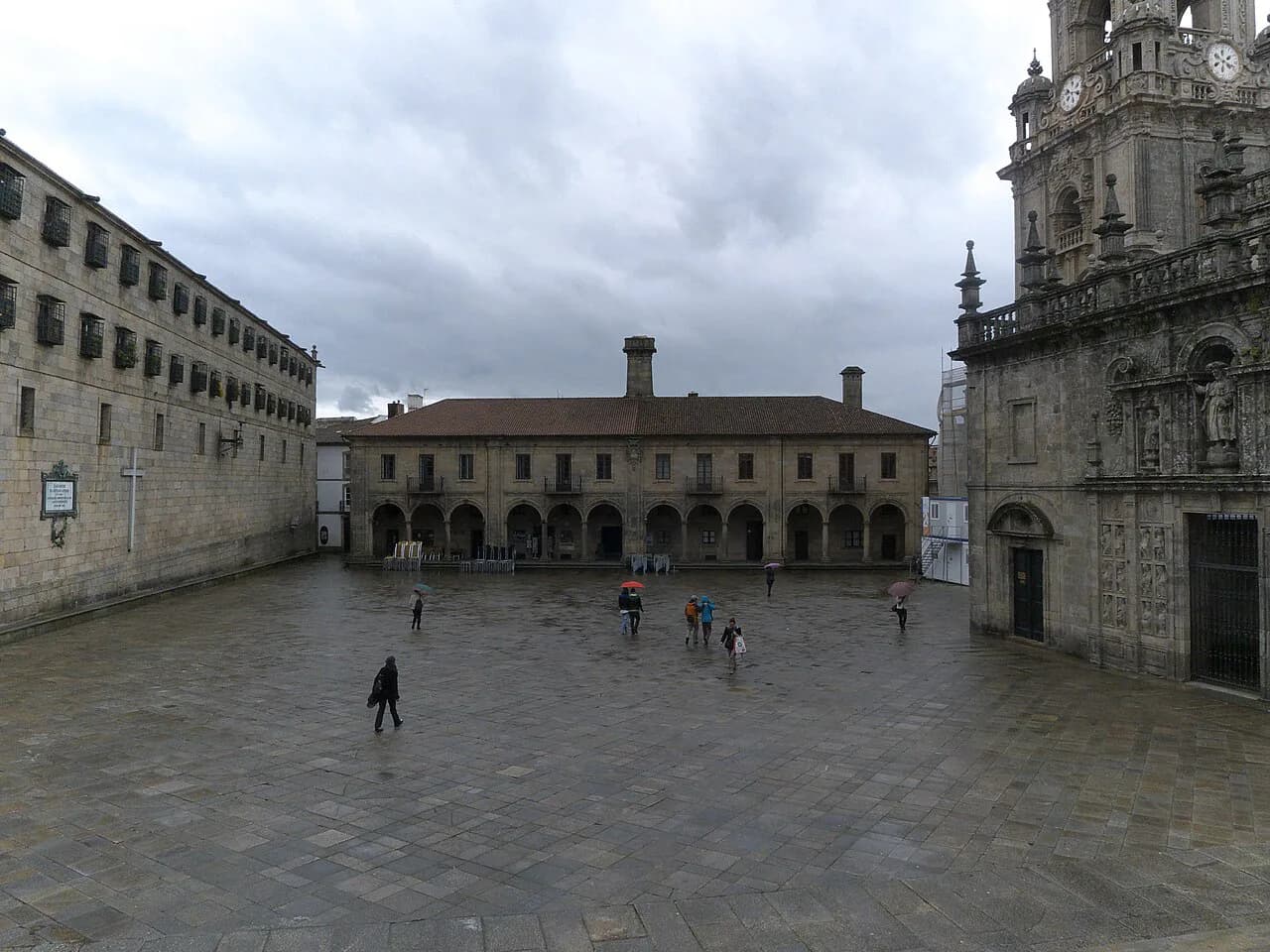
Praza da Quintana is the square on the east side of Santiago de Compostela cathedral, and it reads as one space even though it comes in two levels: the lower Quintana de Mortos and the upper Quintana de Vivos, joined by a wide stairway. It is a public square with no ticket and no queue, so the only planning it needs is fitting it into a walk around the old town. This guide covers where it sits, what frames it, how long to allow and what is within a few minutes on foot. For the practical details, see the Santiago de Compostela guide.
Where the square sits and how to reach it
The square lies against the cathedral's east end, in the heart of the historic quarter, a couple of minutes' walk from the far grander Praza do Obradoiro on the cathedral's western face. Almost everyone arrives on foot, because the old town is a knot of granite lanes where driving makes little sense; come up from the Rúa do Franco or the Rúa das Casas Reais and you meet the square from below. Allow five to ten minutes from the Obradoiro, longer if you keep stopping in the arcades.
The old town is compact and walkable throughout, and the square sits in the middle of it, so the last stretch is all pedestrian lanes and steps. The city is the capital of Galicia and the end point of the Camino de Santiago, so the streets around the square carry a steady flow of walkers with packs.

The two levels: Quintana de Mortos and Quintana de Vivos
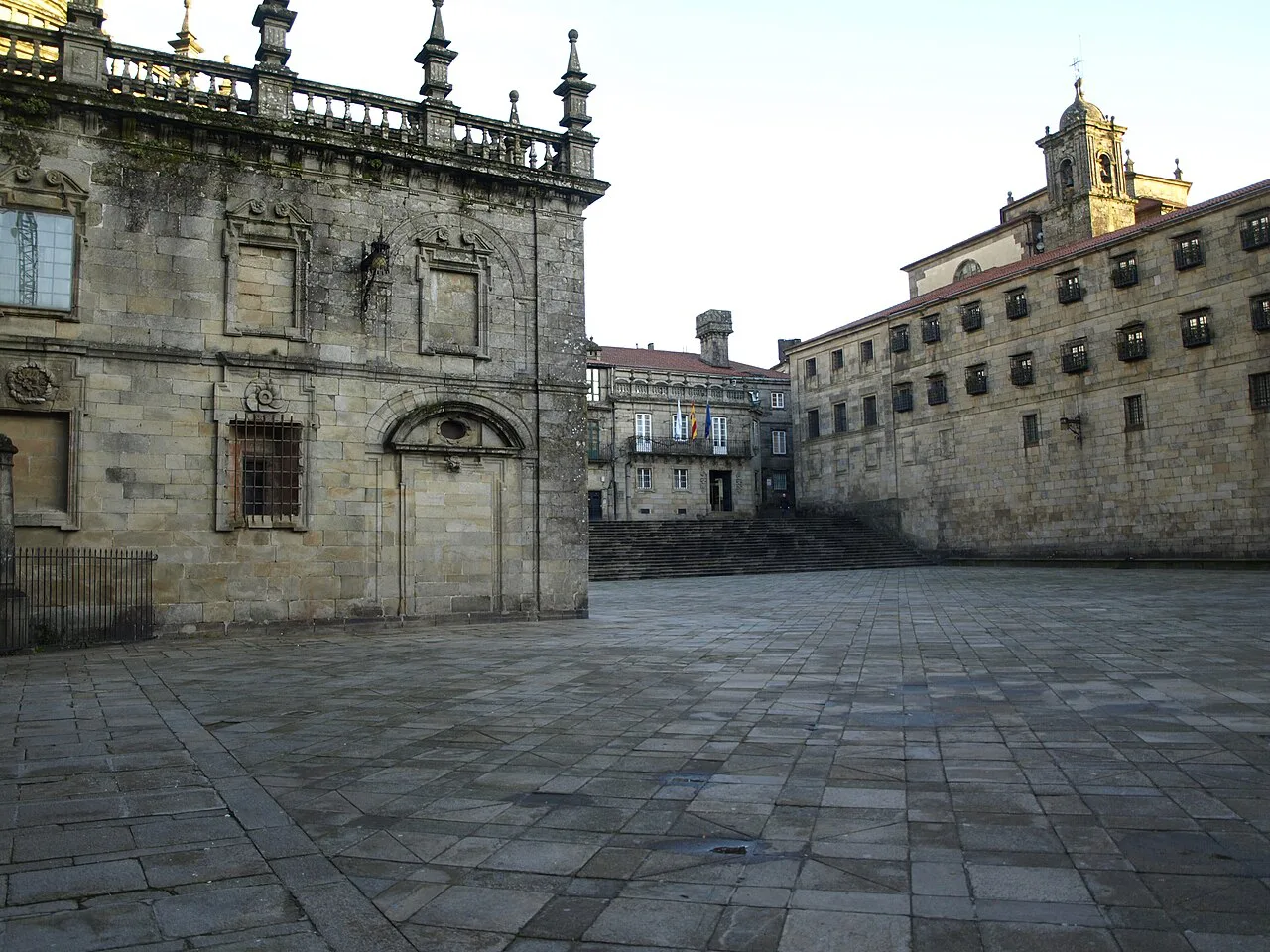
The lower half, the Quintana de Mortos, was levelled at the beginning of the seventeenth century and the stairway was built to connect it with the upper level, the Quintana de Vivos, in work carried out by Xácome Fernández and F. González de Araujo. Knowing that the two halves were engineered into one space explains why the square feels like a shallow amphitheatre: you stand in the lower half and look up at the upper, with the cathedral rising behind.
In practice the levels divide the square's moods. The lower half is the route pilgrims take towards the cathedral's east door, while the upper half is where people pause, sit on the steps and look back down. If you want the photograph of the cathedral's east front, take it from the lower half and let the stairway give the frame some depth.

The Puerta Santa and what you actually see
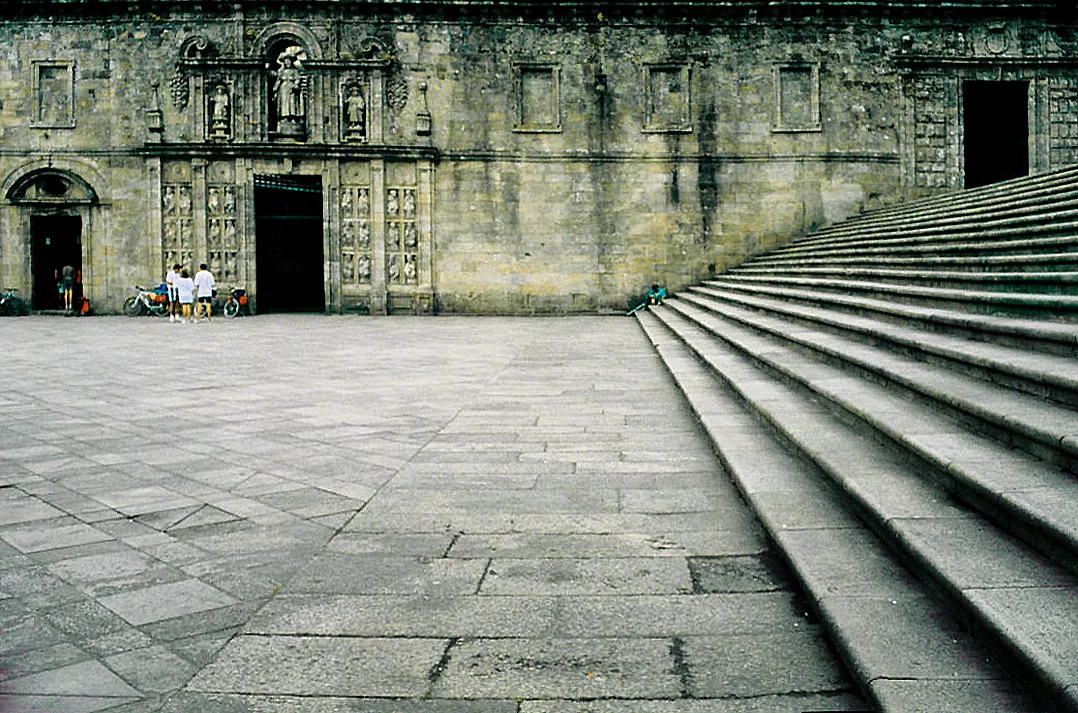
The Puerta Santa, the Holy Door, sits on the square's cathedral side and opens in Holy years, when pilgrims pass through it to gain the Jubilee. In ordinary years it stays shut, so do not count on walking through it unless your visit falls in a Jubilee year.
The square is an open public space, so there is no ticket to buy and no opening time to work around. Treat it as a place you pass through and linger in rather than a sight you book.
What surrounds the square
Four buildings frame the space and give it its shape: the cathedral sanctuary, the Casa de la Parra, the Monastery of San Paio de Antealtares and the Casa da Conga. The monastery's long, severe front closes one side, and the Casa da Conga is the other building most people stop for, whether or not they know its name. Walking the perimeter takes a few minutes and is the quickest way to grasp the square's proportions.
The cathedral's east end is the dominant wall. The upper half gives you the wider view back over the rooftops of the historic quarter towards the towers, and the lower half puts you directly beneath the east front.
A Baroque stage built for crowds
The square was laid out for holding major Baroque celebrations, which is why it was given a flat lower level and a stairway wide enough for processions and spectators. That history is the reason it feels more like a stage than a square: the levels create natural seating, and the cathedral wall provides the backdrop. It also means the space handles crowds well, so even a busy pilgrim afternoon rarely feels cramped.
Pilgrims arriving at the end of the Camino
This is where walkers on the Camino de Santiago tend to arrive, coming up through the old town to the cathedral's east side before rounding it to the Obradoiro. Expect rucksacks, walking poles, embraces and a fair amount of photography, particularly in the late morning and early afternoon when the day's arrivals cluster. If you want the square close to empty, come early or in the evening after the day's walkers have dispersed.
How long to allow
Fifteen to twenty minutes covers the square properly: both levels, the buildings around it and a look at the Puerta Santa. Add half an hour if you want to sit on the steps and watch the arrivals, which is the better use of the time. There is no interior to tour and nothing to queue for, so the visit is as long as you make it.
What is nearby
The Praza do Obradoiro, the cathedral's west front and the Pazo de Raxoi are a few minutes away and make the obvious continuation of a walk through the historic quarter. The Parque de la Alameda, the city's main park with its views back to the cathedral towers, is a short walk south-east and a good place to end an afternoon.
For a longer half-day, the Museo do Pobo Galego in the former Mosteiro de San Domingos de Bonaval and the adjoining Parque de Bonaval sit a short walk away and give the old town a different scale.
Is the square worth a stop on your walk?
Yes, briefly. Praza da Quintana is free, open and takes about fifteen minutes, and it gives you the cathedral's east face and the Puerta Santa in a setting far quieter than the Obradoiro. Build it into a walk between the Santiago de Compostela Cathedral and the Alameda rather than treating it as a destination of its own.
Explore more Santiago de Compostela guides
Frequently Asked Questions
Do you need tickets for Praza da Quintana?
No. It is an open public square in the historic quarter, open all day, and there is nothing to book or pay for to walk into it. The cathedral alongside it is a separate matter with its own arrangements.
When is the Puerta Santa open?
The Holy Door opens in Holy years, when pilgrims pass through it to gain the Jubilee. In ordinary years it stays shut; check the current cathedral arrangements before planning a trip around walking through the door.
How long should you spend at Praza da Quintana?
Fifteen to twenty minutes is enough to see both levels and the buildings around them. Add half an hour if you want to sit on the steps and watch pilgrims arrive, which is the reason many people stay longer.