Cádiz Cathedral: Tickets, Hours and What to See
Cádiz Cathedral in Plaza de la Catedral: published hours, ticket prices in euros, the crypt, the yellow-tiled dome and the Torre del Reloj climb in one visit.
On this page
Cádiz Cathedral is worth two hours, and a single ticket covers the church, the Torre del Reloj climb and the Casa de la Contaduría. It stands on Plaza de la Catedral in the heart of the Cádiz old town, a short walk from the waterfront; the wider layout is mapped in this guide to Cádiz Spain. This guide sets out the published hours and prices, then walks you through the façade, the chapels, the crypt and the tower in the order most visitors meet them.
Cádiz Cathedral at a glance
The cathedral replaces a much older church: the Catedral Vieja de Santa Cruz was burned when an English and Dutch fleet under Admiral Howard and the Earl of Essex sacked Cádiz in 1596, and its successor was consecrated in 1602. As the city grew rich on the American trade, that building was judged too small for the liturgy the merchant community expected. The first stone of the new cathedral was laid in 1722 to designs by Vicente Acero, and the church was finally consecrated in 1838.
The long build explains the mixed style. Acero's plan grafts Italian Baroque curves onto a Spanish Gothic ground plan, and later architects pushed the upper levels towards Neoclassicism, which is why the dome, towers and the crowning of the main façade look cooler and more restrained than the base. The money came from the quarter share of one per cent levied on the treasure fleets arriving from the New World, and work stalled when that trade faltered.
Opening hours and last entry
The cathedral opens Monday to Saturday from 10:00 to 20:00 and Sunday from 13:30 to 20:00, with last admission 45 minutes before closing. That Sunday afternoon slot is the one to plan around if you are arriving by train or coach late in the morning. Visitor opening is separate from worship, so the building is not shut to tourists on Sundays.
The Torre del Reloj keeps its own hours, and they differ from the cathedral's on Sundays in particular: Monday to Saturday 10:00 to 20:00, Sunday 12:00 to 15:00 and 16:00 to 20:00, with the last ascent 30 minutes before closing. In practice that means the tower is open on Sunday mornings when the church itself is not, and shuts for the early afternoon.
Sunday and feast-day mass is at 12.00, which is the reason the tower and the church follow different rhythms on a Sunday. If you want the interior quiet, aim for a weekday morning; if you want both tower and church on a Sunday, come after 16:00.
Ticket prices in euros and who gets in free
General admission is 10 EUR. Visitors over 65 pay 9 EUR, and people with a disability assessed below 60% and students under 25 pay 8 EUR. Groups of more than 20 pay 7 EUR each, and student groups pay 6 EUR.
Entry is free for people born or resident in the Diócesis de Cádiz y Ceuta, for children under 12 and for visitors with a disability above 60%. Bring proof of residence or age, since the free categories depend on documentation rather than appearance.
The ticket includes the Torre del Reloj and the Casa de la Contaduría, so there is no separate charge for the climb or the archive rooms. The desk works in cash, the building has adapted access, and pets are not admitted.
What to see outside: the façade, the towers and the yellow dome
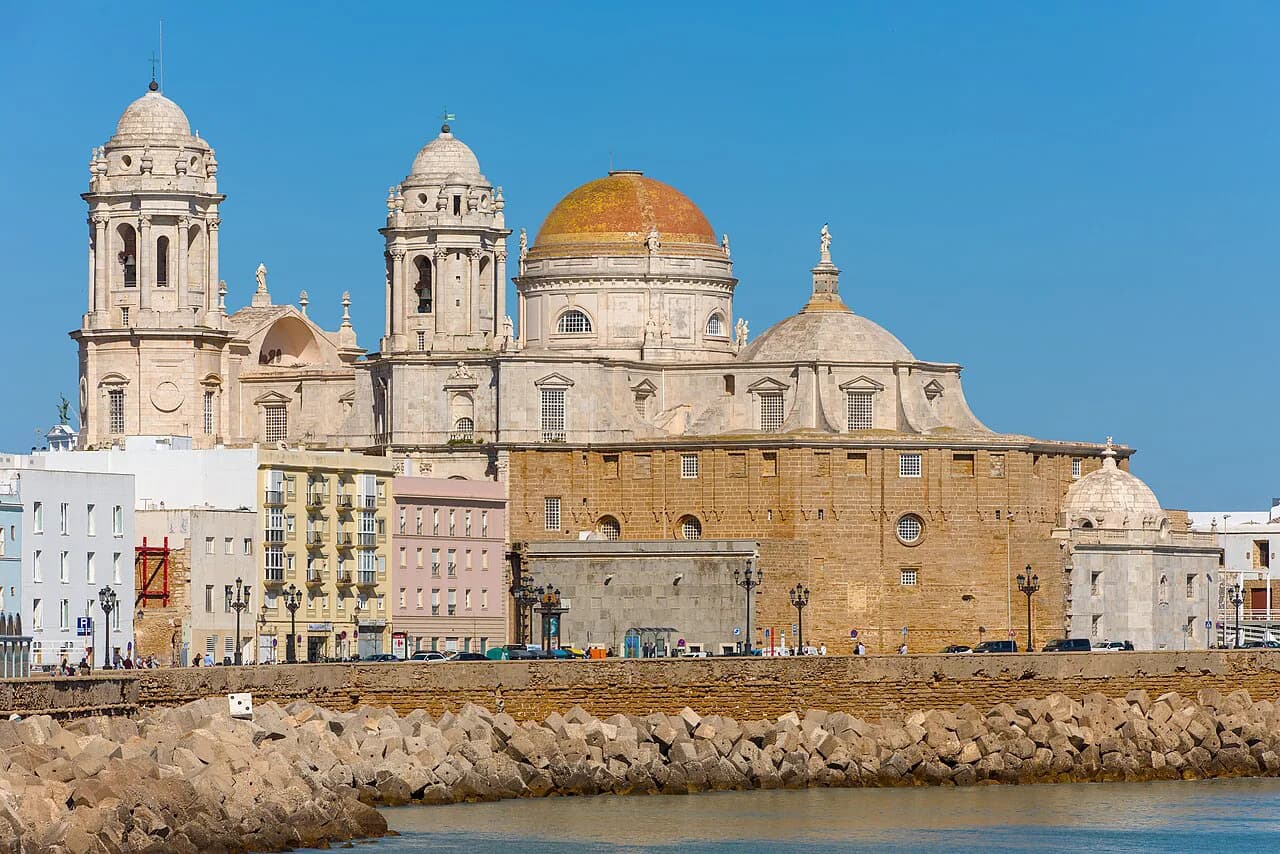
Start on the plaza and read the main façade from the bottom up. The central portal has two storeys, the lower with four richly carved Corinthian columns and the upper with a large window flanked by the patron saints, San Germán and San Servando, carved by the Genoese sculptor Esteban Frucos in the seventeenth century and moved here from the Catedral Vieja. Above them sits a marble figure of the Divino Salvador, also by Frucos.
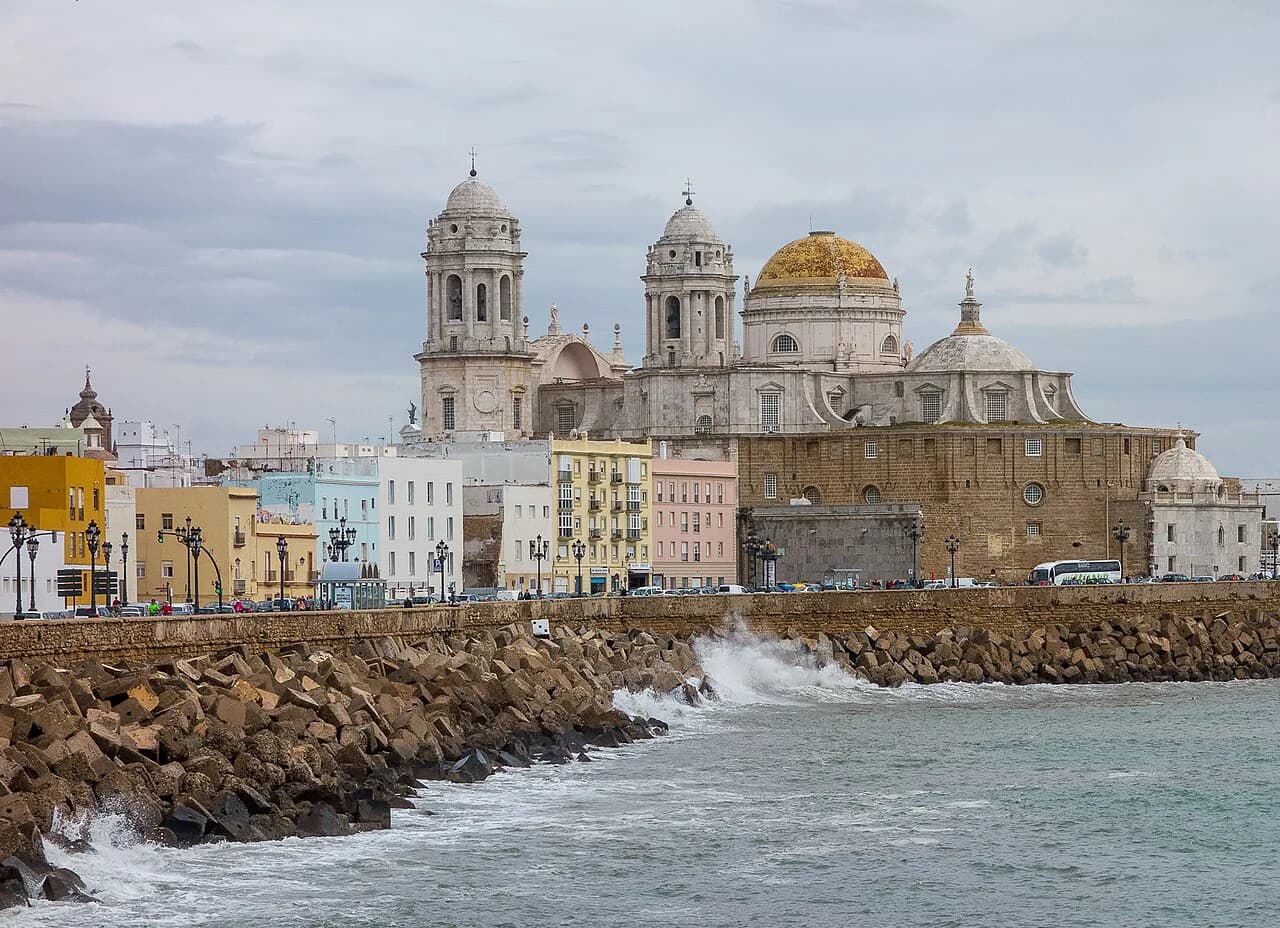
The two side doors are matched in marble and jasper, and each is framed by an octagonal tower in three stages: a rusticated base, a middle stage with openings between pilasters, and a top stage of columns under a hemispherical cap. The lower part of the façade is marble, the upper part limestone, which shows as a subtle change of colour in strong light.
The dome over the crossing is the image most people carry away: a shallow hemisphere by Juan Daura sheathed in glazed yellow tiles and ringed with figures of saints. Look at it from a street away rather than from directly below, where the curve flattens.
Inside: three naves, sixteen chapels and the pieces to seek out
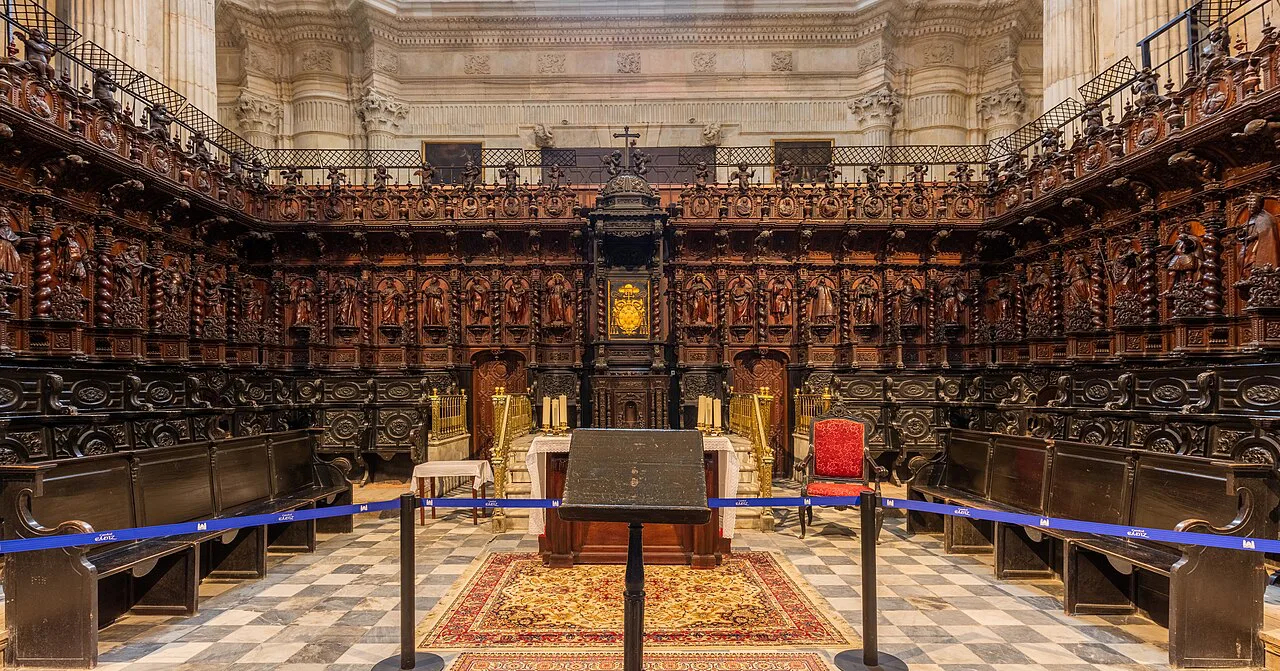
The plan is a Latin cross with three naves separated by elliptical piers with fluted Corinthian columns at the ends, and sixteen chapels run along the sides. Walk the perimeter first, then the centre, so you do not lose the big picture in the detail.
Three chapels repay a proper stop. San Sebastián holds a 1621 painting of the saint by the Genoese artist Andrea Ansaldi; San Servando and San Germán keeps Baroque sculptures of the patron saints from 1687 by Luisa Roldán, known as La Roldana; and Santa Teresa displays the silver processional tabernacle for Corpus Christi, made between 1649 and 1664 to a design by Alejandro Saavedra. The high altar is a circular Neoclassical temple in coloured marble and gilded bronze following Manuel Machuca's project of 1790.
The crypt under the high altar
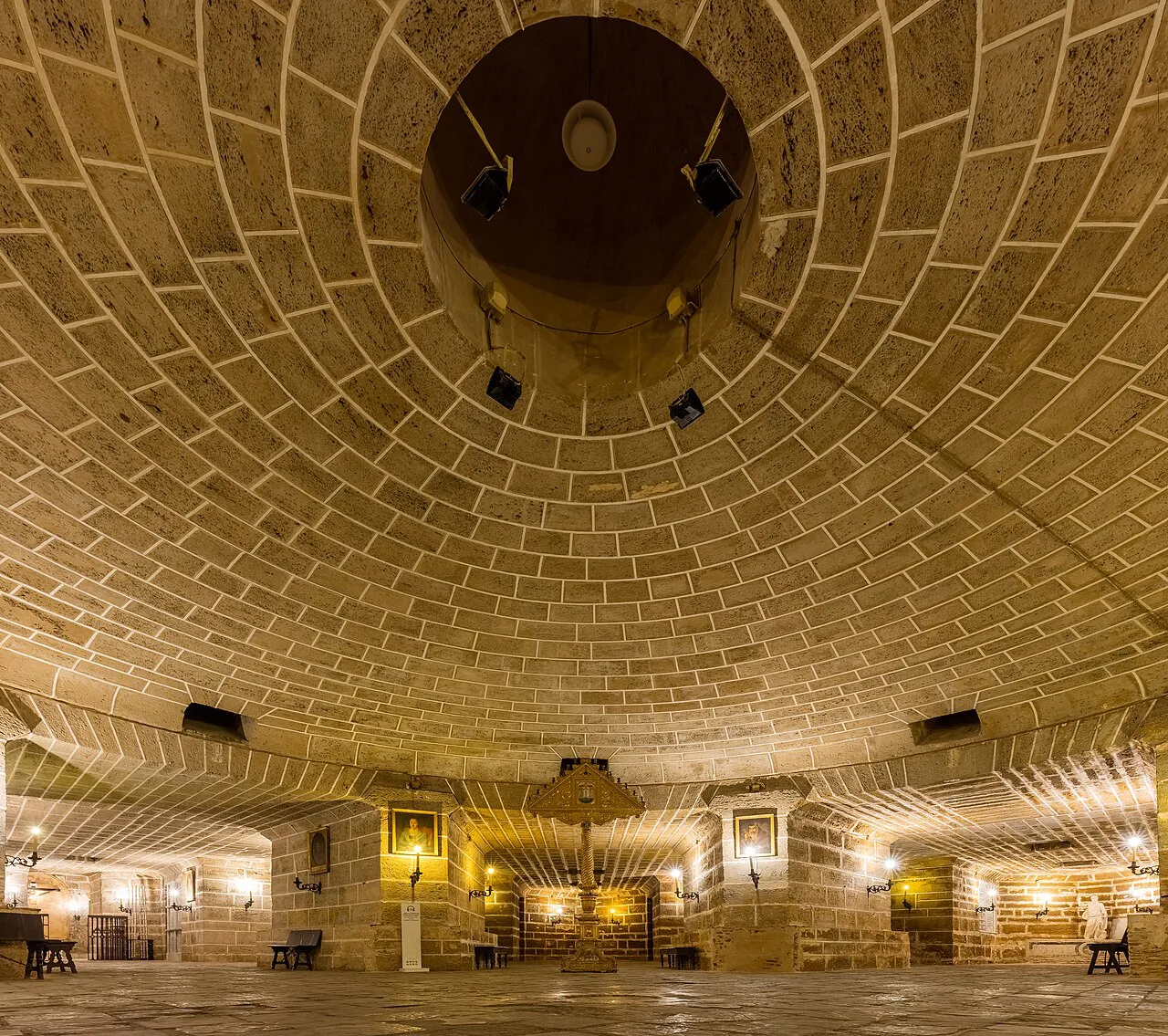
The crypt was designed by Acero and finished in 1726. It is organised around a circular space under a flat vault, with burial niches opening off it, and a rectangular chamber at the head wall holding a seventeenth-century Genoese marble altar with a white marble Virgin of the Rosary. Because it sits below the high altar, it is easy to miss if you turn back halfway round the ambulatory.
The crypt is also the burial place of the composer Manuel de Falla and the writer José María Pemán, alongside the bishops of the diocese. It is cool and dim even on a hot afternoon, which makes it a sensible stop at the height of a Cádiz midday rather than at the end of a visit.
Climbing the Torre del Reloj
The tower climb is included in the cathedral ticket, so there is no reason to choose between the two unless you are short of time. Follow the tower's own hours, not the church's, and respect the last ascent 30 minutes before closing.
The climb goes in stages, and the reward is the view back over the yellow dome to the harbour and the rooftops of the old town. With the sea on three sides, the shape of the city is a reminder that Cádiz sits on its own sandbar. The tower is the part of the visit most affected by the Sunday timetable, so keep the 12:00 to 15:00 and 16:00 to 20:00 split in mind.
Casa de la Contaduría and what the ticket adds
The Casa de la Contaduría is the third element folded into the same ticket, after the cathedral and the tower. It gives you a further look at the cathedral's own history and archive, which helps make sense of the American silver that paid for the building.
If you have already seen the tower, the Casa rewards a short, focused look rather than a long diversion. Otherwise, it is the natural place to fill a gap before the next stop on foot.
Sunday mass and access for visitors
Mass on Sundays and feast days is at 12.00, and visitors are welcome to attend but should not treat it as sightseeing. If you are there for the building rather than the service, come after the mass has ended or on a weekday.
The cathedral has adapted access at the Plaza de la Catedral entrance. The tower climb involves stairs, so anyone with mobility limits should plan to enjoy the church and crypt and leave the ascent.
Around Plaza de la Catedral
Once outside, the old town around the cathedral is a tight grid of white-washed streets and small plazas. The Barrio del Pópulo, the oldest quarter, is a few minutes' walk away, and the route back towards the harbour passes the seafront.
Cádiz is also a practical base for the white towns and the coast: Vejer de la Frontera, up on its hill, and Tarifa, on the strait, both sit within a manageable road or bus trip of the city. Those are separate days out rather than an addition to a cathedral morning.
Is the combined ticket worth it?
Yes, if you want the tower and the church in one go: one purchase covers both, plus the Casa de la Contaduría. If the tower timetable clashes with your day, the church and crypt alone still justify the visit.
Plan around two fixed points: the tower's split Sunday hours and the 12.00 mass. Everything else fits into a straightforward two hours on foot, starting and finishing on Plaza de la Catedral.
Explore more Cádiz guides
Frequently Asked Questions
Do I need a separate ticket for the Torre del Reloj?
No. The cathedral ticket covers the Torre del Reloj and the Casa de la Contaduría as well as the church, so there is nothing extra to buy. The tower does keep its own hours, which differ from the cathedral's on Sundays, so check both before setting out.
What is the best time to avoid the Sunday mass crowd?
Sunday and feast-day mass is at 12.00, and the cathedral's visitor hours on Sunday start at 13:30. Arriving after the service has finished, or visiting on a weekday, gives you a calmer interior.
Where is the cathedral in relation to the old town?
It sits on Plaza de la Catedral, in the middle of the old town and within walking distance of the harbour and the Barrio del Pópulo.
Sources
Notes for your next Spanish town break
Optional updates to our guides.
You might also like
Continue reading
More guides you'll find useful