Shopping in Almería: Streets, Souvenirs and Opening Hours
Shop Almería's centre on foot: the Paseo de Almería, Calle de las Tiendas for ceramics and índalos, two shopping centres and weekday-only hours.
On this page
Shopping in Almería is a centre-of-town affair: nearly every shop and commercial street lies within the historic centre, so you can cover it on foot in an afternoon. The main axis is the Paseo de Almería, with the narrow Calle de las Tiendas as the place for crafts and souvenirs and two out-of-centre shopping centres for everything else. This guide sets out the streets, the souvenirs worth carrying home and the opening pattern that decides which day you shop.
Shopping here sits alongside the Alcazaba of Almería and the rest of the things to do in Almería, and shops keep Spanish retail hours that shape which day works. For the wider old-town lanes see this guide to Almería Old Town.
Where shopping in Almería happens: almost everything sits in the historic centre
The city's commercial offer is modest but concentrated, and the centre holds the great majority of shops and businesses. The Paseo de Almería is the principal shopping artery, with the densest run of shops in its own length and the streets immediately around it. Only the shopping centres sit outside that core.
That compactness is the practical point: you can treat shopping as a walk rather than a series of trips. Pair it with the old town's lanes and gates, and the morning's sightseeing and the afternoon's browsing share the same streets. An Almería Map for Visitors shows how tightly the centre folds around the paseo.
The Paseo de Almería: 700 metres of clothes, shoes, jewellery and pharmacies
The Paseo de Almería cuts diagonally across the historic centre, starting between the Puerta de Purchena and the Casa de las Mariposas and running down to the remodelled plaza de Emilio Pérez, also called the plaza Circular. Its 700 metres are lined with clothes shops, shoe shops, jewellers and pharmacies, and its position near the port and the Paseo Marítimo keeps it busy, especially at weekends and on summer evenings.
The paseo remains open to traffic, and the trade-off is parking: finding a space on the street is not easy, so arriving on foot from the old town or the port saves a frustrating loop. The pedestrianisation debate continues locally, but for now you cross side roads rather than stroll a closed street.
Even without buying anything, the paseo works as a route through the centre: window-shopping with an ice cream or a drink on a terrace at dusk is a reasonable way to take the city's pulse. Cafés and restaurants along the way cover most budgets.
Calle de las Tiendas: the narrow pedestrian street for ceramics and índalo souvenirs
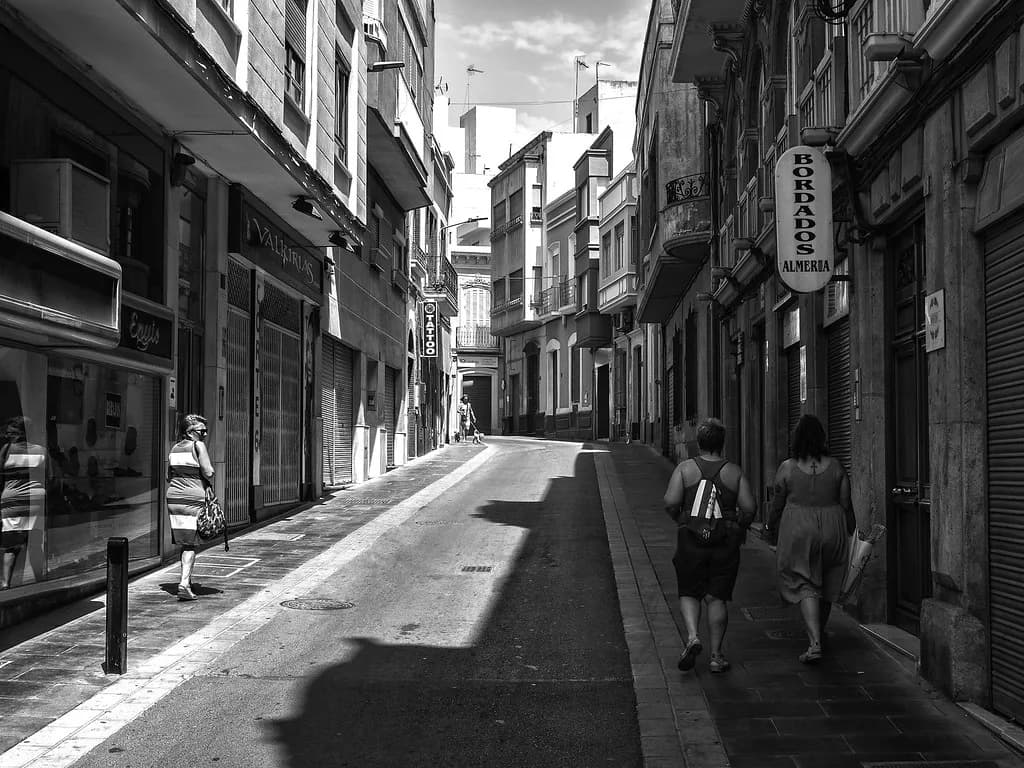
The Calle de las Tiendas is narrow, pedestrianised and named for the shops that have long filled it, connecting the Puerta de Purchena with the Plaza de la Constitución and the Convento de las Claras. Its origins lie in a second Jewish quarter founded around the eleventh century outside the Muslim medina, later an Arab souk, and its trading character is centuries old.
Its commercial importance has faded and many old businesses have closed, with tapas bars taking over former shop units. What survives is the souvenir trade: ceramics, which remain a significant local craft from the Arab period, and índalos, the protective amulet based on a rock painting from the Cueva de Vélez Blanco.
Among the survivors is El Valenciano, a century-old shop that is the address here for a keepsake of the city, whether an índalo or a piece of pottery. Come here first if a souvenir is the aim; the tapas bars that have replaced former shop units serve as the reward rather than the main event.
Surrounding streets worth a wander: Real, Rueda López and Menéndez Núñez
Beyond the paseo, the centre's shops cluster on Calle Real, Calle Rueda López and Calle Menéndez Núñez. These are ordinary shopping streets rather than sights, useful for everyday Spanish brands and pharmacy errands, and quieter than the main artery.
The better plan is to let the old town's alleys carry you between them without a fixed route. The lanes around the cathedral quarter and the Puerta de Purchena reward wandering, and shops appear where the streets narrow; this guide to Almería Old Town covers the lanes in more detail.
This is also where a little Almería history sharpens the walk: the street pattern of the medina still shapes which corners hold the smallest shops. A detour costs minutes and explains why the centre feels the way it does.
Two shopping centres for rain, heat or a cinema: Mediterráneo and Torrecárdenas
The city has two shopping centres, Mediterráneo on Avenida del Mediterráneo and Torrecárdenas on Calle Médico Francisco Pérez Company. Torrecárdenas, with more than 60,000 square metres, is the larger reference for fashion, leisure and dining. Both are places to retreat to when the inland heat or a wet day makes street browsing unappealing.
The centres' listed hours are Monday to Saturday, 10.00 to 22.00, which is the opening pattern that matters most for a short break. Those hours cover the centres as a whole; individual units inside may differ.
Opening hours and the Sunday problem
The shopping centres trade Monday to Saturday, 10.00 to 22.00, so a Sunday in Almería means the centre's streets rather than a mall. Street shops set their own timetables, so plan clothes and shoe shopping for a weekday morning if the trip is short, and keep Sunday for the paseo and the old town.
For anything time-sensitive, such as a specific shop's hours on a public holiday, confirm directly with the shop before you build a day around it. The Almería Attractions: 4 Visitor Guides page covers the monuments whose timetables are easier to pin down.
What to buy: ceramics, índalos and everyday Spanish brands
The signature purchases are local: pottery, which has been an important Almería industry since the Arab period, and the índalo, a small amulet figure drawn from the rock art of the Cueva de Vélez Blanco. Both are light, packable and unmistakably from here, which makes them better souvenirs than generic coast merchandise.
For everyday purchases, the paseo and the surrounding streets cover Spanish fashion chains, shoes and jewellery, and the shopping centres gather national and international labels in one place. Individual shops do not publish prices in any central list, so compare on the spot.
How shopping fits a short break: timing it around the midday heat and the sights
Almería's centre is compact enough that shopping rarely needs its own half-day. Slot it into the early evening, when the paseo is liveliest, or into a weekday morning for the centres, then give the middle of the day to the Almería Old Town, its cathedral and its shaded lanes.
If pottery and an índalo are the goal, head straight to the Calle de las Tiendas and El Valenciano, then walk the Paseo de Almería back towards the port. If you need clothes, shoes or a pharmacy, work along the paseo and its side streets instead.
Which streets to shop on a short break
For most visitors, one loop covers it: the Calle de las Tiendas for ceramics and an índalo, the Paseo de Almería for clothes, shoes and pharmacies, and the side streets around them for everything else. Reserve the shopping centres for a weekday, when their Monday-to-Saturday hours work in your favour.
Build the loop around Things to Do in Almería, and treat browsing as the filler between monuments rather than a separate outing. Confirm any shop's holiday hours before relying on it.
Frequently Asked Questions
Is Almería good for shopping?
It is adequate rather than exceptional. Almost all shops sit in the historic centre, led by the Paseo de Almería and the Calle de las Tiendas, with two shopping centres outside the core. You will find Spanish fashion chains, shoes, jewellery, pharmacies, ceramics and índalo souvenirs within a short walk of each other.
What souvenirs should I buy in Almería?
Ceramics and an índalo are the local choices. Pottery has been an important Almería industry since the Arab period, and the índalo is a protective amulet based on a rock painting from the Cueva de Vélez Blanco. The Calle de las Tiendas, and El Valenciano in particular, is the place to look for both.
Are shops in Almería open on Sundays?
The two shopping centres list Monday-to-Saturday hours of 10.00 to 22.00, so Sunday shopping means the centre's streets. Individual street shops set their own hours, and traditional Spanish retail often pauses at midday, so check with a specific shop if a Sunday purchase matters.
Sources
Notes for your next Spanish town break
Optional updates to our guides.
You might also like
Continue reading
More guides you'll find useful