Ronda Old Town: Streets, Squares and Walls to Walk
Plan a walk through Ronda's old town: the Puente Nuevo, Plaza Duquesa de Parcent, the Arab Baths, the old walls and the miradors that frame the Tajo.
On this page
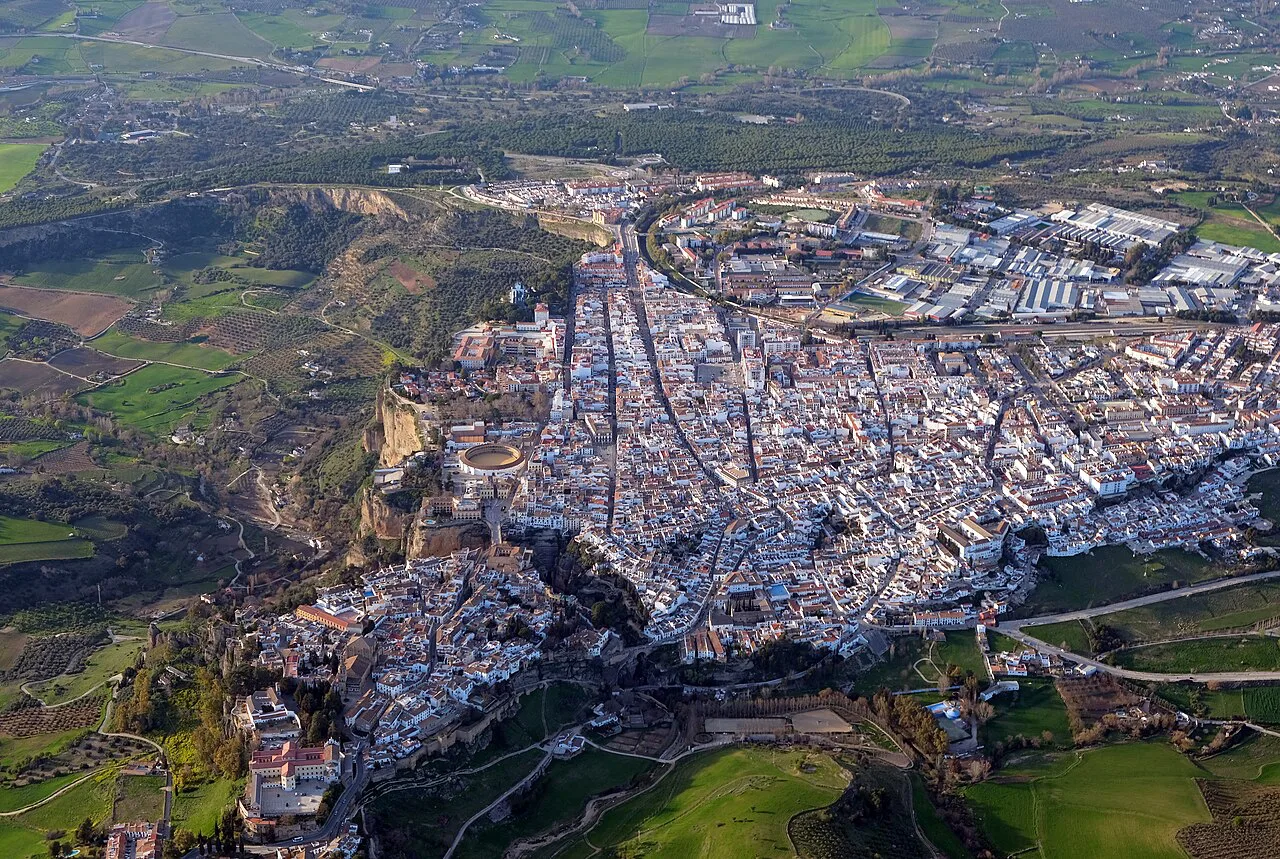
Ronda's old town takes a half day on foot if you walk it as a loop, starting at the Puente Nuevo, crossing to the Ciudad side through the Puerta de Carlos V and returning by the lanes around Calle La Bola. The historic quarter sits on the southern ledge of the Tajo, the 100-metre-deep gorge cut by the Río Guadalevín, so every route in and out involves a bridge or a slope. This guide sets out the street-by-street sequence, the squares that break it up and the hours when the lanes are at their best.
The layout matters more than any single sight. Ronda grew as two settlements, the Mercadillo side around the plaza de toros and the Alameda del Tajo, and the Ciudad side with the judería, the Iglesia de Santa María la Mayor and the San Francisco quarter, joined in the eighteenth century by the bridge over the gorge. Read the town as those two halves and the walking order falls into place.
What the old town covers, and what it leaves out
The old town proper is the Ciudad side: the warren of lanes between the Puente Nuevo and the Puerta de la Cijara, with the Plaza Duquesa de Parcent at its heart. The Mercadillo side, with the plaza de toros and the Alameda del Tajo, is the newer half of the historic centre and belongs in the same walk because you cross from one to the other over the gorge. Treat the two as one circuit and you avoid doubling back up the slopes.
The gorge is the reason the town is laid out this way. The Tajo drops almost a hundred metres to the Río Guadalevín and splits the centre in two, which is why the Puente Nuevo was built between 1751 and 1793 to link the modern zone of the plaza de toros, the Parador and the Alameda with the old judería, Santa María and San Francisco. Knowing which side you are on before you set off saves a lot of uphill walking later.
Start at the Puente Nuevo and read the gorge
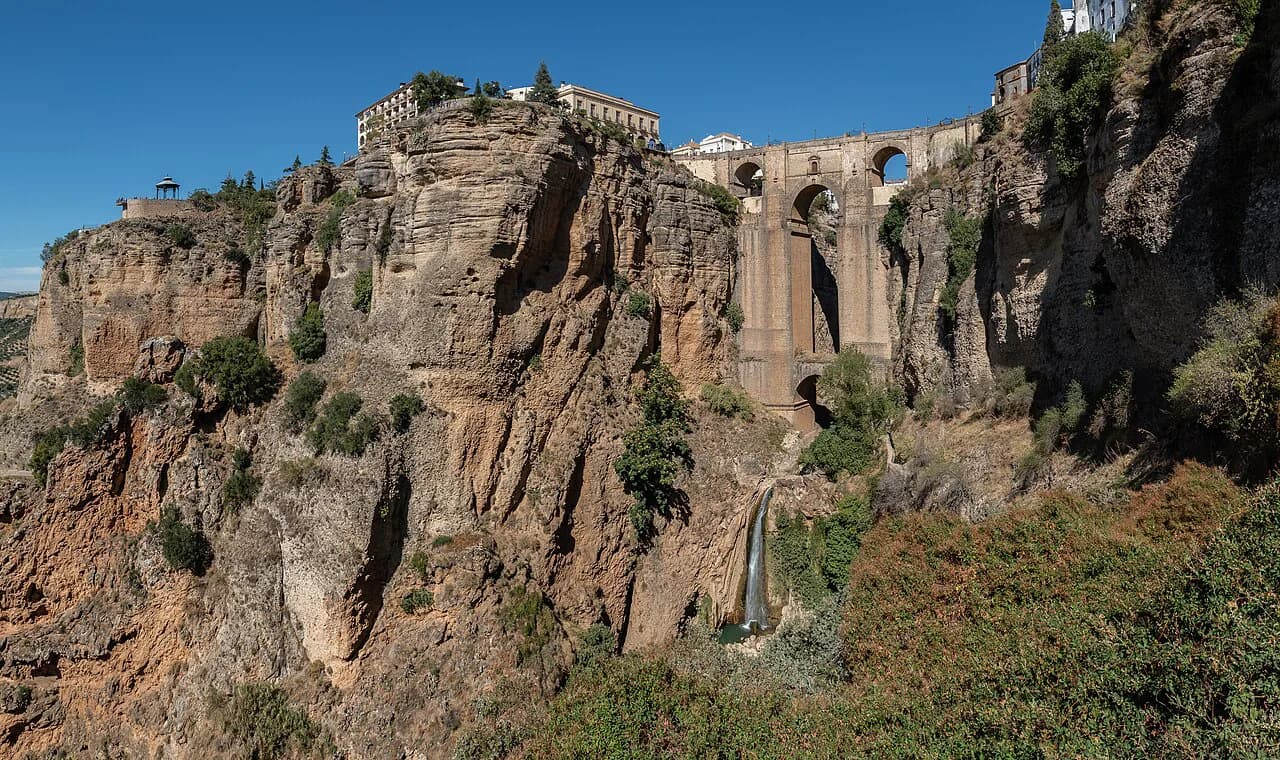
Begin on the Mercadillo side and walk out onto the Puente Nuevo, the bridge that has become Ronda's signature image. It was built in the mid-eighteenth century and was the highest bridge in the world at 98 metres until 1839, and the scale only makes sense when you stand at the parapet and look down at the Guadalevín in the bottom of the gorge. Cross slowly and look back at the town from the far side, where the bridge, the cliff and the white houses line up in one frame.
The best-known photographs of the bridge are taken from the paths below the town, not from the road. From the Plaza de María Auxiliadora, take the stone staircase to the left of the miradors; the first viewpoint gives the classic full-height shot and the second adds the bridge and the river cascade. The steps are uneven and slippery after rain, so wear proper shoes if you plan to go down.
Plaza de España, the Alameda del Tajo and the Mirador de Aldehuela
On the Mercadillo side, the Plaza de España is the junction where the bridge, the Parador and the Alameda meet, and it is the natural place to pause before crossing. The Alameda del Tajo is the tree-lined promenade that runs along the cliff edge, with the Mirador de Aldehuela at its end giving the long view over the Hoya de Ronda and the Guadalevín below. This is the easiest place in town to see the gorge without any climbing.
The Alameda is also where the local tourist office sits, in the pedestrian zone in front of the plaza de toros, which makes it a sensible first stop for a town map and any current monument hours. Ask there for the combined monument ticket rather than buying each sight separately at the door. The office is the one place to confirm what is open on the day you walk, since church and museum hours in Ronda shift with the season and with services.
Crossing into the historic quarter: the Puerta de Carlos V and the Islamic walls
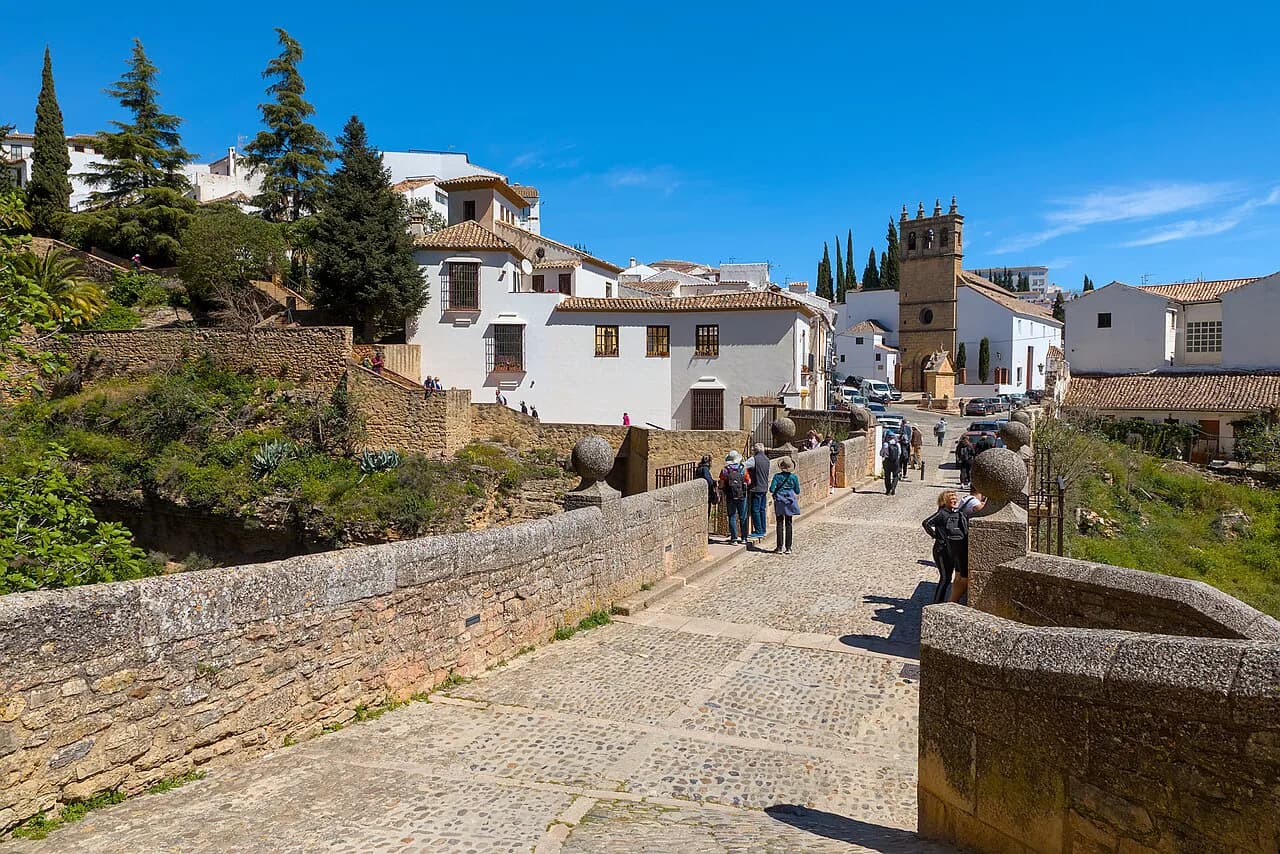
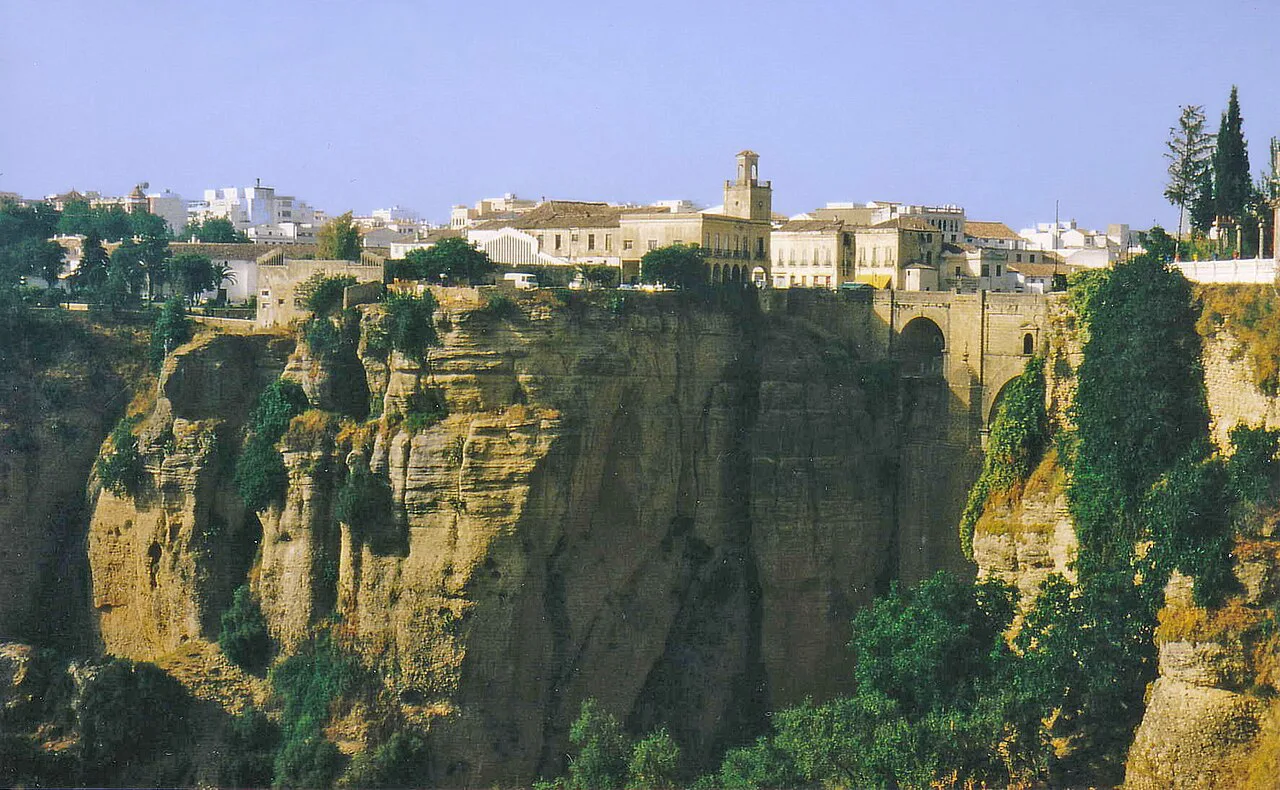
Cross the Puente Nuevo and the character of the town changes at once. The Puerta de Carlos V, the Puerta de la Cijara and the surviving stretches of Islamic wall mark the old defended edge of the Ciudad, and they are best read as a sequence rather than as separate monuments. Walk through the gate and turn to look back at the arch and the wall line against the gorge; it is the clearest way to understand how the town was fortified.
The walls are fragmentary and unlabelled in places, so this stretch rewards a slow pace rather than a tick-list. Pause at the Puerta de Carlos V, then follow the wall line towards the Puerta de la Cijara, which controlled the lower route down towards the river. The lanes between the two gates are steep and cobbled, and a wrong turn costs you a climb, so keep the gorge on your left as a rough compass.
Plaza Duquesa de Parcent and the churches and convents around it
The Plaza Duquesa de Parcent is the heart of the old town and the obvious place to stop for a coffee. The Iglesia de Santa María la Mayor, the Ayuntamiento and convents including the Clarisas front onto or sit just off the square, and the whole space is pedestrian, so the photographs are clean. Sit on the far side and the square reads as a single ensemble of church, civic building and convent walls.
Santa María la Mayor is the one interior in Ronda that most repays the entrance fee, and it is also the one most likely to be closed to tourists during mass. Plan to visit it earlier rather than later in the day, and if the doors are shut, walk the square and come back. The convents around the plaza keep their own hours and are quieter in the middle of the day, which suits a slower second pass.
Calle La Bola and the lanes of the old judería
Calle La Bola is one of the most atmospheric lanes in the old town, narrow and lined with whitewashed houses that open onto small patios. It sits inside the old judería, the Jewish quarter that grew up on the Ciudad side before the expulsion of 1492. Walk it slowly, look up at the balconies and the ironwork, and take the side alleys that drop towards the gorge for the occasional framed view.
The judería is where Ronda's literary reputation was built. The Mural de los Viajeros Románticos commemorates the travellers whose writing turned the town into a stop for visitors, and it is worth a few minutes on the way through. The mural is a painted panel rather than a museum, so it fits into the walk without adding a stop.
This is also the quarter to browse if you are after ceramics, leather or local food rather than souvenirs aimed at the bridge crowds. The shops are small and family-run, and several close for the afternoon, so morning is the better window if you want to look properly. Keep an eye on the time here, because the lanes are easy to lose an hour in.
The Arab Baths and the Casa del Rey Moro: what each one adds
The Baños Árabes, built between the thirteenth and fourteenth centuries, are among the best-preserved Arab baths in Europe and the most rewarding interior in the old town after Santa María. The sequence of cold, warm and hot rooms and the star-shaped openings in the vaults are the reason to go in rather than just past. Allow a proper half hour inside, because the site is small and the detail is the point.
The Casa del Rey Moro is a palace whose gardens, designed by Forestier, and water mine are the draw. The gardens have coloured tiles, fountains and terraces looking onto the Tajo, and the mine is the hydraulic work used to hold out during the Christian siege. The palace interior is closed for restoration, so the gardens and the mine are the visit, and they are the part visitors linger in.
The combination of baths and palace gardens works because they sit close together on the same side of the old town and offer two different experiences, one architectural and one horticultural. Do the baths first while you are fresh, then the gardens, which are open and shaded in patches rather than fully covered. If you only have time for one, choose the baths for the interior and the gardens for the views over the Tajo.
Palacio de Mondragón: the building, the courtyard and the museum inside
The Palacio de Mondragón is the old town's other essential interior, a Mudéjar palace that was the residence of the Nasrid governors and later hosted the Catholic Monarchs after the reconquest. It now houses the municipal museum, and the courtyard with its tiles and arches is the part that justifies the visit even if the displays are modest. The building itself is the exhibit.
The palace is a short walk from the Plaza Duquesa de Parcent, so it slots naturally between the square and the lower lanes. The museum keeps shorter hours at weekends and on public holidays than on weekdays, so check them before you build the day around it. If it is shut, the exterior and the courtyard views from the street still repay the detour.
The Puerta de la Cijara and the lower gateways towards the river
The Puerta de la Cijara marks the lower edge of the walled town, where the lanes start to fall towards the river. Walk out through it and turn back to see the gate set into the wall line, then follow the path down as far as the first bend for the view back up at the bridge and the cliff. The descent is short but steep, and the surface is loose in places.
This is the stretch to take slowly if you are interested in how Ronda was defended, because the gate, the wall and the gorge explain each other better here than anywhere else in town. There are no facilities on the way down, so carry water in summer. Come back up the way you went down rather than looking for a shortcut through private lanes.
The Mural de los Viajeros Románticos and the literary layer of the town
The Mural de los Viajeros Románticos is a painted tribute to the writers and travellers who put Ronda on the map in the nineteenth century. It is a small stop, but it explains why the town's image, the bandit, the bullfighter, the romantic gorge, is so fixed in the British imagination. Look at it on the way through the judería rather than making a separate trip.
The literary layer is part of how the old town works as a place to walk, because the most photographed corners are the ones the travellers wrote about first. Knowing that, the bridge and the gorge stop being just scenery and become the backdrop to a specific way of looking at Spain. Pair the mural with the Museo del Bandolero if you want the full nineteenth-century bandit mythology in one go.
How long the old town takes and where to break the walk
A relaxed circuit of the old town takes four to five hours including interiors, and a brisk version without going inside anything takes about two. The natural break is the Plaza Duquesa de Parcent at the midpoint, with a second stop at the Alameda del Tajo or the Paseo Blas Infante at the end. Build the day around the interiors you actually want rather than trying to see every monument.
Guided walks are worth considering if you want the walls, the gates and the judería explained as one story rather than as separate stops. The city's official tourism site accredits official guides and sells guided visits of the historic city, and the walks usually cover the Puente Nuevo, the Plaza Duquesa de Parcent and the Arab Baths in a single loop. Book ahead in spring and autumn, when the town is busiest.
When to go: mornings, midday heat and the siesta lull
Morning is the best time to walk the old town, both for the light on the bridge and for the temperature in the lanes. Inland Andalusian towns like Ronda get seriously hot at midday in summer, and the judería has little shade, so start early and save the interiors for the hottest hours. Churches and small shops often close for the afternoon, so the middle of the day is the moment for a long lunch or a museum rather than a shopping stop.
Late afternoon and early evening are the second good window, when the day-trippers have gone and the lanes empty out. The bridge is floodlit after dark and is worth a second look from the Alameda, though the paths down to the lower miradors are not somewhere to be after sunset. In winter, the town is quieter but the interiors keep shorter hours, so plan around fewer stops rather than more.
Which half of Ronda to walk first
Start on the Mercadillo side with the Puente Nuevo and the Alameda del Tajo, then cross into the Ciudad for the walls, the Plaza Duquesa de Parcent and the Arab Baths. That order puts the gorge at the beginning, when your legs are fresh, and leaves the lanes and the judería for the slower part of the day. Anything you miss on the first pass is easier to reach from the square than from the bridge.
Before you set out, confirm the day's opening hours and any combined ticket at the tourist office in the pedestrian zone in front of the plaza de toros. Take the walk at a pace that lets you stop, because the old town rewards looking up at the walls and down at the river more than it rewards a checklist. Leave the afternoon free for the interiors that run on shorter hours.
Explore more Ronda guides
Sources
Notes for your next Spanish town break
Optional updates to our guides.
You might also like
Continue reading
More guides you'll find useful